Best price
Canon 50/3,5mm Col
Sold by Classic Connection
€273 ≈ $295
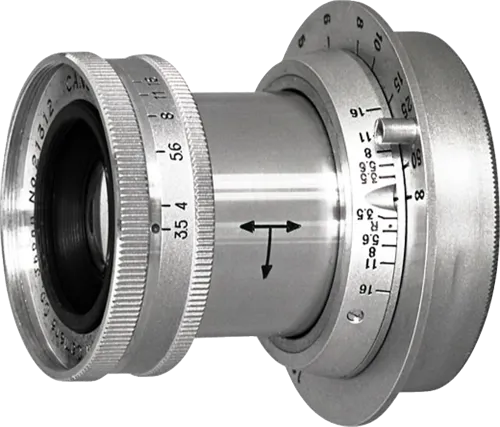
An August 1952 Canon Serenar 50mm f/3.5 standard lens with four elements in three groups, coupled LTM focusing and a collapsible barrel.
LTM mount
The Canon Serenar 50mm f/3.5 II is a LTM-mount lens for Leica rangefinder cameras. As of October 2026, it sells from €273 used across 1 listing, with a 30-day median of €273. Leica price index →
Measured against the 108 other 50mm LTM-mount lenses in the catalogue.
The Canon Serenar 50mm f/3.5 II is a compact Japanese standard lens marketed in August 1952. It combines a four-element, three-group optical system with a collapsible, rangefinder-coupled Leica screw-mount barrel. Canon specifies a 1-metre minimum focusing distance, a 34mm filter thread, an f/16 minimum aperture and dimensions of 47 by 37.5mm. Its listed weight is 144g.
This profile covers the second Serenar-branded 50mm f/3.5 in its later coupled LTM construction. It is distinct from Canon's first postwar 50mm f/3.5, from the Canon-branded continuation and from the rigid 50mm f/2.8 that replaced the slower collapsible lens. Branding and barrel form are important collector identifiers.
Rendering
Canon documents four elements in three groups but does not apply a formula name on the surviving product page. The design should therefore not be labelled automatically from its element count. No dependable laboratory test for the exact Serenar Type II has been found, so numerical resolution, distortion and vignetting claims are omitted.
The 50mm focal length gives a standard field on 35mm film, while f/3.5 provides greater depth of field than Canon's faster contemporary standard lenses at the same framing. A clean, correctly assembled lens may behave very differently from an example affected by haze, coating wear, fungus or disturbed element spacing.
At f/3.5
Maximum aperture is useful when available light is limited and when a moderate degree of subject separation is wanted. Rangefinder calibration should be checked at infinity, an intermediate distance and near the 1m minimum. A focus discrepancy may arise from body adjustment, cam wear or servicing rather than the optical design.
Canon does not state the blade count, so background highlight geometry is left undescribed. The small front element can still suffer veiling flare when strong light reaches it, making a correctly fitted hood useful. Haze or coating damage should be treated as condition, not as an intended vintage effect.
Stopped down
Closing the aperture increases depth of field and normally improves consistency across the frame. Canon specifies settings through f/16. Middle apertures suit general travel and street photography, while the smallest setting provides more depth at the cost of increasing diffraction.
Handling and compatibility
The 144g weight and retractable barrel make the lens compact for storage. It must be extended and locked before photography. Collapse it only after checking clearance inside the exact camera or adapter, especially on digital bodies where internal baffles and sensor assemblies differ from film-era screw-mount cameras.
The 34mm filter thread is a useful identification point. The coupled LTM cam should agree with a calibrated rangefinder from infinity to 1m. An LTM-to-M adapter provides mounting on Leica M bodies but does not correct cam error. Mirrorless use permits direct sensor focus and makes safe collapse clearance especially important.
Development and Launch
Canon identifies the original Serenar 50mm f/3.5 of 1946 as its first camera lens developed and manufactured in-house. It served as a standard lens during the difficult immediate postwar period, when material shortages also led Canon bodies to be supplied with lenses from more than one maker.
The Type II was marketed in August 1952. It retained the recorded four-element, three-group count in a later coupled, collapsible S-mount barrel. Canon's Camera Museum provides the exact dimensions, weight, filter size and 1m focusing limit for this version.
Production Evolution
The Serenar name was replaced by “Canon Lens” on the 50mm f/3.5 around December 1952. Specialist historical research indicates that the Canon-branded continuation remained available until February 1955, when a rigid 50mm f/2.8 replaced it. That later branding should be recorded distinctly rather than silently folded into the Serenar title.
The optical count remained four elements in three groups, but branding, engraving and barrel presentation changed. No complete evidence has been located for an optical recalculation within the brief Serenar Type II period. Minor engraving variations do not by themselves establish a new generation.
Special Editions/Variants
No commemorative edition of the Serenar Type II has been documented. Export markings and engraving differences are production details. The Canon-name continuation is a branding successor, while the rigid 50mm f/2.8 is a different model with its own launch and mechanics.
Collector Notes
Confirm Serenar 1:3.5 f=50mm engraving, the 34mm front thread, collapsible chrome barrel, Leica-standard S thread and functioning rangefinder cam. The listed 47mm diameter, 37.5mm length and 144g weight help identify the correct version. Check that the tube extends and locks securely.
Test focus agreement to 1m and verify infinity with the barrel fully extended. Inspect for haze, fungus, separation, coating wear and cleaning damage, and check the diaphragm through f/16. Individual serial numbers, cases, caps, filters, auction grades and prices do not belong to the generic profile.
About the usual price. The lowest listing is around the 30-day average.
Over the last 7 weeks the median price for the Canon Serenar 50mm f/3.5 II has held steady, ranging from €273 to €273 (now €273).
Weekly price (EUR). Median (Good or better) and lowest (Good or better) across 7 weeks. The full figures follow in the table below.
| Week | Median | Lowest |
|---|---|---|
| Aug 24, 2026 | €273 | Unknown |
| Aug 31, 2026 | €273 | Unknown |
| Sep 7, 2026 | €273 | Unknown |
| Sep 14, 2026 | €273 | Unknown |
| Sep 21, 2026 | €273 | Unknown |
| Sep 28, 2026 | €273 | Unknown |
| Oct 5, 2026 | €273 | Unknown |
Every shop grades differently. Leica Classic uses letters, Ffordes uses E++ and E+, German dealers write "Zustand B", Japanese dealers write A−. We map all of them onto the one ladder below. Where a shop states its own grade, we print it under ours.
As of October 2026, the Canon Serenar 50mm f/3.5 II sells from €273 used, with a 30-day median of €273, across 1 active listing.
As of October 2026, the Canon Serenar 50mm f/3.5 II is sold by 1 source (1 listing), from €273 used: all compared cheapest-first on this page.
Similar lenses you might be interested in
Comments