The Canon 50mm f/2.8 II is a compact four-element LTM rangefinder lens of the late 1950s, a collectible screw-mount standard prime for Barnack-style bodies.
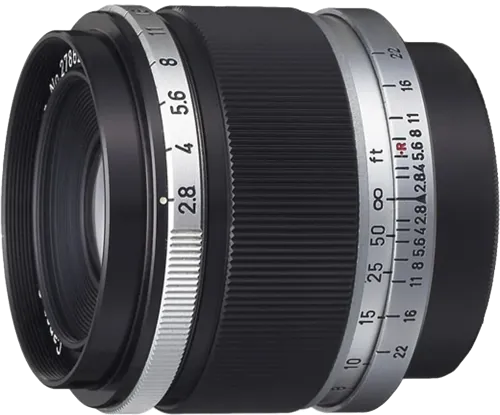
Canon 50mm f/2.8 II
LTM mount
No listings tracked for this lens right now.
The Canon 50mm f/2.8 II is a LTM-mount lens for Leica rangefinder cameras. Leica price index →
How it compares
Measured against the 108 other 50mm LTM-mount lenses in the catalogue.
Specification
About this lens
Canon 50mm f/2.8 II
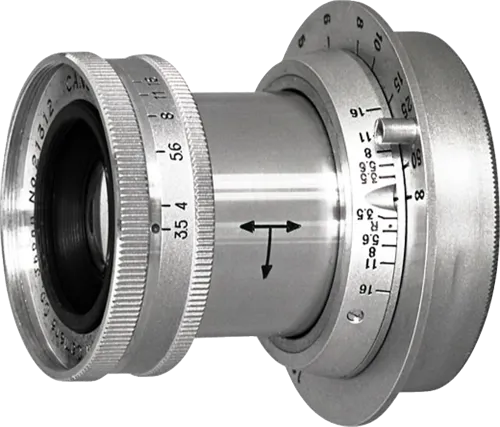
The Canon 50mm f/2.8 II belongs to a short-lived family of standard rangefinder primes that Canon built to replace its older collapsible 50mm f/3.5. Where the first version of the f/2.8 carried an unusual two-tone "Zebra" barrel that stood apart from the rest of Canon's screw-mount line, the second version was restyled in late 1957 to match the appearance of Canon's other rangefinder lenses of the period [1]. It is a small, light optic built for Leica thread mount (LTM, also called L39 or M39) bodies and coupled to the rangefinder, so it works directly on Canon's own screw-mount cameras and on Barnack Leicas, and on later Leica M bodies through a simple adapter that preserves coupling [2].
Optically the lens is a simple four-element design in three groups, a layout that Canon appears to have carried unchanged across all three iterations of the f/2.8. The aperture uses eight blades and runs from f/2.8 to f/16. On the second version the front of the lens no longer rotated during focusing, which allowed Canon to drop the duplicate aperture scale used on the first model and fit a single f-stop scale, and an infinity focus lock lug was added in keeping with the rest of the series. The barrel diameter and the filter thread both grew on this version, the filter size moving up to 40 mm. The result is a modest, pocketable standard lens that handles much like its contemporaries in the Canon screw-mount lineup.
According to Peter Kitchingman's reference work on Canon rangefinder lenses, as relayed by the FlynnGraphics collection, the first version ran from about January 1955 to October 1957, the second from November 1957 to January 1959, and the third from February 1959 to December 1959, with official figures putting total production of all three models combined at roughly 7,500 units. That makes the f/2.8 family as a whole considerably less common than Canon's faster and more popular 50mm offerings such as the f/1.8 and f/1.4.
Optical qualities
Rendering Published testing of this optical formula is limited, and the lens is far less reviewed than Canon's faster fifties. One collector who tested the matching first-version optic on a high-resolution digital body reported brighter-than-expected color and strong contrast, even sharpness across most of the frame with only slight softening in the extreme corners, and a notable absence of color fringing. Because the optical design is reported to be the same across all three versions, similar behavior can reasonably be expected from the second version, subject to the usual sample-to-sample variation in lenses of this age. Beyond this, documented performance data is sparse, so broad claims about its drawing character should be treated with caution.
History
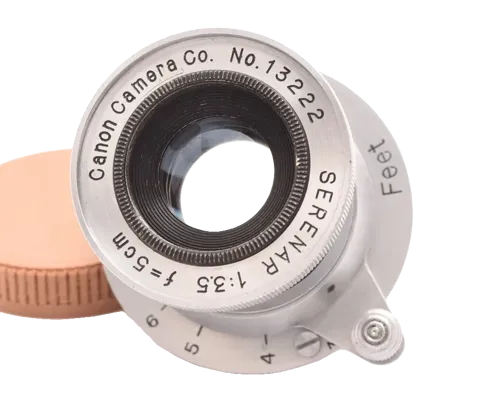
Development and Launch Canon introduced the first of three f/2.8 fifties in January 1955, intending it to retire the long-serving 50mm f/3.5 collapsible, one of the company's earliest in-house commercial lenses. The new lenses kept essentially the same optical recipe but were non-collapsible, slightly faster, and more attractive in finish. The second version followed in November 1957, abandoning the distinctive Zebra styling of the first model and reverting to the standard look of Canon's other rangefinder lenses of the time.
Production Evolution The principal changes from the first to the second version were cosmetic and mechanical rather than optical. The two-tone Zebra barrel gave way to a more conventional finish, the front element was made to stay fixed during focusing, the second aperture scale was eliminated in favor of one, an infinity lock was added, the barrel diameter increased, and the filter thread grew to 40 mm. The name-ring engraving did not change between models, and the optical formula is reported to have remained the same throughout. Period clamp-on lens hoods were offered for the first and second versions in 36 mm and 42 mm fittings respectively.
Special editions No major factory special editions, military variants, or rare regional versions of the 50mm f/2.8 are widely documented; the notable differences are simply the three sequential production versions.
Collector Notes The clearest way to separate the versions is by appearance and controls: the first model has the two-tone Zebra barrel, a rotating front with twin aperture scales, and a 34 mm filter thread, while the second model has the plainer matched finish, a non-rotating front with a single scale, an infinity lock, and a 40 mm filter thread. Buyers should note that LeicaLensList records this lens under a 2-Tone finish; sources describing the second version emphasize that it moved away from the original Zebra two-tone styling, so finish descriptions in listings are worth confirming against photographs of the actual barrel. As with most LTM lenses approaching seventy years of age, internal haze, cleaning marks, and aperture or focus stiffness are the main condition issues to check, and matching original clamp-on hoods and caps add to collector value.
Sources
Where to buy
Related lenses
Similar lenses you might be interested in
Comments