The Canon 50mm f/2.2 is a rare LTM rangefinder lens, a 1961 economy normal sold only in Japan, prized by collectors for its gentle rendering.
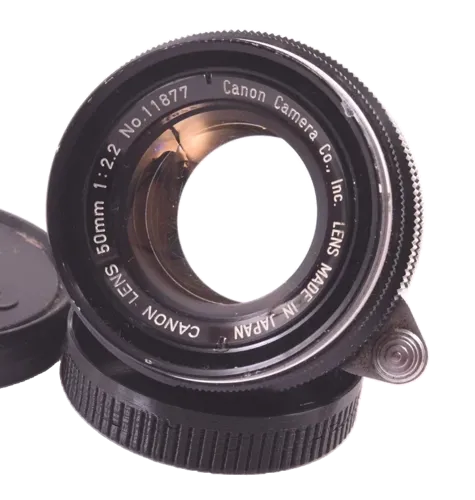
Canon 50mm f/2.2
LTM mount
No listings tracked for this lens right now.
The Canon 50mm f/2.2 is a LTM-mount lens for Leica rangefinder cameras. Leica price index →
How it compares
Measured against the 108 other 50mm LTM-mount lenses in the catalogue.
Specification
About this lens
Canon 50mm f/2.2
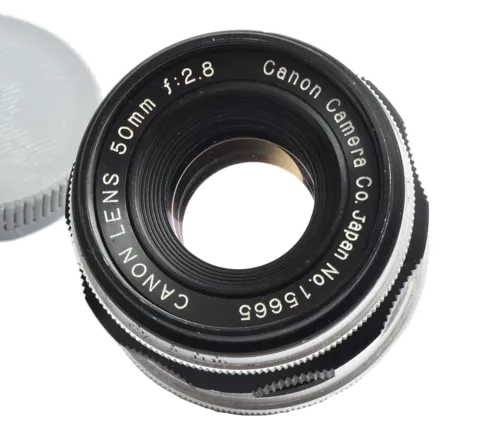
Among Canon's rangefinder normals, the 50mm f/2.2 is one of the scarcest, an economy lens sold for only a brief window in 1961 and intended for the domestic Japanese market [1][2]. Canon priced it below its faster siblings as a budget standard lens for cameras such as the Canon P, and because the well-regarded 50mm f/1.8 outclassed it, it never sold in large numbers and was quickly discontinued[3]. Canon's own museum lists it as marketed in January 1961 at an original price of 12,000 yen, and collector references put total production at only a few thousand units, which is why the lens turns up infrequently today.
The optical layout is unusual for its class: five elements in four groups, described by collectors as a simplified double-Gauss in which the rear cemented doublet of a conventional 1-2-2-1 design was reworked into a single element of higher power, giving a 1-2-1-1 arrangement. The rear element is proportionately large, close in diameter to the front. It is a compact, lightweight lens in a 2-tone finish, with a ten-blade diaphragm, a 41 mm filter thread, and a minimum focusing distance of 1 metre. The barrel is small enough that it suits a Barnack-style body better than the larger Canon P, and the focusing ring carries a tab that resembles an infinity lock but does not actually lock; handling is described as good despite the lens being a basic, budget design. It uses the standard Leica thread mount and is rangefinder coupled, so it mounts and focuses on Leica screw bodies and, by adapter, on Leica M cameras.
Documentation of factory variants is thin. The lens appears to have been made in essentially one form during its short run, with serial numbers reported by Peter Kitchingman's reference as running in a narrow band beginning at 10000. No widely documented military, export, or alternate-finish versions are recorded.
Optical qualities
Rendering Reviewers and collectors consistently describe a gentle, lower-contrast look with modest resolution that improves only slightly on stopping down, paired with notably attractive out-of-focus rendering. The simple formula is credited with a pleasing, somewhat three-dimensional rendering despite the moderate contrast.
Sharpness The lens is not high-resolving wide open and tends to render finer detail softly, which several users feel makes it better suited to portraiture and closer subjects than to detailed landscape work; it is reported to be noticeably sharper by f/4. Center sharpness wide open is described as acceptable even at f/2.2.
Bokeh and transitions The out-of-focus rendering is the trait users praise most. Backgrounds stay smooth even with foliage, specular highlights are cleanly formed, and the transition into defocus is gradual; this is attributed to a diaphragm and aberration correction that avoid the edge-weighted blur circles common to many double-Gauss 50s.
Flare resistance The lens flares readily when pointed toward a light source, producing veiling flare and colored artifacts even with the sun outside the frame.
Distortion and vignetting Vignetting is visible wide open at f/2.2 and largely clears by f/4. Some swirl in the out-of-focus field, typical of Planar-type designs, has been observed.
History
Development and Launch Canon introduced the 50mm f/2.2 in January 1961 as a low-cost normal lens for the Japanese market, positioned beneath the faster and more expensive 50mm f/1.8 and 50mm f/1.4 in the Canon rangefinder line. Period pricing placed it well below those lenses, reflecting its role as an entry-level option.
Production Evolution Production was very short, reported as roughly the first half of 1961, after which the lens was dropped. Collector references record a small total output and a narrow serial-number range, and no major optical or coating revisions are documented for so brief a run.
Special editions No major factory special editions, military versions, or alternate finishes of the Canon 50mm f/2.2 are widely documented.
Collector Notes The lens is genuinely uncommon and changes hands infrequently, though prices have softened from the highs seen in earlier years, and clean examples have appeared for modest sums. The focus tab on the barrel mimics an infinity lock but does not lock, which can confuse buyers expecting a functioning mechanism. As with other Canon LTM lenses of the era, owners report some play developing in the focus and front barrel sections, so checking for looseness, haze, and internal cleanliness before purchase is sensible. One sourced note: Canon's museum lists the maximum diameter and length as about 48 x 33.2 mm and weight as 164.5 g, which round to the figures recorded here.
Sources
Where to buy
Related lenses
Similar lenses you might be interested in
Comments