The Canon 50mm f/2.8 I is a compact four-element LTM rangefinder lens from 1955, a less common slower-aperture normal that interests Leica screw-mount collectors.</parameter> <parameter name="long_description">## Canon 50mm f/2.8 I Among Canon's screw-mount normal lenses of the mid-1950s, the 50mm f/2.8 I stands out for being one of the slower and less common members of the line, made at a time when the company was pushing toward faster f/1.8 and f/1.5 optics for its rangefinder bodies. Canon's own museum records list it as marketed in January 1955 at an original price of 16,000 yen, positioning it as a more modest companion to the higher-speed fifties that dominated the catalogue [1]. The lens uses a simple optical layout of four elements in three groups, a classic compact normal-lens arrangement, and it focuses to one meter. Built in the Leica thread mount (LTM / M39), the lens is rangefinder coupled and works on Canon's own screw-mount bodies as well as Leica screw-mount cameras and, with an adapter, on Leica M and mirrorless cameras. It is a small and light optic, weighing 128 grams in a barrel measuring roughly 48 mm in diameter by 37 mm long, which keeps the package modest on a compact rangefinder body. The aperture closes to a minimum of f/16. As recorded by LeicaLensList, the lens was offered in a two-tone finish, the chrome-and-satin styling typical of Canon screw-mount lenses of the era. Documentation specific to this exact f/2.8 variant is limited compared with Canon's faster fifties, and some published figures vary between sources. The Canon Camera Museum, for example, lists a filter diameter of 34 mm and a length of 37.7 mm, while LeicaLensList records a 41 mm filter thread and a 37 mm length; where sources disagree, the verified LeicaLensList values take precedence. A later 50mm f/2.8 II followed in the Canon line, so buyers should confirm which version they are handling. --- ## Optical qualities **Rendering** Detailed, independent test data for this specific lens is scarce, so its rendering is best described from its design type rather than measured performance. The four-element, three-group construction is a compact normal-lens formula of a kind that typically delivers good central sharpness with a restrained, neutral character at moderate apertures. Because the maximum aperture is f/2.8 rather than f/1.5 or f/1.8, the lens is less suited to extreme shallow-depth-of-field work than Canon's faster fifties, and claims about its bokeh, flare, or contrast beyond this cannot be reliably supported from available sources. --- ## History **Development and Launch** The 50mm f/2.8 I appeared in January 1955 during the most active period of Canon's rangefinder development, when the company was expanding its screw-mount lens range to accompany a growing line of Leica-compatible cameras. At 16,000 yen it slotted in as a comparatively affordable standard lens alongside Canon's brighter and more expensive f/1.8 and f/1.5 normals. **Collector Notes** Buyers should distinguish this first f/2.8 from the later 50mm f/2.8 II in the same family, as the two share the same focal length and aperture but are separate products. Because the lens is uncommon and lightly documented, confirming the engraving, mount thread, and overall originality is worthwhile before purchase. As with most chrome screw-mount lenses of this age, internal haze, cleaning marks, and stiff or dried-out focus helicoids are the usual condition concerns to check. --- ## Sources * [1] Canon Camera Museum. *CANON 50mm f/2.8 I*. https://global.canon/en/c-museum/product/s50.html
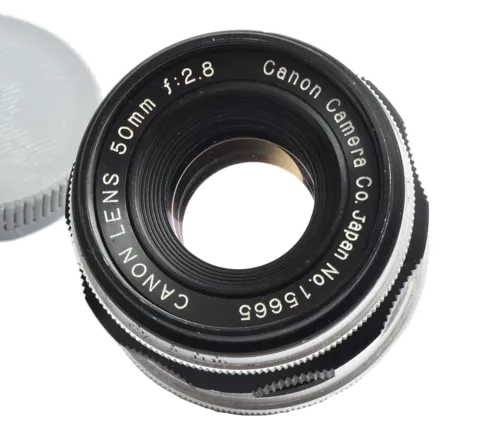
Canon 50mm f/2.8 I
LTM mount
No listings tracked for this lens right now.
The Canon 50mm f/2.8 I is a LTM-mount lens for Leica rangefinder cameras. Leica price index →
How it compares
Measured against the 108 other 50mm LTM-mount lenses in the catalogue.
Specification
About this lens
Canon 50mm f/2.8 I
A compact, four-element standard lens built for the Leica thread mount, the Canon 50mm f/2.8 I was the first of three closely related f/2.8 designs that Canon produced for its rangefinder cameras in the second half of the 1950s. It was introduced in January 1955 to take over from the older 50mm f/3.5 collapsible, one of Canon's earliest in-house lenses, offering a slightly faster aperture in a non-collapsible, more modern barrel [1][2]. The optical scheme is a simple and well proven Tessar type, with four elements arranged in three groups.
Mechanically the lens is small and light, weighing about 128 g and measuring roughly 48 mm in diameter by 38 mm in length, and it carries an aperture range from f/2.8 to f/16 driven by an eight-bladed diaphragm. It focuses to one metre and couples to the rangefinder through the LTM (M39) screw mount, so it works on Canon, Leica and other thread-mount bodies as well as on later mirrorless cameras through an adapter. A distinctive handling trait is that the front of the lens, together with the aperture ring, rotates as the lens is focused; to keep the f-stop scale readable Canon engraved a second aperture scale on the opposite side so that one is always facing the photographer. Period sources note that the lens used a small 34 mm filter thread, while published filter-size figures for the series vary as the diameter grew on later versions.
The 50mm f/2.8 came in three cosmetic variants, designated I, II and III, all sharing essentially the same optical formula and differing mainly in their external trim. The first version is finished in a two-tone "zebra" style with alternating black and bright metal sections on the focus ring, a look that was a little unusual for Canon lenses of the period and helps identify it. According to collector references, the first model was made from about January 1955 to October 1957, after which the second and third versions followed through 1959. At launch the lens was positioned as an economy normal lens, listed at 16,000 yen, sitting below Canon's faster and more elaborate f/1.8 and f/1.4 fifties.
Optical qualities
Rendering As a Tessar-derived design, the lens shows the rendering typically associated with that formula. User reports describe it as sharp in the centre at full aperture while the edges stay comparatively soft, with the frame evening out as the lens is stopped down to around f/5.6, by which point performance is regarded as normal across the field [3]. Owners also describe good contrast and a small, light package that suits slow, deliberate shooting; detailed independent lens-test data is limited, so finer claims about bokeh, flare and distortion are not well documented.
History
Development and Launch Canon brought out the 50mm f/2.8 in January 1955 as a replacement for its earlier 50mm f/3.5 collapsible standard lens, one of the company's first commercial in-house designs. The new lens kept a simple Tessar-style four-element, three-group layout but offered a modestly faster maximum aperture in a fixed, non-collapsible barrel, and it was priced as an affordable normal lens at 16,000 yen.
Production Evolution The f/2.8 was produced in three versions over a short span. All three used the same basic optical formula and were distinguished mainly by cosmetic and mechanical changes, including a growth in barrel and filter diameter on the later models, which has been linked to a redesign in which the front of the lens no longer rotated during focusing. Collector references place the first version from roughly January 1955 to October 1957, the second from late 1957 into early 1959, and the third through the end of 1959. Dedicated clamp-on hoods were offered for the first and second models in different sizes to suit their front diameters.
Collector Notes The first version is recognised by its two-tone zebra focus ring and its small 34 mm filter thread, with a duplicated aperture scale that reflects the rotating front design. Long regarded as an inexpensive alternative to the faster Canon fifties, clean examples have become harder to find and prices have risen accordingly; a recurring fault is haze forming on the glass surface behind the aperture, which in neglected examples can etch the glass and ruin the optics, so the elements should be checked carefully before purchase. Note also that the official Canon Camera Museum lists a 34 mm filter thread for this first version, whereas filter-diameter figures published elsewhere differ as the barrel changed across the series.
Sources
Where to buy
Related lenses
Similar lenses you might be interested in
Comments