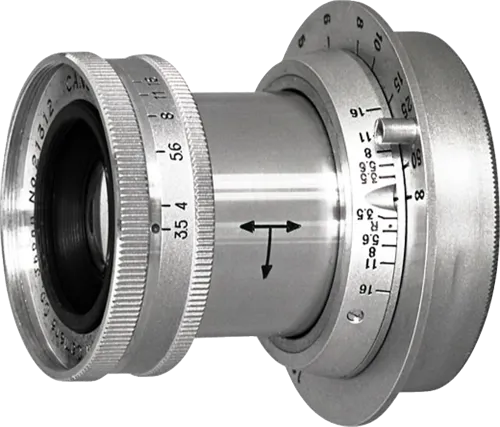
Canon’s final 50mm f/2.8 Leica-thread rangefinder lens, introduced in February 1959 with four elements in three groups and a compact 159g barrel.
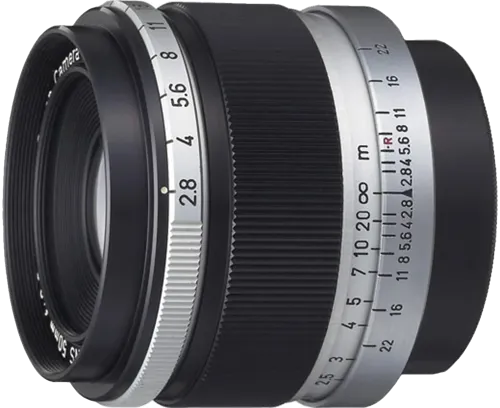
Canon 50mm f/2.8 III
LTM mount
No listings tracked for this lens right now.
The Canon 50mm f/2.8 III is a LTM-mount lens for Leica rangefinder cameras. Leica price index →
How it compares
Measured against the 108 other 50mm LTM-mount lenses in the catalogue.
Specification
About this lens
Canon 50mm f/2.8 III
The Canon 50mm f/2.8 III is the third and final catalogue version of Canon’s compact f/2.8 standard lens for Leica-thread rangefinder cameras. Canon introduced it in February 1959. It combines a four-element, three-group optical construction with a rigid all-metal barrel, manual aperture control and mechanical rangefinder coupling.
Canon’s factory specifications list an aperture range of f/2.8 to f/22, a minimum focusing distance of 1 metre and a 40mm filter thread. The barrel measures 48mm in maximum diameter and 39.3mm in length, with a stated weight of 159g. Canon does not publish a diaphragm-blade count for this version, so that figure should remain unknown rather than being copied from another Canon standard lens.
The lens uses native Leica thread mount registration. It fits compatible LTM or L39 rangefinder bodies directly and can be used on Leica M cameras with a suitable 50mm LTM-to-M adapter. Accurate coupled focus depends on the lens, adapter and camera rangefinder being correctly adjusted.
Optical qualities
Rendering
Dependable version-specific performance evidence for the Canon 50mm f/2.8 III is limited. The surviving Canon specification page documents the optical construction and physical data, but does not provide measured resolution, contrast, distortion or aberration results. It is therefore safer to describe the lens through its confirmed design and intended role than to assign a generalized rendering character.
Sharpness
No controlled test cited here establishes a repeatable sharpness profile for this exact third version. Results from the earlier 50mm f/2.8 I or II should not automatically be transferred to it, even though Canon lists the same four-element, three-group count for all three generations. Present-day performance can also be affected by haze, cleaning damage, element alignment and rangefinder calibration.
Contrast and flare resistance
Canon does not publish version-specific contrast or flare measurements. Coating condition and internal cleanliness should be evaluated on the individual lens. A correctly fitted hood can reduce off-axis light, but it does not substitute for checking the optical cell.
Digital use
The lens can be adapted to full-frame mirrorless cameras with the correct LTM adapter. Direct sensor focusing is useful for evaluating the optics, but does not test the mechanical rangefinder cam. Digital results from one sample should not be treated as representative of every surviving copy.
History
Development and Launch
Canon marketed the 50mm f/2.8 III in February 1959 as the last member of its three-version f/2.8 standard-lens family. It appeared during the closing phase of Canon’s interchangeable-lens rangefinder system, when faster 50mm lenses already occupied the company’s higher-performance positions.
Production Evolution
The first Canon 50mm f/2.8 appeared in January 1955. Canon lists four elements in three groups, a minimum aperture of f/16, a 34mm filter thread, dimensions of 48 by 37.7mm and a weight of 128g.
Version II followed in November 1957. It retained the four-in-three construction but adopted an f/22 minimum aperture, a 40mm filter thread and a 48 by 39.3mm barrel. Canon lists its weight as 143g.
Version III kept the principal dimensions, aperture range, filter size and element count of version II, while the official weight increased to 159g. These documented catalogue differences justify the separate I, II and III identities. They should not be collapsed merely because the focal length, maximum aperture and optical count are shared.
Special Editions/Variants
No separate factory special edition of the Canon 50mm f/2.8 III has been reliably documented. Cosmetic wear, repainted parts or replacement caps do not constitute separate production variants.
Collector Notes
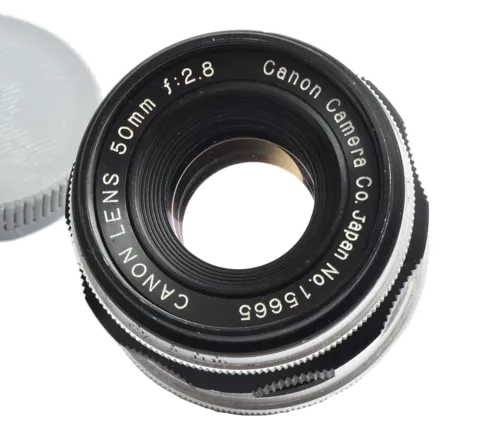
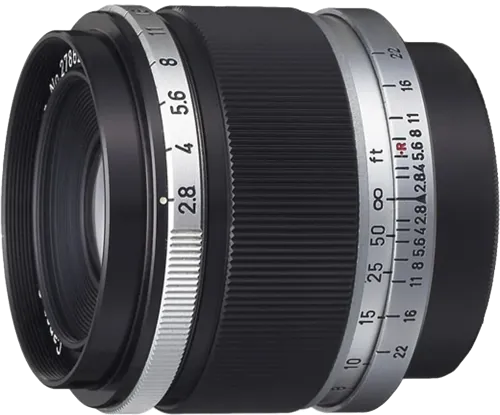
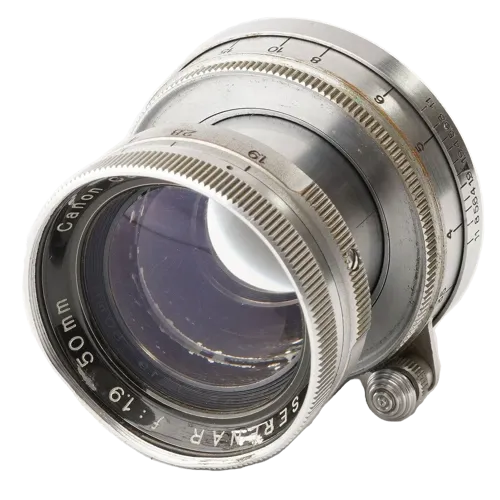
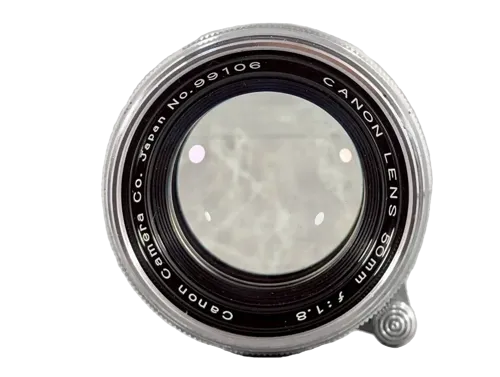
The strongest identifiers are the official III designation, rigid Leica-thread barrel, 40mm filter fitting, f/22 minimum aperture and 48 by 39.3mm factory dimensions. Sellers may omit the version number, so the complete engraving and barrel design should be compared with Canon’s three factory pages.
For use, check smooth focusing, full aperture movement, clear glass and accurate rangefinder operation. A screw thread alone does not establish correct Leica-rangefinder registration, so this lens should not be confused with mechanically incompatible 39mm SLR or enlarging lenses.
Sources
Where to buy
Related lenses
Similar lenses you might be interested in
Comments