An exceptionally rare British 50mm f/2 Double Gauss lens for Leica Thread Mount, documented in both collapsible and rigid rangefinder barrels.
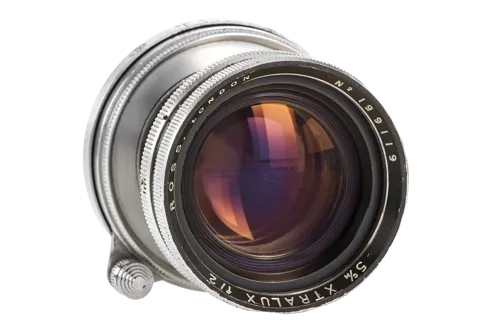
Ross Xtralux 50mm f/2
LTM mount
No listings tracked for this lens right now.
The Ross Xtralux 50mm f/2 is a LTM-mount lens for Leica rangefinder cameras. Leica price index →
How it compares
Measured against the 108 other 50mm LTM-mount lenses in the catalogue.
Specification
About this lens
Ross Xtralux 50mm f/2
The Ross Xtralux 50mm f/2 is an exceptionally rare British standard lens produced for Leica Thread Mount cameras around the end of the 1940s. Contemporary and collector sources place its introduction around 1948 to 1950, during a period when British optical manufacturers were producing Leica-compatible lenses because German Leica equipment remained difficult to obtain in the United Kingdom after the Second World War.
The Xtralux uses six elements in four groups in a Double Gauss configuration incorporating then-modern high-index optical glass. The Leica version was produced in M39 screw mount for rangefinder cameras and is documented in both collapsible and rigid focusing mounts. Most surviving examples are chrome finished.
Production was extremely limited. Leitz Photographica Auction repeatedly states that approximately twenty examples were made, apparently largely or entirely as special orders. This figure is consistent with the very small cluster of surviving serial numbers known to collectors, although no surviving Ross factory production ledger has been cited to establish an exact total.
Optical qualities
Rendering
The Xtralux 50mm f/2 uses a six-element, four-group Double Gauss design. Historical discussion surrounding the lens indicates that it was regarded as a high-performance standard lens when introduced. Modern reports from surviving examples describe strong central definition and relatively clean overall rendering, although the tiny surviving sample makes broad performance claims difficult.
Contrast and color
The lens is coated. Several surviving Xtralux 50mm examples show strong yellow coloration caused by radioactive glass.
Leitz Auction has explicitly confirmed thorium-containing glass in multiple examples. Yellowing can alter color transmission but can sometimes be reduced through prolonged exposure to ultraviolet light. Any treatment should be undertaken cautiously on a collector-grade lens.
Aberrations
The Double Gauss configuration was intended to provide high correction at the relatively fast f/2 aperture. Controlled modern comparison data are too limited to support detailed claims about coma, distortion or field curvature.
History
Development and Launch
Ross of London introduced the Xtralux 50mm f/2 during the difficult post-war period for the British photographic industry. British photographers had limited access to new German Leica lenses, creating a market for domestically produced Leica-compatible optics from Ross, Taylor-Hobson, Dallmeyer and Wray.
Period information reproduced by collectors indicates that the Xtralux was announced around 1948 and appeared in British photographic literature by 1949–1950.
The lens was expensive when new and apparently achieved little commercial success. This helps explain the exceptionally small surviving population.
Production Evolution
The standard optical formula remained six elements in four groups.
Most documented examples use a collapsible focusing mount broadly reminiscent of contemporary Leica fast standard lenses. A much rarer rigid version is also documented.
Known serial numbers cluster closely around the 199xxx range, supporting the view that production was extremely limited.
Several documented examples contain thorium-bearing optical glass and show the characteristic yellow coloration associated with radiation-induced discoloration.
Special Editions/Variants
Rigid version: An extremely rare factory rigid-barrel Xtralux 50mm f/2 is documented by Leitz Photographica Auction. No separate catalogue number has been confirmed.
Collapsible version: The more commonly documented configuration uses a collapsible chrome barrel.
These mechanical variants appear to share the same underlying optical design.
Special Editions/Variants
Rigid barrel: Extremely rare factory rigid version documented in original Leica M39 mount. No separate catalogue number is confirmed.
Collapsible barrel: The more frequently documented original production configuration. No separate catalogue number is confirmed.
Collector Notes
Authenticity is critical because of the extraordinary values reached by original examples. Leitz Auction has sold Xtralux 50mm lenses for tens of thousands of euros, and a rigid example reached a substantially higher result.
Collectors should verify the Ross engraving, serial number, original M39 mount and barrel construction.
Radioactive thorium glass is documented. The radioactivity itself is generally of limited practical concern in normal handling, but the optical yellowing is important for both photography and collector condition.
Separation is another documented issue. One surviving lens head sold at auction exhibited separation around the middle optical group, while another complete lens showed peripheral separation.
Original front and rear caps are particularly valuable because complete examples are exceptionally scarce.
Historical lenses should not be judged from one sample alone. Haze, fungus, separation, cleaning damage, displaced elements and dried lubricant can alter contrast and focus more than modest design differences. Film choice, processing, digital sensor cover glass and adapter tolerances also influence results. A hood may reduce oblique flare but cannot correct internal contamination.
Sources
- Leitz Photographica Auction. Ross f. Leica M39 Xtralux 2/5cmleitz-auction.com →
- Leitz Photographica Auction. Ross f. Leica M39 Xtralux 2/5cm rigidleitz-auction.com →
- Oldlens.com. Ross Xtralux 50mm f2.0oldlens.com →
- Flints Auctions. A Ross Xtralux f/2 50mm Lens Headflintsauctions.com →
- Rangefinderforum. Ross Xtralux 50mm f2 LTM mountrangefinderforum.com →
Where to buy
Related lenses
Similar lenses you might be interested in
![Chiyoda Kogaku Super Rokkor 50mm f/2 [C]](https://assets.leicalenslist.com/images/2063_medium.webp)
Comments