A 1930s British 4-inch f/5.5 collapsible Teleros in uncoupled Leica M39 mount, one of Ross's early third-party telephotos for Leica.
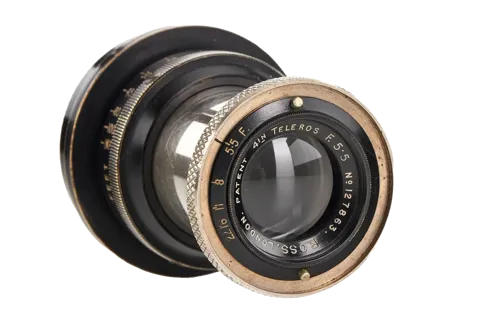
Ross Teleros 4-inch 101.6mm f/5.5 (Collapsible)
LTM mount
No listings tracked for this lens right now.
The Ross Teleros 4-inch 101.6mm f/5.5 (Collapsible) is a LTM-mount lens for Leica rangefinder cameras. Leica price index →
Specification
About this lens
Teleros 4-inch 101.6mm f/5.5 (Collapsible)
The Ross Teleros 4-inch f/5.5 is a British collapsible telephoto lens made for early Leica screw-mount cameras. Four inches equals 101.6mm, although period sources and camera finders often expressed the setting more approximately as 10cm or 10.5cm. Leitz Auction dates the black-and-nickel Leica M39 version to the 1930s. The Leica Society's account identifies the 4-inch Teleros as one of the interchangeable Ross lenses available for Leica cameras and states that the example discussed was not rangefinder coupled.
The wider Teleros family was introduced in 1922, replaced the Telecentric, and remained available until at least 1938. Focal lengths ran from this 4-inch Leica fitting to 40-inch plate-camera lenses. The f/5.5 series used two-times telephoto magnification, giving back focus around half the stated focal length and allowing a compact mount.
The lens focuses by scale and does not operate the camera's rangefinder. Distance must be measured or estimated and transferred to the lens. Composition requires an external finder; the Leica Society recommends the 10.5cm setting on a VIDOM or VIOOH as the closest practical match to 4 inches.
Optical qualities
Rendering
The established optical fact is the approximately two-times telephoto arrangement, not a securely documented element count. Positive and negative optical power shorten the back focus relative to focal length, reducing the extension needed for a 101.6mm view. No diagram specific to this Leica version was found, so the element count is omitted.
At f/5.5 the Teleros is relatively slow, but its focal length still narrows the view and permits background separation. No period resolution figures or controlled comparisons were found. Definition, chromatic correction, and focus shift require testing, with film-plane registration especially important for uncoupled scale focus.
Contrast and flare
The sources do not confirm coating for the 1930s Leica Teleros. Uncoated glass and old barrel surfaces may lose contrast in oblique light, so a hood can help if it does not block the finder. Haze, marks, and degraded blackening are condition issues, not intentional character.
Out-of-focus rendering
The roughly 102mm focal length permits visible blur at suitable distances. Blade count and pupil geometry are not established, so highlight shape and smoothness cannot be generalized. Scale-focus error can also imitate optical softness.
Vignetting and distortion
No measured vignetting or distortion data has been found for this version. Stopping down may improve illumination and aberration control, while digital sensors can introduce effects absent from film-era use.
History
Development and Launch
Ross was a long-established British optical maker. The Science Museum Group dates Ross Limited from 1897 to its 1948 merger with Barnet Ensign, while the firm's roots reach back to Andrew Ross's nineteenth-century workshop. It made cameras, binoculars, and photographic lenses under its own and licensed names.
The Teleros appeared in 1922 as successor to the Telecentric and served many camera sizes. The 4-inch f/5.5 brought it to Leica format during a period when British dealers and workshops fitted third-party optics to early Leica bodies. It used the Leica thread but was neither designed nor made by Leitz.
Production Evolution
The family offered f/5.5 two-times and f/6.3 three-times telephoto arrangements in many focal lengths. A Science Museum object documents a rigid 12-inch f/5.5 lens around 1930, but specifications from larger Teleros lenses should not be transferred to the 4-inch Leica version.
The 4-inch Leica lens is documented in a collapsible black-and-nickel barrel in the 1930s. No year-by-year sequence, confirmed optical revision, or exact end date for this mount version is available.
Special Editions/Variants
Teleros lenses differed in focal length, aperture, camera format, and mount. This profile is limited to the 4-inch f/5.5 collapsible Leica M39 lens; larger museum and field-camera examples only give family context. Black-and-nickel finish is documented, but no named editions, coupled version, or optical redesign have been established.
Collector Notes
Identification rests on the Ross Teleros engraving, 4-inch f/5.5 specification, collapsible barrel, and Leica thread. Because the lens is uncoupled, focus requires measured distance, a separate rangefinder, ground glass, or live view. The 10.5cm finder setting is only a practical approximation to 101.6mm. Confirm working extension and film-plane registration; auction condition and one camera pairing do not define the model, and production quantity remains unknown.
Sources
- Leitz Auction: Ross Teleros 4-inch f/5.5 for Leica M39leitz-auction.com →
- The Leica Society: British lenses for Leica camerasleicasociety.uk →
- Tim Layton Fine Art: Ross Teleros history and specificationstimlaytonfineart.com →
- Science Museum Group: Ross Limited company historycollection.sciencemuseumgroup.org.uk →
- Science Museum Group: Teleros telephoto lenscollection.sciencemuseumgroup.org.uk →
Where to buy
Related lenses
Similar lenses you might be interested in
Comments