Best price Fair
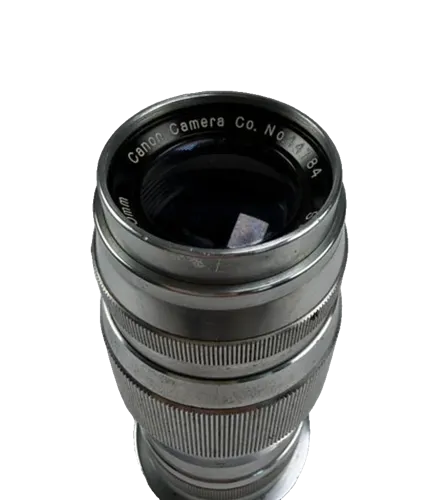
Canon 100mm f/2 L39 LTM Leica Thread Mount Lens from Japan
Sold by Five Star Camera
€361 ≈ $390
The Canon 100mm f/2 is a fast LTM screw-mount rangefinder telephoto made from 1959 to 1973, prized by collectors for its sharp, smooth rendering.
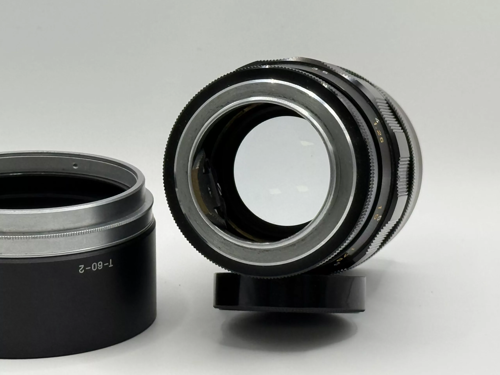
LTM mount
The Canon 100mm f/2 is a LTM-mount lens for Leica rangefinder cameras. As of October 2026, it sells from €361 used across 2 listings, with a 30-day median of €361. Leica price index →
Measured against the 8 other 100mm LTM-mount lenses in the catalogue.
Among Canon's screw-mount telephotos, the 100mm f/2 stands out for pairing a fast f/2 aperture with a compact short-tele focal length, a combination that gave Leica-thread shooters a portrait-friendly lens with strong subject isolation. Produced from 1959 to 1973, it arrived as Canon's rangefinder system was maturing, and it remains a lens that adapter-equipped users still seek out for its rendering [1]. Reviewers note that despite its age the optic resolves with surprising clarity, performing well even when adapted to high-resolution modern sensors.
Optically the lens uses a six-element design in four groups, with a 13-blade diaphragm and a maximum aperture of f/2. It focuses to roughly 1 meter and is built in the Leica thread (LTM, M39) screw mount. As with Canon's longer rangefinder lenses, focusing and aperture operation are handled on the barrel; the lens is not internally rangefinder-coupled in the LeicaLensList record, and there is no six-bit coding. Filters mount on a 58mm thread on the documented black "Late" version [2].
The lens was produced in black finish. A later production variant is sometimes distinguished by sellers as the "Late" version, and it carries a 58mm filter size. Coating is single-layer rather than modern multicoating, which affects contrast more than resolution.
Rendering Documented impressions describe a lens that is sharp from wide open, with one reviewer reporting near-modern sharpness by f/2.8 and useful resolution even on a 45-megapixel sensor. The out-of-focus rendering is described as smooth and creamy, isolating the subject without the swirl or distraction of older Petzval-type designs.
Contrast and color Because the lens is single-coated, contrast is comparatively soft by modern standards, a trait noted by users who adapt it to digital bodies.
Bokeh and transitions The diaphragm produces rounded highlights wide open and slightly into the stopped-down range, with a polygonal shape becoming visible in defocused highlights around f/5.6 to f/8.
Aberrations A slight green color fringing can appear on bright highlights, consistent with the lens's vintage optical design and coating.
Digital use The lens adapts readily to mirrorless cameras, where close-focus adapters allow shooting nearer than the native minimum distance, and it has been reported to hold up well wide open in such use.
Development and Launch The 100mm f/2 was made for Canon's rangefinder cameras using the Leica thread mount during the late period of that system, with production spanning 1959 to 1973. It belongs to the family of Canon screw-mount telephotos that competed directly with Leica's own offerings of the era.
Collector Notes The black "Late" rangefinder version is the form most often encountered in the used market, and verifying the 58mm filter thread and intact single coating is worthwhile before purchase. As with any single-coated lens of this age, internal haze and coating condition are the main things to check. One published user review describes the diaphragm as having 12 blades, which conflicts with the 13-blade figure recorded here; buyers relying on blade count for identification should treat such counts cautiously.
About the usual price. The lowest listing is around the 30-day average.
Lowest price Click a mark to open that listing · arrow keys to step, Enter to open
Price against condition for 2 listings of Canon 100mm f/2, €361 to €647, median €505. Excellent: 1 at €647. Fair: 1 at €361. The full table follows.
| Condition | Lowest | Median |
|---|---|---|
| Excellent | €647 | €647 |
| Fair | €361 | €361 |
Over the last 18 weeks the median price for the Canon 100mm f/2 has fallen, ranging from €361 to €509 (now €361).
Weekly price (EUR). Median (Good or better) and lowest (Good or better) across 18 weeks. The full figures follow in the table below.
| Week | Median | Lowest |
|---|---|---|
| Jun 1, 2026 | €371 | €371 |
| Jun 8, 2026 | €371 | €371 |
| Jun 15, 2026 | €371 | €371 |
| Jun 22, 2026 | €371 | €371 |
| Jun 29, 2026 | €371 | €371 |
| Jul 6, 2026 | €509 | €371 |
| Jul 13, 2026 | €371 | €371 |
| Jul 20, 2026 | €371 | €371 |
| Jul 27, 2026 | €371 | €371 |
| Aug 3, 2026 | €371 | €371 |
| Aug 10, 2026 | €371 | €371 |
| Aug 17, 2026 | €366 | Unknown |
| Aug 24, 2026 | €647 | €647 |
| Aug 31, 2026 | €647 | €647 |
| Sep 7, 2026 | €647 | €647 |
| Sep 14, 2026 | €647 | €647 |
| Sep 21, 2026 | €647 | €647 |
| Sep 28, 2026 | €647 | €647 |
Every shop grades differently. Leica Classic uses letters, Ffordes uses E++ and E+, German dealers write "Zustand B", Japanese dealers write A−. We map all of them onto the one ladder below. Where a shop states its own grade, we print it under ours.
As of October 2026, the Canon 100mm f/2 sells from €361 used, with a 30-day median of €361, across 2 active listings.
As of October 2026, the Canon 100mm f/2 is sold by 2 sources (2 listings), from €361 used: all compared cheapest-first on this page.
Similar lenses you might be interested in
Comments