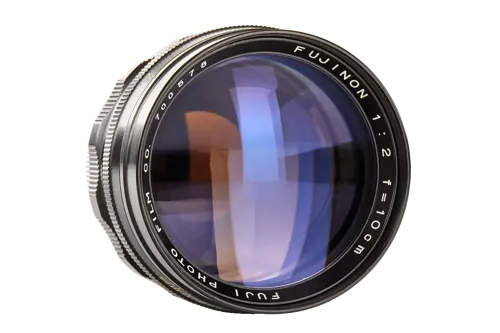
A circa-1963 Japanese 100mm f/2 telephoto in an original black-and-chrome, rangefinder-coupled Leica M39 barrel with a feet distance scale.
Fujifilm Fujinon 100mm f/2
LTM mount
No listings tracked for this lens right now.
The Fujifilm Fujinon 100mm f/2 is a LTM-mount lens for Leica rangefinder cameras. Leica price index →
How it compares
Measured against the 8 other 100mm LTM-mount lenses in the catalogue.
Specification
About this lens
Fujifilm Fujinon 100mm f/2
The Fujifilm Fujinon 100mm f/2 is a Japanese high-speed short telephoto documented in an original rangefinder-coupled Leica M39 barrel. An early black-and-chrome version dates to about 1963 and carries a feet distance scale. The 100mm focal length and f/2 maximum aperture place it among the faster portrait and low-light telephotos offered for Leica-thread rangefinder cameras.
Reliable figures for the exact optical formula, diaphragm blade count, filter fitting and minimum focusing distance have not been located. This profile therefore leaves those fields unknown. It does not import data from later Fujinon SLR, enlarging, cinema or mirrorless lenses that happen to share the focal length or brand.
Optical qualities
Rendering
No factory optical diagram or controlled period test for the coupled 10cm f/2 Leica-thread lens has been found in the consulted sources. The formula should not be labelled Sonnar, Gauss or telephoto-derived without evidence. The physical existence and camera application are well documented, but a cautious profile must separate those facts from repeated, unsupported specification tables.
On 35mm film, 100mm gives a narrow field suitable for portraits, stage subjects and distant details. The f/2 aperture provides substantial control over depth of field and permits shorter exposure than slower 90mm and 100mm lenses of the period. It does not guarantee one consistent background character. Focus distance, subject placement, diaphragm shape and the optical condition of the individual lens all matter.
At f/2
Maximum aperture places a high demand on rangefinder calibration because depth of field is limited, particularly at closer portrait distances. Focus should be checked at infinity and at several measured distances. A mismatch may arise from body adjustment, wear in the lens cam or earlier servicing rather than from the optical design itself.
No dependable exact-version data support claims about wide-open resolution, flare, chromatic aberration, distortion or vignetting. A clean example should be evaluated at repeated focus distances. Auction documentation notes optical corrosion in one copy, but that is a condition issue, not a Fujinon rendering trait.
Stopped down
Closing the aperture increases depth of field and normally improves consistency across more of the frame. Middle settings are useful when facial features or layered subjects need more depth. The blade count and smallest marked aperture should be read from the actual barrel until a reliable factory specification is located.
Handling and compatibility
The long, fast barrel should be supported when mounted on an older screw-mount camera. The native coupling cam must be calibrated over the lens's focusing range. Many Leica bodies do not provide a dedicated 100mm frame, so a suitable 100mm or adjustable accessory finder may be required for accurate composition.
On Leica M bodies, an LTM-to-M adapter provides the bayonet interface but does not create a 100mm frame or correct coupling error. Mirrorless adaptation allows direct sensor focusing and can help distinguish optical performance from rangefinder calibration. The front fitting and near-focus limit should be measured rather than inferred from a different Fujinon.
History
Development and Launch
Fuji Photo Film Co., Ltd. was established in 1934. Fujifilm's own historical account records that the company's FUJIC computer, completed in 1956, was used for lens-development calculations. This places the 100mm f/2 within a period of active postwar expansion in Japanese optical design and photographic manufacturing.
Leitz Auction dates an early black-and-chrome, rangefinder-coupled Leica M39 example to approximately 1963. KEH independently records the same 10cm f/2 Fujinon product for Leica screw mount in a black-and-chrome finish. No original catalogue announcement has been located to establish a more precise launch date.
Production Evolution
The documented early version combines a black main barrel with chrome sections and a feet scale. The word “early” in the auction description suggests other presentations may exist, but the available evidence does not establish a reliable sequence of later finishes, scale variants or optical revisions. These possibilities should remain observations, not invented generations.
No verified end year or complete production figure has been found. The lens should also remain distinct from Fujinons for SLR cameras and from later professional, broadcast or digital products. Brand continuity does not establish shared optics or mechanics.
Special Editions/Variants
No commemorative edition or factory special series of the LTM 100mm f/2 has been reliably documented. A different distance scale or finish may represent a market or production variation, but it requires independent evidence before being catalogued separately. A workshop-converted Fujinon from another mount is not equivalent to the original coupled barrel.
Collector Notes
Identification should combine Fujinon and 1:2 f=10cm engraving, the black-and-chrome construction, Leica-standard M39 thread, feet scale and a functioning rangefinder cam. Confirm that the rear mount is original and that infinity register matches LTM. A generic M39 label in a sales listing is not sufficient.
Inspect the optics for haze, fungus, separation, coating wear and corrosion, and check the long helicoid for play. Test aperture movement and coupling at several distances. Hoods, cases, caps, individual serial numbers, condition grades and sale prices belong to particular examples rather than the profile.
Sources
Where to buy
Related lenses
Similar lenses you might be interested in
Comments