A 1950s Japanese 100mm f/2 portrait lens with six elements in three groups, coupled LTM focusing, 58mm filters and 1.1m close focus.
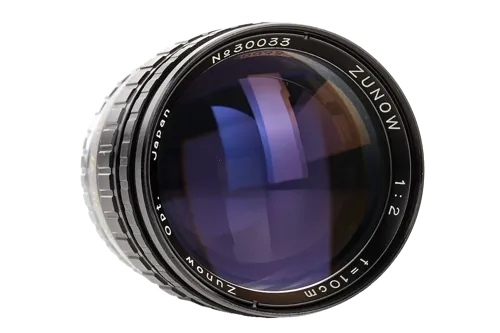
Zunow 100mm f/2
LTM mount
No listings tracked for this lens right now.
The Zunow 100mm f/2 is a LTM-mount lens for Leica rangefinder cameras. Leica price index →
How it compares
Measured against the 8 other 100mm LTM-mount lenses in the catalogue.
Specification
About this lens
Zunow 100mm f/2
The Zunow 100mm f/2 is a high-speed Japanese portrait telephoto from the 1950s, documented in an original rangefinder-coupled Leica M39 mount. The recorded optical construction is six elements in three groups. Its focusing barrel reaches approximately 1.1 metres and accepts 58mm filters. The f/2 aperture made it an unusually fast 100mm option for a compact rangefinder system.
This profile covers the 2/10cm Leica-thread product rather than Zunow's better-known 50mm f/1.1 lenses or a lens later adapted from another camera. The original coupling cam and barrel are central to its identity.
Optical qualities
Rendering
The six-element, three-group specification indicates extensive cementing and relatively few air-to-glass surfaces, but the consulted sources do not provide a verified optical section or factory formula name. It is therefore safer to retain the documented element and group count than to label the lens as a particular Sonnar derivative without direct evidence.
At 100mm on 35mm film, the lens gives a narrow field of view suitable for portraits, stage work and distant details. The f/2 aperture provides strong subject separation and shorter exposure than slower telephotos of the period. Image character at full aperture depends strongly on focus placement, coating condition and internal cleanliness.
At f/2
Depth of field is limited at the 1.1m near distance, so rangefinder calibration must be accurate. Residual spherical aberration, field curvature and mechanical vignetting are sensible points to examine, but no controlled test has been located for the LTM version. This entry therefore avoids claims of a fixed glow, swirl or edge signature.
The diaphragm blade count has not been confirmed in the database. No particular stopped-down highlight shape is asserted. A hood can help maintain contrast in oblique light, while haze, separation or cleaning damage require service rather than stylistic interpretation.
Stopped down
Closing the aperture increases depth of field and usually improves contrast and consistency across the frame. Middle settings are appropriate when more of a face, group or landscape detail must remain sharp. At the smallest apertures, diffraction limits fine resolution. The best setting depends on the intended balance between separation and field coverage.
Handling and compatibility
The long, fast lens should be supported when fitted to an older screw-mount body. Its native coupling cam should agree from infinity to 1.1m. A 100mm or adjustable accessory finder may be needed for accurate framing. On a mirrorless camera, a suitable M39 adapter allows direct sensor focusing but does not verify the historical coupling mechanism.
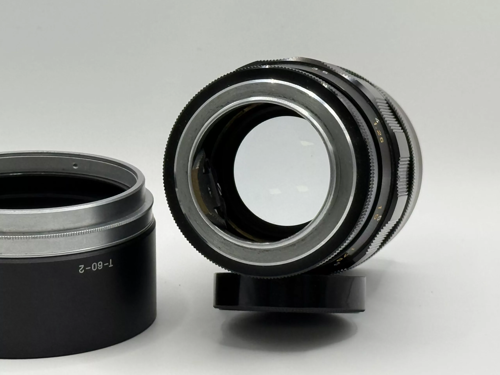
The 58mm thread is a useful identification point and accommodates a hood or filter without resorting to an uncertain slip-on size. Thread condition should be checked before accessories are attached.
History
Development and Launch
Zunow emerged from Japan's postwar optical industry and became known for unusually fast rangefinder and cinema lenses. Its output included focal lengths beyond the celebrated 5cm f/1.1. The 100mm f/2 belongs to that broader effort to provide high-speed lenses for small-format cameras.
Leitz Auction dates its documented coupled M39 example broadly to the 1950s. Lens-DB assigns 1956 to the Leica screw version. In the absence of a surviving factory launch notice, 1956 is best treated as a specialist-reference date within the confirmed 1950s period rather than an exact announcement day.
Production Evolution
The model is documented in a black barrel with a contrasting metal mount section. Engraving and distance-scale differences may occur, but no complete production chronology or confirmed optical revision has been located. A precise lifetime production total is therefore omitted.
The 100mm f/2 is independent of Zunow's 50mm f/1.1 lenses. Shared brand, high speed and rangefinder use do not establish shared optical construction or a single product family for database purposes.
Special Editions/Variants
This entry is restricted to the native coupled Leica-thread barrel. Other Zunow lenses and any workshop conversions require separate identification. No commemorative special edition or verified alternative optical generation of the M39 100mm f/2 has been established.
Collector Notes
Confirm the Zunow Opt. Japan and 2/10cm engraving, original M39 thread, functional coupling cam, 58mm front and focusing travel to approximately 1.1m. Compare scale layout and finish with documented examples. A fitting thread without a correct cam is not sufficient proof of factory rangefinder construction.
Inspect the optics for haze, fungus, coating wear and separation within the cemented groups. Check helicoid play, aperture movement and rangefinder agreement. Dealer rarity claims, sale prices, serial numbers and accessories belong to individual examples rather than the general lens profile.
Sources
Where to buy
Related lenses
Similar lenses you might be interested in
Comments