Best price Good
Canon Serenar 100mm F/4 lens for Leica LTM / M39
Sold by Fotohandel Delfshaven
€208 ≈ $225
The Canon Serenar 100mm f/4 II is a lightweight LTM screw-mount triplet telephoto, a 1950 refinement of Canon's early rangefinder lens line.
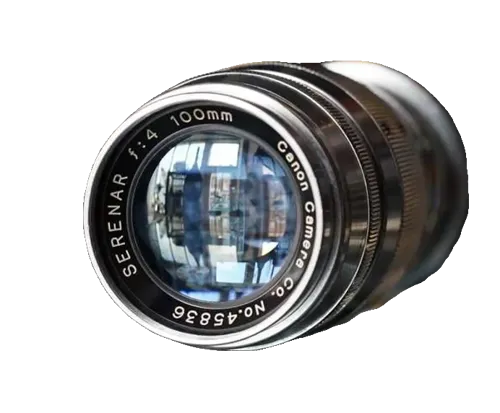
LTM mount
The Canon Serenar 100mm f/4 II is a LTM-mount lens for Leica rangefinder cameras. As of October 2026, it sells from €215 used across 1 listing, with a 30-day median of €215. Leica price index →
Measured against the 8 other 100mm LTM-mount lenses in the catalogue.
Among Canon's earliest rangefinder telephoto lenses, the Serenar 100mm f/4 II stands out for its simplicity: a three-element, three-group Cooke triplet in a compact Leica thread mount barrel. Canon marketed this second version in April 1950 as a lighter, revised replacement for the first 100mm f/4, which had appeared in January 1948 [1][2]. The "Serenar" name dates from Canon's pre-1950s lens branding, used before the company standardized on the Canon name for most of its rangefinder optics. As a moderate telephoto on a 35mm rangefinder, the 100mm focal length suited portraits and distant subjects while keeping the lens small and easy to carry.
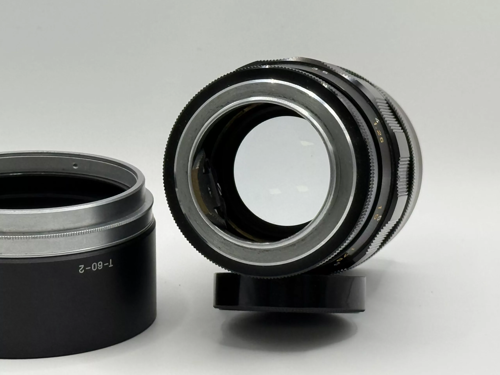
Optically the lens uses a classic triplet, an economical and well-corrected formula appropriate for a slower f/4 maximum aperture [3]. It is a rangefinder-coupled LTM (M39) lens, so it focuses through the camera's coupled rangefinder, and it carries a 41 mm filter thread and weighs 355 g. The minimum aperture is f/22, and close focus is limited to roughly a meter, a constraint several users note as the lens's main practical drawback. The barrel is metal with a chrome finish, and the diaphragm uses a multi-bladed iris. Like other Canon screw mount lenses it mounts directly on Leica and other M39 bodies and, via an adapter, on mirrorless digital cameras.
The most useful identifier separating the two versions is weight and construction. Canon's records show the 1948 first version at 459 g, while the 1950 second version dropped to 355 g, reflecting a lighter barrel rather than a change to the three-element optical layout, which both versions share. Period examples are typically brass-bodied with chrome plating, and coatings on this era of lens were limited rather than the full multicoating of later optics.
Rendering Documented impressions of this lens are limited and come mainly from individual users rather than formal testing. As a single-coated triplet, it tends to deliver modest contrast that benefits from a small lift in post-processing, with color that some users describe as needing slight warming. Out-of-focus rendering is generally regarded as pleasant for a lens of its age and simple design. These are subjective observations from collector use, not standardized measurements, so they should be treated as indicative rather than definitive.
Development and Launch Canon introduced the first Serenar 100mm f/4 in January 1948, then released this revised second version in April 1950 at an original price of 18,200 yen. Both belonged to Canon's early postwar rangefinder lens range, built around the Leica screw mount system that Canon used throughout its rangefinder era.
Production Evolution The principal documented change from the first to the second version is a reduction in weight, from 459 g to 355 g, achieved without altering the three-element, three-group triplet design. Canon's specification records list both versions with the same construction, a minimum aperture of f/22, and the same close-focus capability.
Special editions No major factory special editions, military variants, or unusual finishes of the Serenar 100mm f/4 II are widely documented; it was produced as a standard chrome-finished screw mount telephoto.
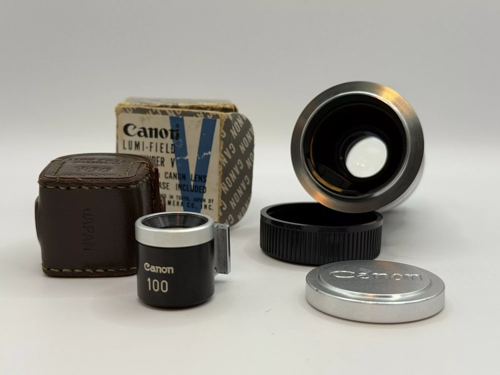
Collector Notes Because the two versions share an identical optical layout, weight is the most reliable way to tell them apart, with the lighter 355 g barrel indicating the second version. As with most lenses of this vintage, internal haze is a common condition issue and buyers report that genuinely clear examples are comparatively lucky finds. Original rangefinder coupling should be checked, since some surviving lenses have had the coupling damaged or modified, which limits them to scale focusing on a rangefinder body. Worth verifying before purchase are the matching shoe-mount finder, caps, hood, and case that often accompanied the lens. One minor note: Canon's own museum records list close focus at 1.07 m, slightly longer than the figure recorded here, a small discrepancy typical of differing measurement conventions.
About the usual price. The lowest listing is around the 30-day average.
Over the last 12 weeks the median price for the Canon Serenar 100mm f/4 II has held steady, ranging from €215 to €215 (now €215).
Weekly price (EUR). Median (Good or better) and lowest (Good or better) across 12 weeks. The full figures follow in the table below.
| Week | Median | Lowest |
|---|---|---|
| Jun 1, 2026 | €215 | €215 |
| Jun 8, 2026 | €215 | €215 |
| Jun 15, 2026 | €215 | €215 |
| Jun 22, 2026 | €215 | €215 |
| Jun 29, 2026 | €215 | €215 |
| Jul 6, 2026 | €215 | €215 |
| Jul 13, 2026 | €215 | €215 |
| Jul 20, 2026 | €215 | €215 |
| Jul 27, 2026 | €215 | €215 |
| Aug 3, 2026 | €215 | €215 |
| Aug 10, 2026 | €215 | €215 |
| Aug 17, 2026 | €215 | €215 |
Every shop grades differently. Leica Classic uses letters, Ffordes uses E++ and E+, German dealers write "Zustand B", Japanese dealers write A−. We map all of them onto the one ladder below. Where a shop states its own grade, we print it under ours.
As of October 2026, the Canon Serenar 100mm f/4 II sells from €215 used, with a 30-day median of €215, across 1 active listing.
As of October 2026, the Canon Serenar 100mm f/4 II is sold by 1 source (1 listing), from €215 used: all compared cheapest-first on this page.
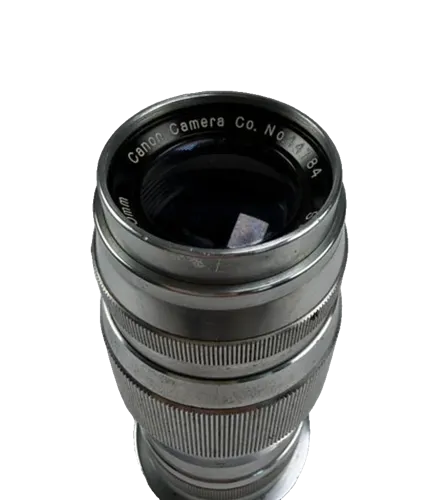
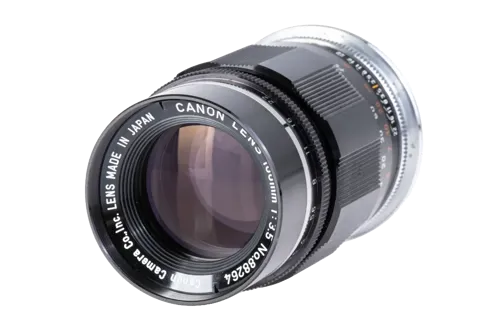
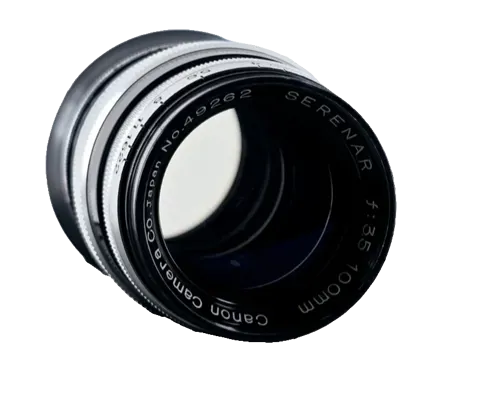
Similar lenses you might be interested in
Comments