Best price For Parts / Repair
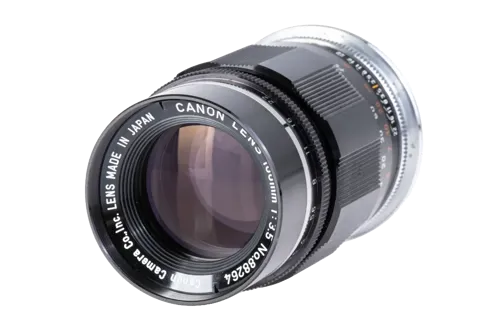
Canon Rangefinder RF 100mm f4 Serenar Leica SM LTM lens
Sold by Cardinal Camera Used
€83 ≈ $90
The Canon Serenar 100mm f/4 I is an early postwar LTM telephoto, a compact three-element rangefinder lens of 1948 prized by Canon screw-mount collectors.
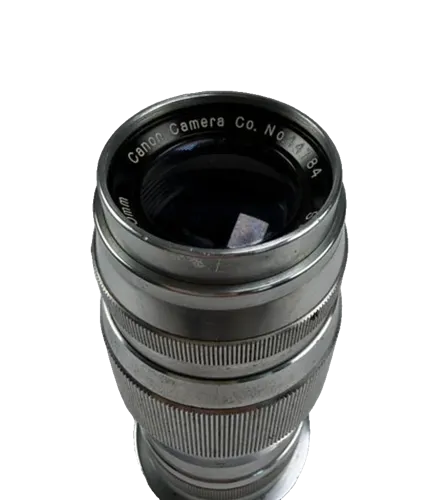
LTM mount
The Canon Serenar 100mm f/4 I is a LTM-mount lens for Leica rangefinder cameras. As of October 2026, it sells from €83 used across 2 listings, with a 30-day median of €83. Leica price index →
Measured against the 8 other 100mm LTM-mount lenses in the catalogue.
Introduced as one of Canon's earliest postwar telephoto offerings, the Serenar 100mm f/4 I belongs to the period when the company still branded its lenses "Serenar" rather than "Canon Lens." According to Canon's own archive it was marketed in January 1948 at an original price of 17,720 yen, placing it among the first short telephotos the firm built for its Leica-thread rangefinder cameras [1]. The simple three-element, three-group optical layout and the modest f/4 maximum aperture reflect a design philosophy aimed at a light, affordable medium telephoto rather than a fast portrait lens.
Built in the Leica screw mount (M39 / LTM) with a rangefinder-coupled focusing helical, the lens couples to the camera's rangefinder for focus confirmation and works on Canon, Leica, and other compatible screw-mount bodies, as well as on mirrorless cameras through an LTM adapter. The optical formula uses three elements in three groups, the diaphragm stops down to f/22, and the chrome barrel carries the period-correct engraving and a relatively long focusing throw typical of a 100mm rangefinder lens. Because a 100mm focal length exceeds the coverage of most built-in rangefinder finders of the era, the lens was normally sold or used with a matching auxiliary optical finder slipped into the accessory shoe.
Canon followed this first version with a revised Serenar 100mm f/4 II around 1950, so collectors should distinguish the early [I] barrel from later iterations by engraving style, coating, and serial range. Examples that carry "Made in Occupied Japan" markings date from the occupation period and are sought after by collectors for that reason.
Rendering Documented technical detail on this lens is limited, and firm review-based conclusions are scarce. What can be stated from the design is conservative: a three-element telephoto at a moderate f/4 aperture is optically simple, which tends to keep the lens small and light while limiting maximum sharpness and contrast compared with later, more complex Canon 100mm designs. The lens was coated in the postwar manner of its day, but specific, repeatable claims about its bokeh, flare resistance, distortion, or vignetting are not well supported by reliable sources, so they are not asserted here.
Development and Launch The Serenar 100mm f/4 I was marketed in January 1948, during the era when Canon's interchangeable rangefinder lenses still carried the Serenar name and the company was rebuilding its optical line in the early postwar years. At 17,720 yen it represented a comparatively accessible telephoto for the Canon and Leica screw-mount system, complementing the standard 50mm lenses with a longer focal length suited to portraits and distant subjects. The three-element construction kept weight to about 459 grams.
Production Evolution A second version, the Serenar 100mm f/4 II, appeared around 1950, indicating that Canon revised the 100mm f/4 within a few years of the original launch. The two versions are catalogued separately by collector databases, which is the main reason to confirm exactly which variant a given barrel represents before purchase.
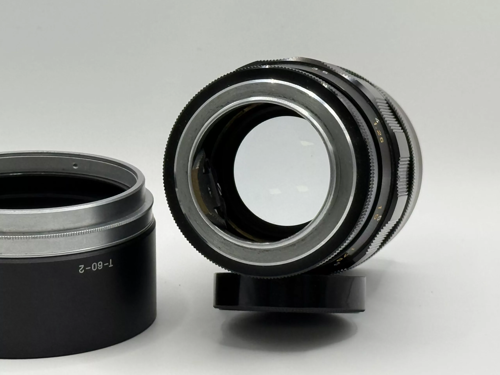
Collector Notes Buyers should verify the lens against the matching auxiliary 100mm viewfinder, caps, hood, and case, since complete outfits command a premium and are often advertised together. Originality of the chrome finish and engraving, and the absence of internal haze or fungus in the cemented elements, are the usual condition concerns for a lens of this age. One sourcing note worth flagging: Canon's own museum specification page lists a 34mm filter thread and a closest focusing distance of about 1.07 m for this lens, which differs slightly from the values recorded here for filter diameter and minimum focus; where they conflict, the verified specifications recorded by LeicaLensList take precedence.
About the usual price. The lowest listing is around the 30-day average.
Lowest price Click a mark to open that listing · arrow keys to step, Enter to open
Price against condition for 2 listings of Canon Serenar 100mm f/4 I, €83 to €83, median €83. For Parts / Repair: 2 at €83, €83. The full table follows.
Over the last 8 weeks the median price for the Canon Serenar 100mm f/4 I has held steady, ranging from €83 to €83 (now €83).
Weekly price (EUR). Median (Good or better) and lowest (Good or better) across 8 weeks. The full figures follow in the table below.
| Week | Median | Lowest |
|---|---|---|
| Aug 10, 2026 | €83 | Unknown |
| Aug 17, 2026 | €83 | Unknown |
| Aug 24, 2026 | €83 | Unknown |
| Aug 31, 2026 | €83 | Unknown |
| Sep 7, 2026 | €83 | Unknown |
| Sep 14, 2026 | €83 | Unknown |
| Sep 21, 2026 | €83 | Unknown |
| Sep 28, 2026 | €83 | Unknown |
Every shop grades differently. Leica Classic uses letters, Ffordes uses E++ and E+, German dealers write "Zustand B", Japanese dealers write A−. We map all of them onto the one ladder below. Where a shop states its own grade, we print it under ours.
As of October 2026, the Canon Serenar 100mm f/4 I sells from €83 used, with a 30-day median of €83, across 2 active listings.
As of October 2026, the Canon Serenar 100mm f/4 I is sold by 1 source (2 listings), from €83 used: all compared cheapest-first on this page.
Similar lenses you might be interested in
Comments