Canon's compact 100mm f/3.5 II telephoto in Leica screw mount, a five-element LTM rangefinder lens prized by collectors for travel-friendly size and crisp rendering.
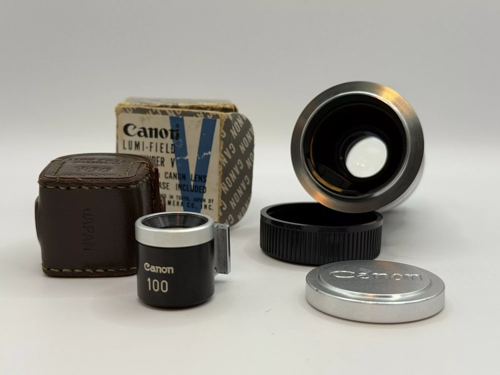
Canon 100mm f/3.5 II
LTM mount
No listings tracked for this lens right now.
The Canon 100mm f/3.5 II is a LTM-mount lens for Leica rangefinder cameras. Leica price index →
How it compares
Measured against the 8 other 100mm LTM-mount lenses in the catalogue.
Specification
About this lens
Canon 100mm f/3.5 II
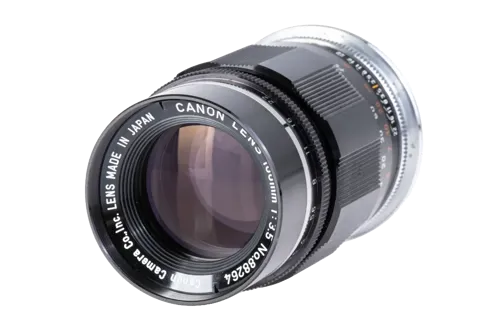
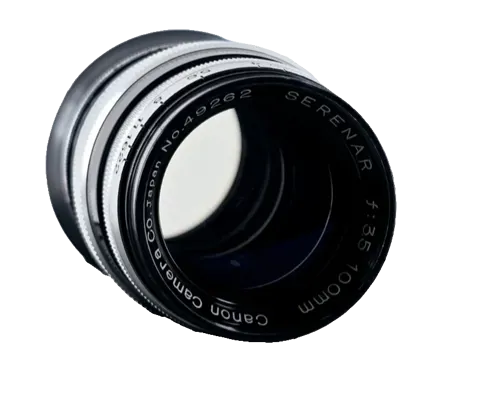
Among the small telephotos made for Leica screw-mount cameras, the Canon 100mm f/3.5 stands out for packing a five-element optical layout into a barrel scarcely larger than a normal lens. The design traces back to Canon's first 100mm rangefinder lens, the Serenar 100mm f/3.5, marketed in January 1953 with a five-element, four-group construction, fifteen diaphragm blades and a 34mm filter thread [1]. The version recorded here is the second iteration of that lens, a later revision in which Canon reduced the weight of the original while keeping the same basic optical and mechanical recipe [2]. The result is a light short telephoto that, despite the modest f/3.5 maximum aperture, earned a strong reputation among Leica thread-mount users for its image quality and portability [3].
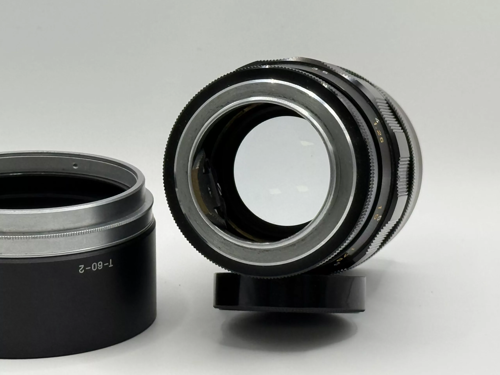
The lens carries five elements in four groups, a step beyond the three- and four-element Leitz Elmar designs it competed with, and uses a fifteen-blade diaphragm that runs from f/3.5 to f/22. It focuses to one metre and couples to the camera rangefinder through the standard LTM (M39) thread, so it can be used on Canon, Leica and other screw-mount bodies, or adapted to M-mount and mirrorless cameras. Handling reflects its late-1950s origins: the focus throw is long and the aperture ring is clickless. The early black-and-chrome body closely resembles the Leitz Elmar 90/4, down to the 34mm filter ring, which makes filters and hoods somewhat awkward to source today. Because the lens covers a focal length without built-in framelines on many bodies, an accessory 100mm or 105mm viewfinder is commonly used, though cameras such as the Canon P provide the framelines directly.
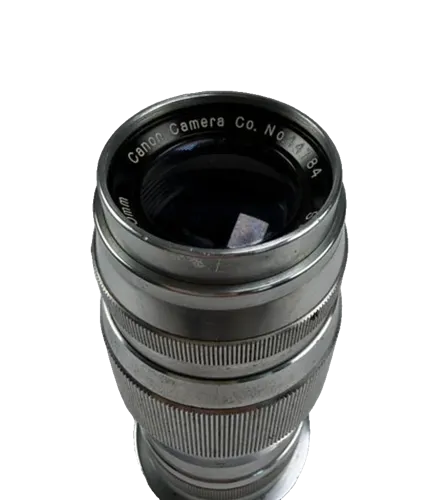
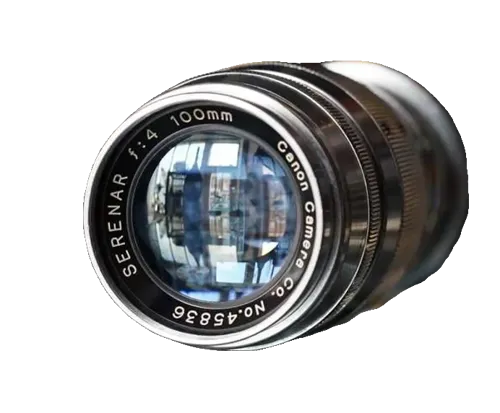
Collectors should distinguish this lens from its relatives in the same family. Canon's earliest 100mm screw-mount lens was an f/4 triplet in a heavy brass barrel, while the f/3.5 line introduced the five-element design. The original f/3.5 of 1953 is the heavier example, and a later all-black housing version with a more conventional 40mm filter size is also documented, weighing more than the chrome-and-black types. Names also vary across the family, with early examples marked Serenar before the Canon branding was adopted.
Optical qualities
Rendering Documented impressions of the lens are positive. Users describe it as sharp with pleasing contrast, agreeable color rendition and smooth out-of-focus areas, with overall character compared to that of a Leitz Summitar. On rangefinder and adapted digital bodies it is reported to be capable of fine detail at the focus plane and a sense of three-dimensionality, though as with most lenses of this vintage individual results depend heavily on the condition and collimation of the specific sample [4]. Reviews note its suitability as a compact travel telephoto rather than a high-speed portrait lens.
History
Development and Launch Canon's 100mm f/3.5 grew out of the company's S-series rangefinder lenses. The first 100mm f/3.5, sold under the Serenar name, reached the market in January 1953 at a price of 22,000 yen and established the five-element, four-group formula that the later versions retained. This second version followed as a lighter revision of that lens, after which the line continued into Canon's screw-mount production of the period.
Production Evolution The principal change across the f/3.5 versions was weight and external styling rather than the basic optical scheme. The original 1953 lens was the heaviest of the chrome-bodied examples, and the subsequent revision trimmed the weight while retaining the 34mm filter thread and the compact barrel similar to the Elmar 90/4. A later variant housed in all-black finish adopted a larger, more conventional 40mm filter size and styling closer to Canon's early SLR lenses, and was heavier still.
Collector Notes The chrome-and-black early bodies are mechanically simple, which can make servicing relatively straightforward, but examples are frequently found needing collimation or with stiff, dried focusing grease, and haze, cleaning marks or fungus in the elements are common faults to check. The 34mm filter size on the earlier barrels is difficult to source, so buyers often rely on step-up rings for filters and hoods. Verify that the lens couples correctly to the rangefinder and focuses across its full range before purchase, since focus that stops short of infinity or the close limit usually points to old grease or a decentered assembly. One discrepancy worth noting: the Canon Camera Museum lists the 1953 first version at 205g, heavier than the weight recorded here, which is consistent with collector reports that this later version was a weight-reduced revision.
Sources
Where to buy
Related lenses
Similar lenses you might be interested in
Comments