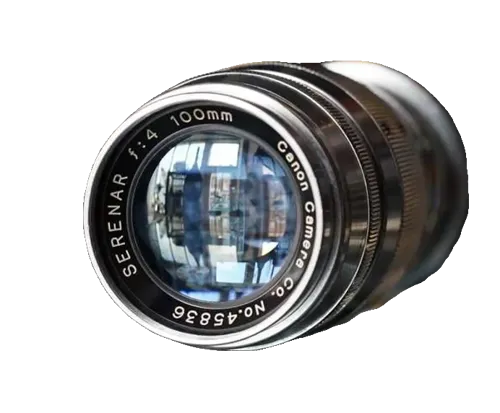
The Canon 100mm f/3.5 I is a compact LTM short telephoto from 1953, a five-element rangefinder lens prized by Leica screw-mount collectors.
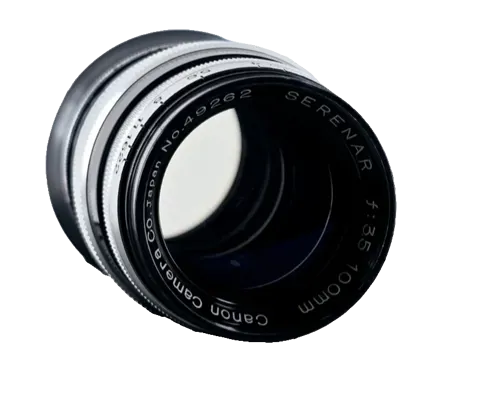
Canon 100mm f/3.5 I
LTM mount
No listings tracked for this lens right now.
The Canon 100mm f/3.5 I is a LTM-mount lens for Leica rangefinder cameras. Leica price index →
How it compares
Measured against the 8 other 100mm LTM-mount lenses in the catalogue.
Specification
About this lens
Canon 100mm f/3.5 I
This was Canon's first 100mm lens and a notably compact short telephoto for the Leica screw mount, marketed under the Serenar name from January 1953 [1]. In a class where Leitz offered the well-regarded 90mm f/4 Elmar, the Canon stood out by pairing a small, lightweight barrel with a more ambitious optical formula, giving rangefinder users a portable mid-telephoto without the bulk of faster designs [2]. Measuring 69 mm long with a 44 mm maximum diameter and weighing 205 g, it is easy to carry and well suited to travel kits built around Leica and Canon bodies.
The lens uses five elements in four groups, a step up from Canon's earlier 100mm f/4, which was a simpler triplet in a heavier brass barrel. It focuses to one metre, couples to the rangefinder, and uses a fifteen-blade diaphragm. The aperture ring is clickless, and the focus throw is long, both traits typical of LTM lenses of the period. In overall barrel design and handling the early type closely resembles the Leitz 90mm f/4 Elmar, and reviewers have noted the strong family likeness between the two. The verified filter thread for the lens is 41 mm; some references, including the Canon Camera Museum and at least one user account, instead cite a 34 mm thread, a discrepancy worth checking against an individual example.
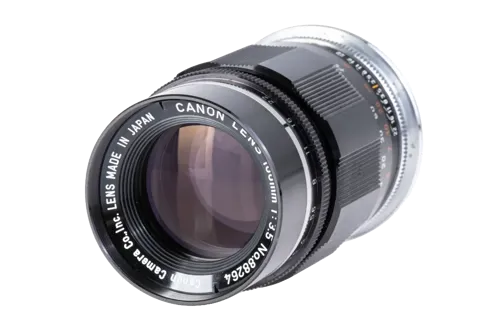
The Mark I was later joined by a Mark II that was lighter still, listed by Canon at 184 g, with styling closer to the company's early SLR lenses; the Mark II proved a strong seller, which is one of the clearest ways to distinguish the early and later types.
Optical qualities
Rendering Documented impressions of this lens are positive but come mainly from collector and user accounts rather than formal testing. One detailed user review describes it as sharp with pleasing contrast, attractive color rendition, and smooth out-of-focus areas, and rates its results above those of a 90mm f/4 Elmar used alongside it. The same account compares its overall color and monochrome character to that of a Leitz Summitar. These observations should be read as experienced-user consensus rather than measured performance data.
History
Development and Launch The Serenar 100mm f/3.5 reached the market in January 1953 at an original price of 22,000 yen, and it was Canon's first 100mm lens to gain wide popularity. It followed an earlier 100mm f/4, and the move to a five-element, four-group design at f/3.5 gave Canon a more capable telephoto while keeping the lens compact and light.
Production Evolution A later Mark II version reduced the weight to 184 g and adopted styling closer to Canon's early SLR lenses, becoming a notable commercial success. The early Mark I retains the slimmer, Elmar-like barrel that distinguishes it visually from the later type.
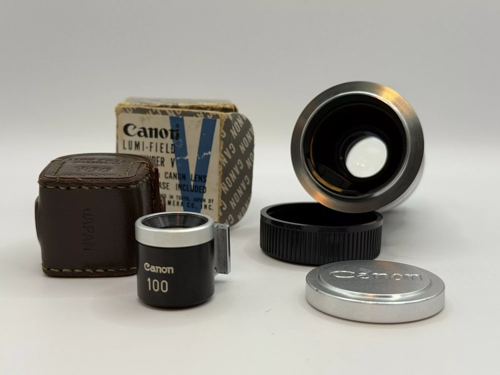
Collector Notes Because the lens shipped during the Serenar-to-Canon naming transition and across two body styles, identifying the early Mark I by its slim barrel and earlier markings is the main point of confusion for buyers. Original examples were often sold with a dedicated viewfinder, which one user describes as small and awkward in use; many owners substitute a brightline finder framed for a 100mm or 105mm lens, or use a body such as the Canon P that already has 100mm framelines. Confirm the filter thread on the actual lens before buying accessories, given the conflicting 34 mm and 41 mm figures in the literature, and check the glass for the haze and coating wear common to lenses of this age.
Sources
Where to buy
Related lenses
Similar lenses you might be interested in
Comments