The Canon 25mm f/3.5 is a compact LTM super-wide for Leica screw-mount cameras, a Topogon-derived design once billed as the world's fastest 25mm.
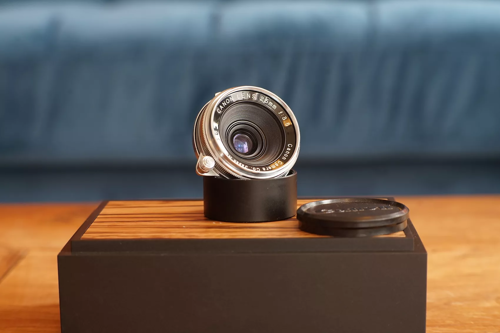
Canon 25mm f/3.5
LTM mount
No listings tracked for this lens right now.
The Canon 25mm f/3.5 is a LTM-mount lens for Leica rangefinder cameras. Leica price index →
Specification
About this lens
Canon 25mm f/3.5
Among Canon's screw-mount wide angles, the 25mm f/3.5 stands out for its very small size and its origins in the Topogon optical layout. Canon describes the lens as a super wide angle covering a diagonal angle of view of about 82 degrees, developed on the basis of the Carl Zeiss Topogon, a wider design that Canon cites at 100 degrees and f/6.3 [1]. Marketed in December 1956 at an original price of 32,500 yen with case, it was promoted by Canon as the fastest 25mm lens in the world at the time of its release.
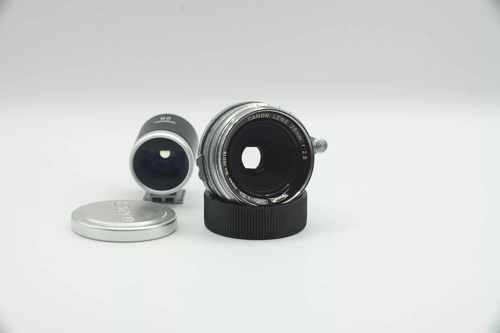
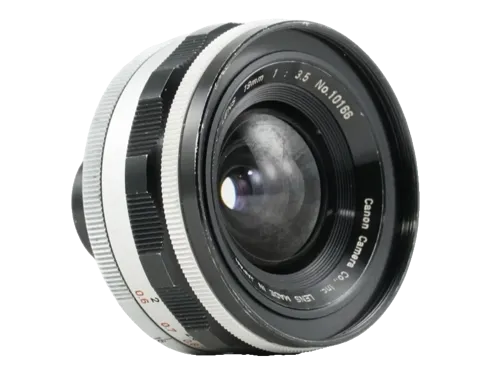
The optical formula is unusually simple for a lens of this coverage, using five elements in five groups. Canon notes a distinctive construction in which a spherical first element of very high refractive index is paired with a rearmost element of effectively flat (infinite radius) curvature. The lens is physically tiny, with a 40mm filter thread, a six-blade diaphragm stopping down to f/22, and a closest focusing distance of one meter. As a 25mm lens it sits well outside the field covered by the built-in finder of most screw-mount bodies, so in practice it is used with a separate 25mm accessory optical viewfinder for framing, with focusing set by scale or by the camera rangefinder. Mounted in Leica thread (M39), it fits Canon, Leica and other LTM rangefinder cameras directly, and adapts to Leica M bodies with the usual screw-to-bayonet adapter.
Documented version detail for this lens is limited in collector literature, and Canon's museum lists a single specification set rather than multiple optical variants. It is typically encountered in a chrome and black two-tone finish. CameraQuest's overview of screw-mount optics notes that postwar Japanese LTM lenses from makers such as Canon and Nikon were often regarded by photographers of the era as the equal of Leitz glass, and that all postwar LTM optics are coated [2].
Optical qualities
Rendering Detailed, repeatable performance data for the Canon 25mm f/3.5 is sparse, so claims should be read cautiously. The design intent is documented: a Topogon-derived super wide angle aimed at broad, even coverage. Symmetrical Topogon-type layouts of this period are generally associated with low distortion across a wide field, though they also tend toward noticeable corner light falloff, especially wide open. Beyond these design-level expectations, this entry does not assert specific sharpness, contrast or bokeh characteristics, as they are not well supported by consistent published testing.
History
Development and Launch Canon introduced the 25mm f/3.5 in December 1956 as part of its line of screw-mount rangefinder lenses. The company positioned it as a super wide angle and based the optical approach on the Zeiss Topogon, adapting that wide-coverage formula into a faster 25mm lens; Canon states it was the fastest 25mm lens in the world when launched. It joined a broad Canon rangefinder system in which accessory optical finders extended framing to focal lengths the camera's own viewfinder could not show.
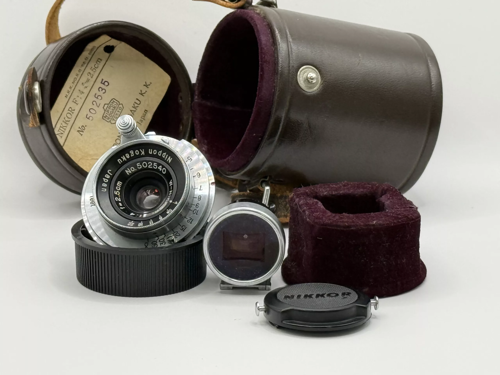
Collector Notes The lens is small and uses an uncommon 40mm filter size, so original caps, the matched 25mm accessory finder and correct filters are worth confirming before purchase, as they are easily separated from the lens over time. As with most lenses of this age, buyers should check the coated elements for haze, cleaning marks and separation, and verify smooth focus and aperture action. Because it is a 25mm optic outside the coupled-finder coverage of most bodies, a period-correct external finder is part of a complete outfit.
Sources
Where to buy
Related lenses
Similar lenses you might be interested in
Comments