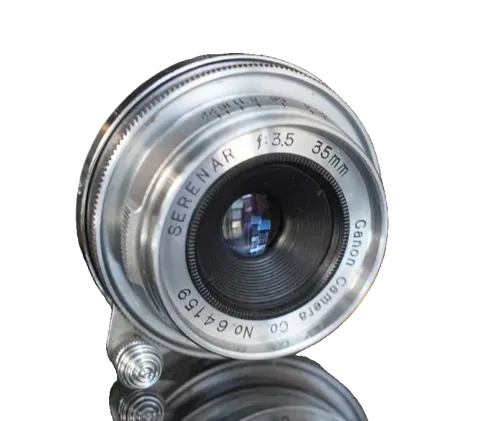
The Canon Serenar 28mm f/3.5 is an early LTM screw-mount wide-angle prime, prized by collectors as Canon's first 28mm and a notably compact rangefinder lens.
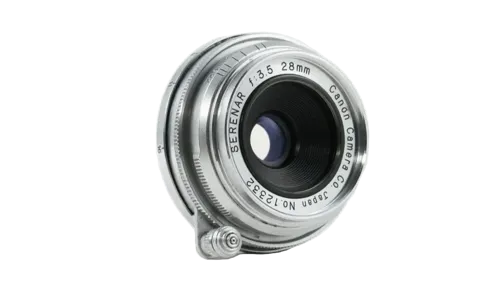
Canon Serenar 28mm f/3.5
LTM mount
No listings tracked for this lens right now.
The Canon Serenar 28mm f/3.5 is a LTM-mount lens for Leica rangefinder cameras. Leica price index →
How it compares
Measured against the 14 other 28mm LTM-mount lenses in the catalogue.
Specification
About this lens
Canon Serenar 28mm f/3.5
When it reached the market in October 1951, this was the fastest 28mm wide-angle lens in the world, and that distinction is the main reason collectors still seek it out today [1]. Canon built it around a Gauss-type optical formula of six elements in four groups, and the company promoted it as roughly five times faster than the contemporary Carl Zeiss Tessar 28mm f/8, which made a genuinely usable wide angle accessible to rangefinder photographers of the era. The "Serenar" name itself came from a Canon in-house naming contest, coined from the Latin sense of serene and the Sea of Serenity on the Moon.
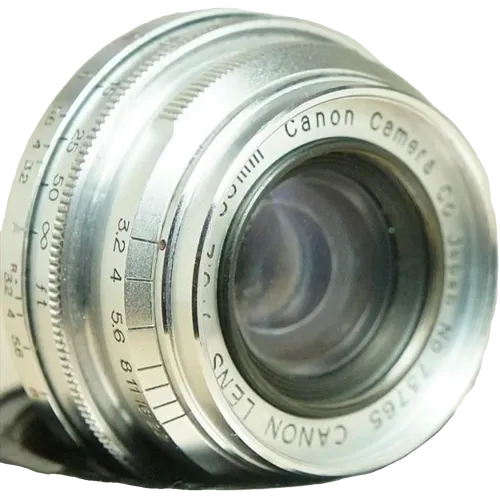
The lens uses the Leica thread mount (LTM, M39) and is rangefinder-coupled, so it focuses through the body's coupled rangefinder on Leica screw-mount and Canon bodies alike, down to a one-metre minimum focus distance [3]. Because 28mm falls outside the framelines of most early screw-mount cameras, it was intended to be used with an accessory 28mm viewfinder in the accessory shoe. The barrel is finished in silver chrome over metal, carries a six-bladed diaphragm stopping down to f/22, and accepts 34mm filters. It is a very small lens: at roughly 18mm long and 48mm in diameter and about 145 grams, it barely protrudes from a Leica body, with one user noting it extends less than a collapsed Summitar[2]. Examples are also fitted with an infinity lock on the focusing mount.
This f/3.5 design is the first of Canon's 28mm rangefinder lenses and predates the company's later, faster 28mm f/2.8 LTM optics, so it represents the starting point of the lineup. Early Serenar-branded barrels were later superseded as Canon dropped the Serenar name on subsequent lenses, which is one of the identifying markers of these earliest examples.
Optical qualities
Rendering Documented impressions describe a classic early-Canon rangefinder character: high resolution paired with low to moderate contrast, with corners that are soft at the widest apertures and sharpen across the frame from around f/5.6. Overall the lens is reported to give an older-fashioned, vintage look rather than the high-contrast rendering of modern wide angles. Detailed published testing is limited, so finer points of distortion, flare and color are not well documented.
History
Development and Launch Canon marketed the Serenar 28mm f/3.5 in October 1951 at an original price of 27,000 yen. Its Gauss-type six-element, four-group construction was notable for delivering an f/3.5 maximum aperture in a 28mm focal length, a speed that Canon highlighted as a world first for the focal length and a large advance over the slow wide angles then available.
Collector Notes The earliest examples carry the Serenar engraving, a useful identification point for collectors. Buyers should confirm the silver-chrome finish and barrel are original, check the six-bladed diaphragm and infinity lock for smooth operation, and inspect the small front and rear elements for haze, which is common on lenses of this age and often clears with a service. Because the lens does not show framelines on most bodies, a period-correct 28mm accessory viewfinder is a desirable companion piece. Reported dimensions and weight vary slightly between sources; the figures recorded by LeicaLensList should be treated as authoritative.
Sources
Where to buy
Related lenses
Similar lenses you might be interested in
Comments