The Canon Serenar 35mm f/3.2 is a compact 1951 LTM wide-angle lens with six elements, rangefinder coupling, a 34mm filter thread and chrome finish.
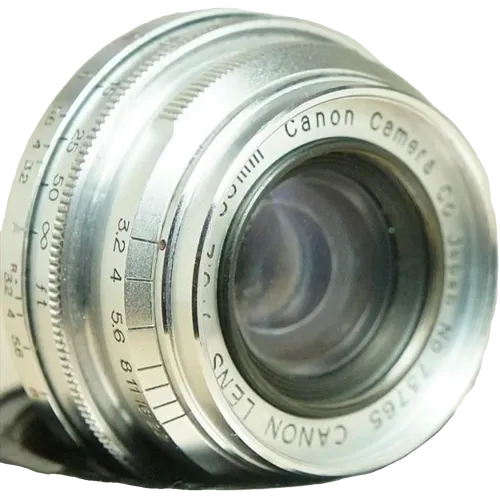
Canon Serenar 35mm f/3.2
LTM mount
No listings tracked for this lens right now.
The Canon Serenar 35mm f/3.2 is a LTM-mount lens for Leica rangefinder cameras. Leica price index →
How it compares
Measured against the 45 other 35mm LTM-mount lenses in the catalogue.
Specification
About this lens
Canon Serenar 35mm f/3.2
The Canon Serenar 35mm f/3.2 is a compact wide-angle lens introduced in June 1951 for Canon screw-mount rangefinder cameras. It uses the Leica thread mount, also known as LTM, L39 or M39, and is mechanically coupled to the camera rangefinder. Its 35mm focal length made it a practical choice for travel, street photography and general documentary work at a time when many rangefinder bodies were normally supplied with a 50mm lens.
Canon specifies six elements in four groups, six diaphragm blades, a minimum aperture of f/22 and a closest focusing distance of 1m. The chrome barrel measures approximately 48mm in diameter and 22.8mm in length, weighs about 165g and accepts 34mm screw-in filters. An infinity lock is fitted to the focusing control.
The lens sits between Canon's earlier Serenar 35mm f/3.5 and the faster 35mm f/2.8 introduced later in 1951. It is a separate model, not merely an aperture-marking variation. The six-element construction also distinguishes it from the simpler four-element, three-group formula of the earlier 35mm f/3.5.
A separate 35mm accessory finder is normally required on Leica screw-mount and early Canon bodies that do not provide a built-in 35mm viewing frame. On a Leica M camera the lens can be used with a correctly made 35mm LTM-to-M adapter, but the adapter does not change its native LTM identity.
Optical qualities
Rendering
The Serenar 35mm f/3.2 belongs to Canon's early postwar generation of coated rangefinder lenses. Its moderate maximum aperture and symmetrical six-element construction favour compactness and controlled general-purpose rendering rather than the shallow depth of field of a faster lens. At normal distances the 35mm field of view gives strong environmental context while remaining natural in perspective.
Surviving examples are often described as producing moderate contrast and a gentler tonal transition than modern multicoated optics. Such impressions must be treated cautiously because haze, cleaning marks, coating wear and previous disassembly can substantially alter the image.
Sharpness
Central definition is generally the strongest part of the image at f/3.2. Stopping down improves the outer field and gives more even performance for architecture, landscape and reproduction work. Exact corner behaviour can vary between samples, especially when a lens has been serviced or reassembled without precise optical alignment.
The one-metre minimum focusing distance is typical of screw-mount rangefinder lenses of the period. The lens is therefore better suited to environmental subjects than close-up detail work. Rangefinder calibration should be checked before judging wide-open sharpness.
Contrast and color
The coated optical surfaces improve light transmission and contrast compared with uncoated prewar lenses, but the coating is less resistant to difficult backlight than current multilayer treatments. A suitable hood can reduce veiling flare and preserve shadow separation when bright sources fall near the frame.
Color response is usually influenced as much by coating condition and sensor processing as by the original formula. A yellow, cool or low-contrast result from one sample should not be assigned to the entire model without inspecting the glass.
Distortion and vignetting
The symmetrical layout is intended to control geometric distortion, although contemporary laboratory data is limited. Some corner darkening should be expected near maximum aperture and normally reduces when stopped down. Architectural users should evaluate a known straight subject rather than infer distortion from perspective convergence.
Handling
The short chrome barrel balances well on compact screw-mount cameras. The infinity lock secures the lens for transport but adds an extra movement when focusing away from infinity. The 34mm filter thread is model-specific enough that original filters, caps and hoods can be harder to replace than common modern accessories.
History
Development and Launch
Canon marketed the Serenar 35mm f/3.2 in June 1951. Canon Camera Museum records an original Japanese price of 20,720 yen and lists the official physical and optical specifications. The lens appeared during a period of rapid expansion in Canon's postwar rangefinder system, when the company was developing alternatives across several focal lengths and maximum apertures.
The Serenar name was used on Canon lenses before the company consolidated its branding around the Canon name. This model therefore exists at an important transition point in Canon's export and product history.
Production Evolution
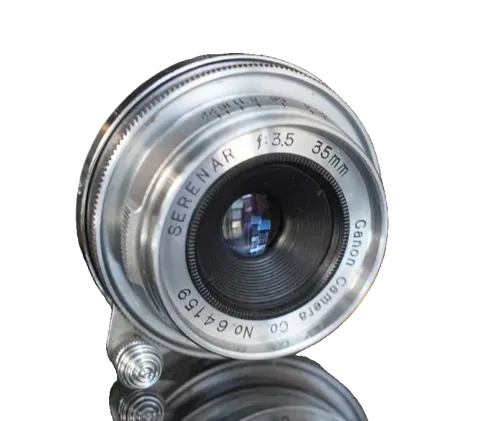
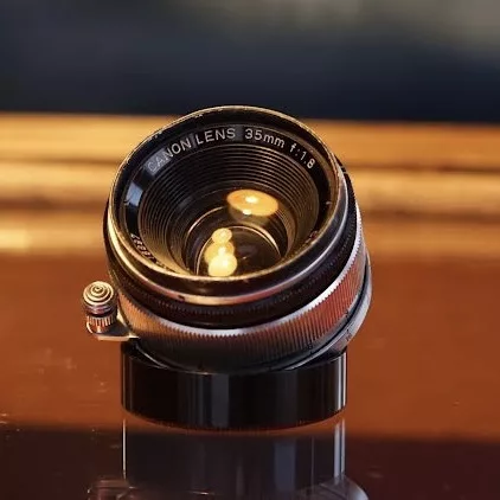
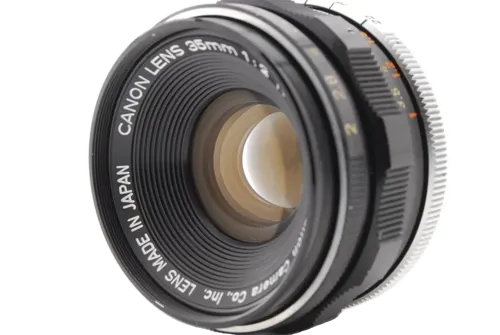
Surviving examples may carry either SERENAR or CANON LENS wording on the front identification ring. These engraving changes reflect branding evolution and do not by themselves establish a different optical formula. Both forms should remain under the same model entry when their focal length, aperture, construction and mechanical specification agree.
Production was relatively brief because Canon introduced other 35mm designs in the same period. The f/3.2 should not be merged with the f/2.8 or f/3.5 lenses, even when a seller uses an incomplete title or omits the Serenar name.
Special Editions/Variants
No factory commemorative or numbered special edition is confirmed. The main documented variation is the transition from Serenar to Canon Lens engraving. Minor differences in distance units, export markings or supplied accessories should be recorded as production or market variants rather than separate optical models.
A lens permanently modified to another mount should be described as a conversion. A removable LTM-to-M adapter does not constitute a converted lens and should not create a separate profile.
Collector Notes
Identification should be based on the 35mm f/3.2 engraving, chrome LTM barrel, 34mm filter thread, infinity lock and six-element specification. The lens can be confused in photographs with Canon's other compact 35mm screw-mount lenses, so the aperture engraving should always be verified.
Collectors should inspect the front coating, internal haze, fungus, separation and cleaning marks. The focusing helicoid and infinity lock should move smoothly, the six-blade diaphragm should remain free of oil, and the rangefinder cam should return consistently. Uneven sharpness can indicate decentring or incorrect reassembly.
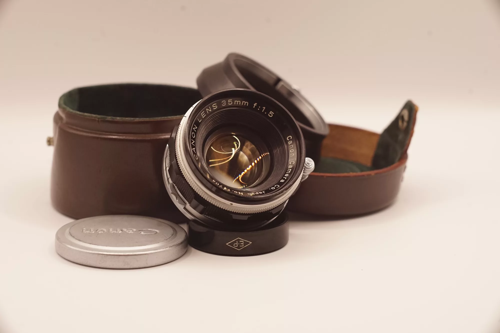
Original caps, filters, hood and finder can add practical and collector value, but accessories do not prove the identity of the optical unit. Serial number, engravings and physical construction remain the more reliable evidence.
Sources
- Canon Camera Museum, *Serenar 35mm f/3.2*global.canon →
- FlynnGraphics, *Canon S Series Lenses*flynngraphics.ca →
- Pentax Lens Research Group, *Canon Serenar 35mm f/3.2 Patent Data*pentaxlens.hatenablog.com →
- Antiquary, *Canon and Serenar 35mm f/3.2 Engraving Variants*antiquary.jp →
- Rangefinder Forum, *Serenar 35mm f/3.2*rangefinderforum.com →
Where to buy
Canon Serenar 35mm f/3.2: frequently asked
What filter size does the Canon Serenar 35mm f/3.2 take?
The Canon Serenar 35mm f/3.2 takes 34 mm screw-in filters (E34).
How close does the Canon Serenar 35mm f/3.2 focus?
The Canon Serenar 35mm f/3.2 focuses down to 1 m, and the rangefinder stays coupled over the whole range.
How heavy is the Canon Serenar 35mm f/3.2?
The Canon Serenar 35mm f/3.2 weighs 165 g, lighter than 33% of the 30 other 35mm LTM-mount lenses in the catalogue.
Which cameras does the Canon Serenar 35mm f/3.2 fit?
The Canon Serenar 35mm f/3.2 is a Leica screw-mount (M39/LTM) lens. It fits Leica M bodies with a screw-to-M adapter, which keeps rangefinder coupling, and mirrorless cameras with an M39 adapter. It carries no 6-bit code, so select the lens profile by hand on a digital M.
When was the Canon Serenar 35mm f/3.2 made?
The Canon Serenar 35mm f/3.2 was produced from 1951.
How does the Canon Serenar 35mm f/3.2 compare to the Canon Serenar 35mm f/3.5?
The Canon Serenar 35mm f/3.5 is 0.3 stops slower (f/3.5 against f/3.2).
Related lenses
Similar lenses you might be interested in
Comments