Best price
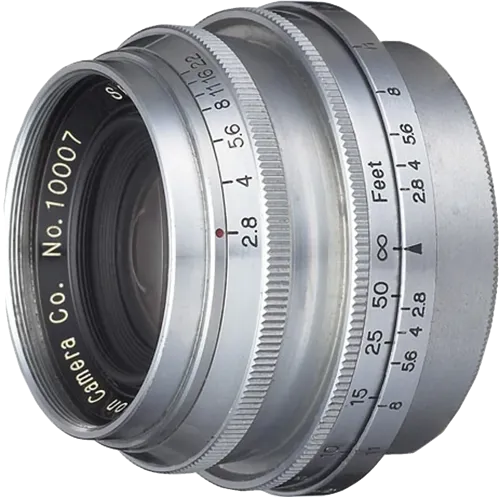
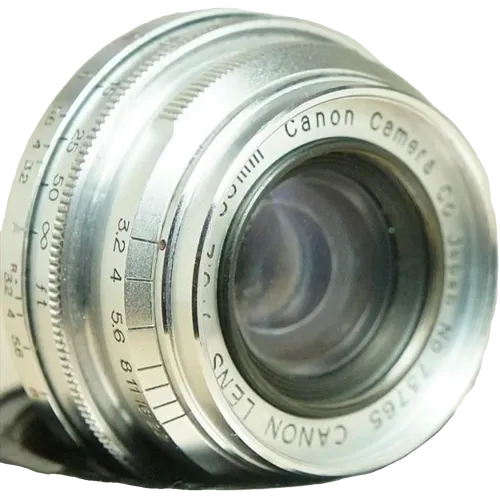
Canon 35mm f1.8 LTM - Leica mount
Sold by One Of Many Cameras
€626 ≈ $676
The Canon 35mm f/1.8 is a fast LTM screw-mount rangefinder wide-angle from the late 1950s, valued by collectors for its compact build and vintage rendering.
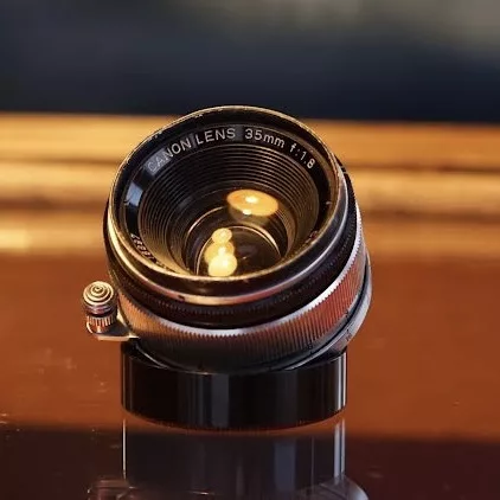
LTM mount
The Canon 35mm f/1.8 is a LTM-mount lens for Leica rangefinder cameras. As of October 2026, it sells from €626 used across 1 listing, with a 30-day median of €626. Leica price index →
Measured against the 45 other 35mm LTM-mount lenses in the catalogue.
Among Canon's screw-mount wide-angles, the 35mm f/1.8 stood out for its speed: when it appeared it was one of the fastest 35mm lenses available for Leica thread mount rangefinders, second within Canon's own line only to the rare 35mm f/1.5 [3]. It was introduced in 1957 for the M39 Leica screw mount, the system Canon used across its rangefinder bodies of the era [1]. Despite the bright aperture, the lens is notably small and light, a quality users still cite when assembling compact travel and street kits [2].
Optically the lens uses a seven-element design arranged in four groups, focusing down to one meter, and was sold in a chrome metal barrel. As an LTM lens it threads directly onto Leica screw mount bodies and, with an adapter, onto Leica M and mirrorless cameras, although focusing relies on the host camera's rangefinder rather than any electronic coupling. The compact dimensions and modest weight make it easy to carry, and the all-metal construction is consistent with Canon's rangefinder lenses of the late 1950s.
Rendering User accounts describe a lens with a vintage but versatile character. Owners report that it is sharp in the center even wide open, while the corners stay soft until the aperture is closed down; by f/2.8 to f/4 performance becomes good across the frame. The rendering is often called moderate in contrast and pleasantly old-fashioned, working particularly well in black and white.
Bokeh and transitions Wide open, the out-of-focus areas are sometimes described as nervous and slightly swirly in busy backgrounds, contributing to a distinctive look that some shooters seek out for portraits.
Flare resistance Flare is the lens's most-cited weakness. Several users warn against shooting toward bright light sources such as open windows or doors, where the lens can flare strongly, and they note that the later Canon 35mm f/2 generally resists flare better.
Collector and user notes Opinion is divided on how the f/1.8 compares with the later 35mm f/2: some find the f/2 more modern and contrastier, while side-by-side tests have shown the two can look surprisingly similar, especially in the center.
Development and Launch The 35mm f/1.8 was introduced in 1957 as a fast wide-angle for Canon's Leica screw mount rangefinder system. At launch its f/1.8 aperture placed it near the top of the available 35mm options for the mount, behind only the faster and scarcer Canon 35mm f/1.5. It sits within a broad family of Canon rangefinder 35mm lenses produced during the rangefinder era, which spanned apertures from roughly f/1.5 to f/2.8.
Collector Notes As with most rangefinder lenses of this age, condition matters more than the model itself. Buyers should check the glass for haze, cleaning marks, and fungus, and confirm that the aperture and focus operate smoothly, since these are common issues in late-1950s screw-mount lenses. The lens is sometimes confused with the later, more modern-rendering Canon 35mm f/2 LTM, so verifying the engraved maximum aperture is worthwhile before purchase. One reported figure to be aware of: a dealer listing cites ten aperture blades and an overall barrel size of 54 by 28 mm, which differs from the nine-blade figure recorded here; sources vary on these details and the verified specifications should take precedence.
About the usual price. The lowest listing is around the 30-day average.
Over the last 18 weeks the median price for the Canon 35mm f/1.8 has risen, ranging from €399 to €652 (now €626).
Weekly price (EUR). Median (Good or better) and lowest (Good or better) across 18 weeks. The full figures follow in the table below.
| Week | Median | Lowest |
|---|---|---|
| Jun 1, 2026 | €399 | €399 |
| Jun 8, 2026 | €399 | €399 |
| Jun 15, 2026 | €399 | €399 |
| Jun 22, 2026 | €432 | Unknown |
| Jun 29, 2026 | €432 | Unknown |
| Jul 6, 2026 | €456 | Unknown |
| Jul 13, 2026 | €456 | Unknown |
| Jul 20, 2026 | €634 | Unknown |
| Jul 27, 2026 | €640 | Unknown |
| Aug 3, 2026 | €643 | Unknown |
| Aug 10, 2026 | €645 | Unknown |
| Aug 17, 2026 | €652 | Unknown |
| Aug 24, 2026 | €649 | Unknown |
| Aug 31, 2026 | €648 | Unknown |
| Sep 7, 2026 | €646 | Unknown |
| Sep 14, 2026 | €639 | Unknown |
| Sep 21, 2026 | €636 | Unknown |
| Sep 28, 2026 | €626 | Unknown |
Every shop grades differently. Leica Classic uses letters, Ffordes uses E++ and E+, German dealers write "Zustand B", Japanese dealers write A−. We map all of them onto the one ladder below. Where a shop states its own grade, we print it under ours.
As of October 2026, the Canon 35mm f/1.8 sells from €626 used, with a 30-day median of €626, across 1 active listing.
As of October 2026, the Canon 35mm f/1.8 is sold by 1 source (1 listing), from €626 used: all compared cheapest-first on this page.
Similar lenses you might be interested in
Comments