Best price Mint
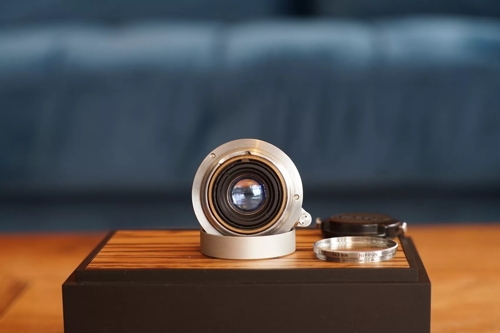
Nikon 3,5cm f1,8 W-Nikkor-C Screw mount “Nippon-Kogaku” rare lens with very uncommon-rare original Nikon lens hood, caps and leather case Mint- / Call or email for more info
Sold by Classic Connection
€4,351 ≈ $4,699
Nippon-Kogaku's W-Nikkor.C 35mm f/1.8, the world's first f/1.8 wide-angle, is a collectible LTM rangefinder lens prized for its symmetric design.
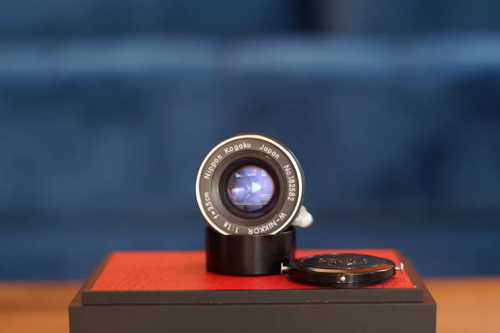
LTM mount
The Nippon-Kogaku W-Nikkor.C 35mm f/1.8 is a LTM-mount lens for Leica rangefinder cameras. As of October 2026, it sells from €4,351 used across 1 listing, with a 30-day median of €4,351. Leica price index →
Measured against the 45 other 35mm LTM-mount lenses in the catalogue.
When it appeared in 1956, this lens was the fastest wide-angle in the world, the first 35mm-class optic to reach f/1.8 at a time when most competing 3.5cm lenses topped out between f/3.5 and f/2.5 [1][2]. It was a showcase product for Nikon's rangefinder system, conceived around the Nikon S2 and the SP and S3 cameras that followed, and it took rivals such as Ernst Leitz several more years to field comparable speed. The optical design was completed in the winter of 1955 by Hideo Azuma of Nippon Kogaku's optical design section, who filed a patent for the large-diameter wide-angle in 1956 and received a U.S. patent in 1959. Although best known in Nikon's S bayonet, it was also produced in Leica screw mount, and on LeicaLensList it is catalogued in its LTM form, a non-rangefinder-coupled, chrome-finished lens.
The optical formula uses seven elements in five groups arranged on a symmetric, modified double-Gauss layout, with a rear cemented doublet and a strongly curved rear group acting as a field flattener. Azuma's design drew on then-new lanthanum (rare-earth) glass to control spherical aberration and field curvature, a glass type that is mildly radioactive and can yellow slightly with age. Elements were single-coated, showing the characteristic blue and amber reflections of the period[3]. The barrel is all-metal with engraved markings, a nine-blade diaphragm clicking in full stops to f/22, and an aperture ring that rotates with focusing. It takes 43mm filters on a fine-pitch internal thread, with a separate outer thread for the snap-on hood and cap. The LeicaLensList record lists a 1.07 m close-focus figure for this lens; the Leica-thread original itself focuses to roughly 0.9 m and is not rangefinder-coupled when adapted onto Leica M bodies, since its large rear group does not clear the M mount directly.
Identification turns largely on the "C" suffix and serial numbers. Like other early Nikon rangefinder lenses, the "C" denoted "coated," advanced for the era, and was dropped around 1957 once coating had become universal. The first few examples carried black-painted aperture rings before Nikon standardized on chrome for the bulk of production. The LTM version was made in far smaller numbers than the S-mount lens, with collector sources citing on the order of 1,500 screw-mount examples, which contributes to its desirability.
Rendering The lens is described by Nikon as a low-distortion design with very low lateral chromatic aberration, a flat field, and minimal astigmatism to the edges, traits that follow from its symmetric construction. Near maximum aperture there is a slight contrast drop from coma flare and a soft, veil-like quality, while definition remains crisp; out-of-focus rendering is reported as smooth, with point light sources kept natural rather than distorted. Some falloff of peripheral illumination is present wide open, as is common for symmetric wide-angle rangefinder lenses, and it clears as the lens is stopped down.
Sharpness Reviewers report strong central sharpness that improves steadily on stopping down, with the corners cleaning up by around f/4; the main practical limit wide open is field curvature rather than a lack of resolution.
Distortion and vignetting Distortion is effectively absent, a benefit of the symmetric layout and the freedom rangefinder designs have from retrofocus compromises. Vignetting is visible at f/1.8 and is largely gone by f/4.
Flare resistance Compared with other fast wide-angles of its day, it uses relatively few elements and shows good resistance to ghosting.
Digital use The lens has been adapted to mirrorless cameras, and one rehousing specialist has rebuilt examples into a new brass barrel with a closer, rangefinder-coupled focusing range for use on Leica M and digital bodies.
Development and Launch Designed under Hideo Azuma and finalized in late 1955, the W-Nikkor 3.5cm f/1.8 was announced in 1956 and reached the market that September as the world's brightest wide-angle. Azuma was an experienced Nikkor designer who, the manufacturer notes, helped lay the foundation for aberration balancing within the company, and his work on this lens was recognized through a granted patent. It sat at the top of Nikon's 3.5cm rangefinder line, above the four-element f/3.5 Tessar-type and the six-element f/2.5.
Production Evolution Across its run the lens saw small cosmetic and engraving changes rather than optical revisions. Early lenses had black aperture rings before chrome became standard, the "C" designation was dropped around 1957, and Nikon revised the style of certain engraved characters at higher serial numbers. Production of the original is generally placed between 1956 and the mid-1960s, after which Nikon's rangefinder business gave way to the SLR era.
Special editions In 2005 Nikon produced a limited reissue of the 3.5cm f/1.8 to accompany its commemorative remake of the Nikon SP, sold only as a kit, by lottery, and direct in Japan, with about 2,500 made. The reissue can be distinguished by a four-digit serial number (originals use six digits), a black aperture ring, a meters-only scale, a coarser 43mm filter thread, and modern green multicoating in place of the original single coating.
Collector Notes The clearest authenticity check is the serial number, with original lenses in a six-digit range and the 2005 edition in four digits. Buyers should be aware that the lanthanum glass can yellow over time, an effect that can sometimes be reduced with ultraviolet exposure and that some shooters find pleasing rather than harmful. The matching snap-on hood (Nikon's AC-521) and the early metal rear cap are sought after and often missing, and the unusual dual filter and hood thread arrangement is worth confirming before fitting accessories. LTM examples are scarcer than S-mount ones and command interest accordingly; note also that the lens does not couple to a Leica rangefinder without modification because of its deep rear group.
About the usual price. The lowest listing is around the 30-day average.
Over the last 6 weeks the median price for the Nippon-Kogaku W-Nikkor.C 35mm f/1.8 has fallen, ranging from €4,351 to €4,599 (now €4,351).
Weekly price (EUR). Median (Good or better) and lowest (Good or better) across 6 weeks. The full figures follow in the table below.
| Week | Median | Lowest |
|---|---|---|
| Jun 1, 2026 | €4,599 | €4,599 |
| Jun 8, 2026 | €4,599 | €4,599 |
| Jun 15, 2026 | €4,599 | €4,599 |
| Jun 22, 2026 | €4,599 | €4,599 |
| Jun 29, 2026 | €4,599 | €4,599 |
| Jul 6, 2026 | €4,351 | €4,351 |
Every shop grades differently. Leica Classic uses letters, Ffordes uses E++ and E+, German dealers write "Zustand B", Japanese dealers write A−. We map all of them onto the one ladder below. Where a shop states its own grade, we print it under ours.
As of October 2026, the Nippon-Kogaku W-Nikkor.C 35mm f/1.8 sells from €4,351 used, with a 30-day median of €4,351, across 1 active listing.
As of October 2026, the Nippon-Kogaku W-Nikkor.C 35mm f/1.8 is sold by 1 source (1 listing), from €4,351 used: all compared cheapest-first on this page.
Similar lenses you might be interested in
Comments