Best price Heavily Used
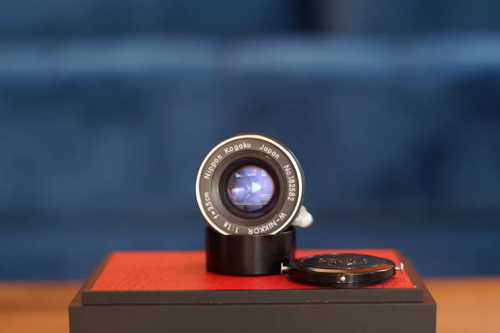
Nikon W-Nikkor 2.5 / 35mm lens in Leica screw mount, Black rim
Sold by Fotohandel Delfshaven
€416 ≈ $449
Nippon-Kogaku's W-Nikkor.C 3.5cm f/2.5 is a compact six-element LTM wide-angle, a brass-built rangefinder favorite prized for its handling and classic rendering.
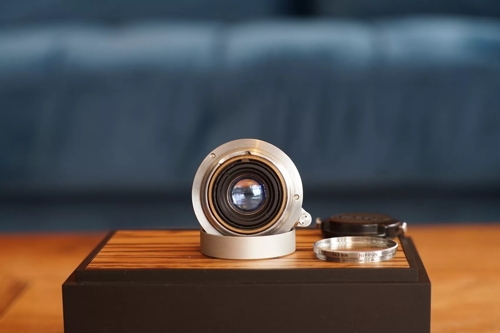
LTM mount
The Nippon-Kogaku W-Nikkor.C 3.5cm f/2.5 is a LTM-mount lens for Leica rangefinder cameras. As of October 2026, it sells from €416 used across 4 listings, with a 30-day median of €463. Leica price index →
Measured against the 45 other 35mm LTM-mount lenses in the catalogue.
One of Nikon's better-selling rangefinder wide angles, the W-Nikkor.C 3.5cm f/2.5 occupies the practical middle ground in the company's 35mm lineup, faster and more useful in low light than the modest f/3.5, yet far cheaper and far more common than the prized f/1.8 [2]. The "C" in the name follows a convention Nikon borrowed from Zeiss to mark a coated lens, a designation later dropped once coating became standard across the catalogue. Although best known to many collectors in Nikon's own S bayonet, it was also produced in Leica thread mount, and that screw-mount version became a long-running favorite for use on Barnack and later Leica bodies.
The lens uses a six-element, four-group design with a near-symmetrical, non-retrofocus layout, a configuration Nikon applied to several of its wide-angle lenses of the era. Built largely of brass with chrome and nickel plating, it feels solid and old-fashioned in the hand despite its small size, projecting only a short distance from the camera mount [1]. The LTM version carries an infinity lock, which matters when choosing an adapter, since it needs the cut-away type to release. Focusing is smooth with a roughly 180-degree throw typical of thread-mount lenses, the eight-blade diaphragm clicks in full stops down to f/22, and the front does not rotate when the aperture is changed, so graduated filters behave predictably. On a digital Leica M body it needs only an LTM-to-M adapter to bring up the 35mm framelines and couple to the rangefinder, and the lens is small enough to stay almost entirely clear of the finder view.
There are minor barrel variations worth knowing. The screw-mount lens appeared in chrome and later in a chrome finish with a black band, and Richard Haw notes that the barrel received a mid-1950s makeover in which it was painted black and the aperture numbers were moved to the outer rim of the aperture ring, improving handling. Because the various W-Nikkor 3.5cm lenses share similar barrels and the same basic schematic, they can be hard to tell apart at a glance, so close inspection of the engravings is advised.
Rendering Documented impressions come mainly from black-and-white digital use on a Leica M Monochrom. The lens is described as more than sufficiently sharp in the centre with good rendering of texture, falling off somewhat in the corners but not drastically, and acceptable across the frame at working apertures. Distortion is reported as not noticeable, which is expected of a near-symmetrical non-retrofocus design, and vignetting is low to moderate. Contrast is considered good for a lens of this age, the single coating handles strong red filters well, and flare resistance is regarded as impressive even without a hood. Out-of-focus rendering is described as nervous, in keeping with the lens's classic, imperfect character, though for a wide angle this is rarely a primary concern.
Development and Launch By the 1940s and 1950s Nikon was an established maker whose rangefinder system followed the Zeiss Contax approach rather than the Leica one, and many of its early lens formulas drew on Zeiss designs while aiming to refine them. Within this system the f/2.5 was positioned as the sensible everyday 35mm: at a time when most wide lenses topped out around f/3.5 to f/5.6, its f/2.5 maximum aperture counted as fast and broadened its usefulness, while its price sat well below the faster f/1.8.
Production Evolution The chief documented changes are cosmetic and ergonomic. The screw-mount lens was offered in chrome and later in chrome with a black band, and the barrel was reworked around the mid-1950s with a black-painted finish and aperture figures relocated to the outer rim of the aperture ring.
Collector Notes Buyers of the LTM version should confirm that any adapter accommodates the infinity lock by using the cut-away type. The original filter thread is awkward to source, so collectors commonly fit A36 clamp-on filters and an A36-to-39mm step adapter, and a Leitz FOOKH hood intended for the Summaron and Elmar 3.5cm lenses fits without darkening the corners, sparing the cost of the scarce genuine Nikon hood. Because the W-Nikkor 3.5cm lenses look alike, verify exactly which version a barrel represents before buying. As a single-coated brass lens of this age, condition of the glass and coating is worth checking. One note on data: published enthusiast sources sometimes cite a 34.5mm filter thread and an earlier introduction than the production span recorded here, so verify physical details against the specific copy.
Good time to buy. The lowest listing is 10% below the 30-day average.
Lowest price Click a mark to open that listing · arrow keys to step, Enter to open
Price against condition for 4 listings of Nippon-Kogaku W-Nikkor.C 3.5cm f/2.5, €416 to €1,246, median €463. Mint: 1 at €1,246. Fair: 2 at €463, €463. Heavily Used: 1 at €416. The full table follows.
| Condition | Lowest | Median |
|---|---|---|
| Mint | €1,246 | €1,246 |
| Fair | €463 | €463 |
| Heavily Used | €416 | €416 |
Over the last 4 weeks the median price for the Nippon-Kogaku W-Nikkor.C 3.5cm f/2.5 has risen, ranging from €308 to €463 (now €463).
Weekly price (EUR). Median (Good or better) and lowest (Good or better) across 4 weeks. The full figures follow in the table below.
| Week | Median | Lowest |
|---|---|---|
| Jun 1, 2026 | €308 | €308 |
| Jun 8, 2026 | €308 | €308 |
| Jun 29, 2026 | €463 | €463 |
| Sep 28, 2026 | €1,246 | €1,246 |
Every shop grades differently. Leica Classic uses letters, Ffordes uses E++ and E+, German dealers write "Zustand B", Japanese dealers write A−. We map all of them onto the one ladder below. Where a shop states its own grade, we print it under ours.
As of October 2026, the Nippon-Kogaku W-Nikkor.C 3.5cm f/2.5 sells from €416 used, with a 30-day median of €463, across 4 active listings.
As of October 2026, the Nippon-Kogaku W-Nikkor.C 3.5cm f/2.5 is sold by 2 sources (4 listings), from €416 used: all compared cheapest-first on this page.
Similar lenses you might be interested in

Comments