Best price Excellent
Jupiter 12 35mm f2.8 LTM
Sold by Camera Obscura Elburg
€130 ≈ $140
The KMZ Jupiter-12 35mm f/2.8 is a compact Soviet Biogon-derived rangefinder lens produced in both M39 and Contax/Kiev mounts, recognised by its deeply projecting rear element and classic low-contrast rendering
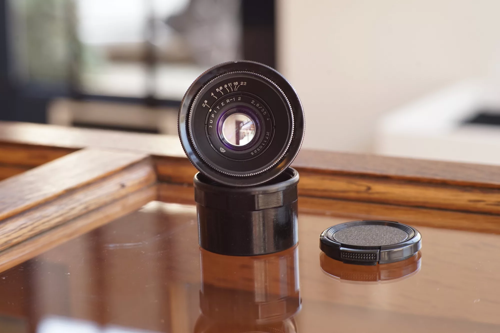
LTM / Contax RF mount
The KMZ Jupiter-12 35mm f/2.8 is a LTM / Contax RF-mount lens for Leica rangefinder cameras. As of October 2026, it sells from €130 used across 1 listing, with a 30-day median of €130. Leica price index →
Measured against the 50 other 35mm lenses in the catalogue.
The KMZ Jupiter-12 35mm f/2.8 is a Soviet wide-angle rangefinder lens derived from the pre-war Carl Zeiss Jena Biogon 35mm f/2.8. It retains the Biogon's characteristic six-element, four-group construction, with a small front element and a large rear element positioned unusually close to the film plane.
Factory versions were produced in both M39 screw mount and Contax/Kiev bayonet mount. The two versions share the same basic optical identity and are therefore covered by a single profile. Both are rangefinder coupled and contain their own focusing mechanism. The Contax/Kiev version attaches to the camera's external bayonet rather than using the internal focusing mount employed by standard 50mm Contax lenses.
The aperture is controlled by a narrow, clickless ring surrounding the recessed front element. This ring also carries the filter fitting, so rotating a mounted filter can unintentionally change the aperture. Most versions use a five-blade diaphragm.
Rendering
The Jupiter-12 combines useful central definition with the lower contrast and softer outer-field rendering associated with many early coated wide-angle lenses. At f/2.8, the centre can be reasonably detailed, while field curvature and weaker corners remain visible. Stopping down improves contrast and overall uniformity.
Distortion and vignetting
Distortion is generally modest, although examples can show slight pincushion distortion rather than the more usual barrel distortion. Vignetting is visible at the widest apertures but is not normally the lens's most prominent optical limitation.
Flare resistance
The deeply recessed front element provides some physical protection, but the coatings remain vulnerable to strong light. Bright sources inside or just outside the frame can cause ghosting and a noticeable reduction in contrast.
Digital use
The large projecting rear element creates compatibility problems on some digital cameras and adapters. It can interfere with internal camera parts or sensor surrounds, and digital sensors can emphasise corner smearing, field curvature and colour shifts that are less obvious on film. Physical clearance should always be checked before mounting the lens.
No meaningful optical difference between the original M39 and Contax/Kiev versions has been established. Sample condition, alignment and previous servicing usually have a greater effect on results than the factory mount.
Development and Launch
The lens originated immediately after the Second World War, when Soviet factories began producing optics based on Zeiss designs and equipment. The earliest Contax/Kiev examples appeared under the BK-35 designation in approximately 1947–1948. These early lenses are reported to have been assembled partly or entirely from German optical glass.
The Jupiter-12 name appeared around 1950. The design subsequently became available for both the Kiev rangefinder system and M39 cameras such as the FED and Zorki.
Production Evolution
Production was spread across several factories. Early examples were made by KMZ, later versions were manufactured by LZOS, and Arsenal also produced lenses for Kiev cameras.
Early Contax/Kiev examples are documented with a minimum focusing distance of approximately 0.9 metres. Many later examples are marked or specified at approximately 1 metre. This should be treated as production evolution rather than a reason to divide the lens solely by mount.
Finishes include early polished aluminium barrels, later silver versions and black LZOS lenses. Many Soviet serial numbers begin with two digits corresponding to the production year, although this convention is not completely reliable for every factory and period.
Collector Notes
Collectors should verify whether a lens is M39 or Contax/Kiev before purchasing. The mount is especially important because of compatibility differences and the unusually deep rear element.
M39 examples can require calibration when used on Leica bodies. Soviet rangefinder lenses were manufactured around Contax-derived focusing assumptions, and individual examples may not track perfectly across the complete focusing range on a Leica camera.
Common mechanical problems include dried lubricant, stiff focusing, chipped internal paint and a loose or easily displaced aperture ring. Optical inspection should concentrate on haze, coating damage and element alignment.
No formal commemorative or separately catalogued special edition is confirmed. The BK-35, BK Zorki, early Jupiter-12 and later KMZ, LZOS and Arsenal versions represent production stages and factory variants rather than special editions.
About the usual price. The lowest listing is around the 30-day average.
Over the last 17 weeks the median price for the KMZ Jupiter-12 35mm f/2.8 has fallen, ranging from €125 to €159 (now €130).
Weekly price (EUR). Median (Good or better) and lowest (Good or better) across 17 weeks. The full figures follow in the table below.
| Week | Median | Lowest |
|---|---|---|
| Jun 1, 2026 | €132 | €132 |
| Jun 8, 2026 | €132 | €132 |
| Jun 15, 2026 | €132 | €132 |
| Jun 22, 2026 | €132 | €132 |
| Jun 29, 2026 | €132 | €132 |
| Jul 6, 2026 | €159 | €159 |
| Jul 13, 2026 | €158 | €158 |
| Jul 20, 2026 | €158 | €158 |
| Aug 3, 2026 | €133 | Unknown |
| Aug 10, 2026 | €134 | Unknown |
| Aug 17, 2026 | €135 | €135 |
| Aug 24, 2026 | €135 | €135 |
| Aug 31, 2026 | €130 | €125 |
| Sep 7, 2026 | €134 | €134 |
| Sep 14, 2026 | €133 | €133 |
| Sep 21, 2026 | €132 | €132 |
| Sep 28, 2026 | €130 | €130 |
Every shop grades differently. Leica Classic uses letters, Ffordes uses E++ and E+, German dealers write "Zustand B", Japanese dealers write A−. We map all of them onto the one ladder below. Where a shop states its own grade, we print it under ours.
As of October 2026, the KMZ Jupiter-12 35mm f/2.8 sells from €130 used, with a 30-day median of €130, across 1 active listing.
As of October 2026, the KMZ Jupiter-12 35mm f/2.8 is sold by 1 source (1 listing), from €130 used: all compared cheapest-first on this page.
Similar lenses you might be interested in
Comments