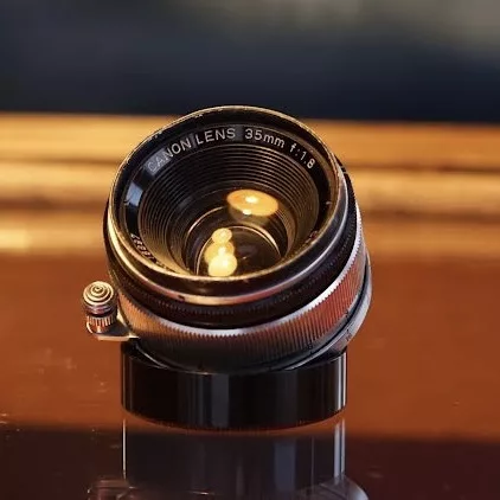
A 1951 Canon Serenar 35mm f/2.8 wide-angle with six elements in four groups, coupled LTM focusing, 1m close focus and a compact chrome barrel.
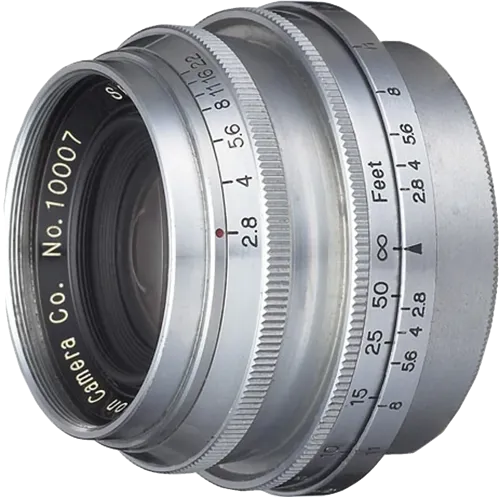
Canon Serenar 35mm f/2.8 I
LTM mount
No listings tracked for this lens right now.
The Canon Serenar 35mm f/2.8 I is a LTM-mount lens for Leica rangefinder cameras. Leica price index →
How it compares
Measured against the 45 other 35mm LTM-mount lenses in the catalogue.
Specification
About this lens
Canon Serenar 35mm f/2.8 I
The Canon Serenar 35mm f/2.8 I is an early postwar Japanese wide-angle lens marketed in October 1951. Canon records a six-element, four-group optical system in a compact screw-mount rangefinder barrel. The lens focuses to 1 metre, accepts 34mm filters and provides aperture settings down to f/22. Its listed dimensions are 48mm in diameter by 25.5mm long, with a weight of 165g.
This profile covers the first factory-designated 35mm f/2.8, identified by its Serenar name and chrome construction. It remains separate from the Canon 35mm f/2.8 II introduced in 1957. Although Canon lists six elements in four groups for both, the later model has a revised barrel, a 40mm filter thread, different dimensions and Canon rather than Serenar branding.
Optical qualities
Rendering
Canon's published diagram count establishes six elements in four groups, but the online museum does not provide factory resolution, distortion or illumination curves. The description therefore avoids assigning fixed modern performance scores. As a moderate-speed 35mm lens from the early coated era, its visible contrast and edge definition depend on both the design and the condition of an individual example.
The 35mm focal length gives a wider field than a standard 50mm lens while retaining a natural perspective when the camera is kept level. It is useful for environmental portraits, streets, interiors and travel. On surviving lenses, haze, coating wear, element separation or incorrect spacing can have a greater effect than modest differences between apertures.
At f/2.8
At maximum aperture the lens offers more light and less depth of field than a slower period wide-angle. Accurate rangefinder agreement remains important at close and middle distances, even though a 35mm lens is more forgiving than a fast telephoto. Focus should be checked on a detailed subject rather than judged only from the distance scale.
No diaphragm blade count is supplied by Canon for this exact version. Highlight shape and stopped-down aperture geometry should therefore not be inferred from unsourced specification tables. A correctly fitted hood can reduce oblique flare, but it cannot remedy internal haze or damaged coatings.
Stopped down
Closing the aperture increases depth of field and normally improves consistency away from the centre. Canon provides settings through f/22. Middle apertures are suitable when foreground and background detail must remain legible, while the smallest setting gives maximum depth at the expense of increasing diffraction.
Handling and compatibility
At 165g and only 25.5mm long, the Serenar is compact on a Canon or Leica-standard screw-mount rangefinder. The native focusing cam should operate the camera rangefinder when both lens and body are correctly calibrated. Bodies without a 35mm frame require an accessory finder or another reliable framing method.
The 34mm front thread is specific to this first version and should not be confused with the 40mm fitting of Type II. An LTM-to-M adapter provides the bayonet interface on a Leica M body and may call up a suitable frame, but it cannot correct a worn or misadjusted coupling cam.
History
Development and Launch
Canon marketed the Serenar 35mm f/2.8 I in October 1951, during the rapid expansion of its postwar screw-mount camera system. Canon's historical archive explains that Serenar was its in-house lens brand and that the name had been chosen to suggest clarity and calm. By the early 1950s Canon was manufacturing a broad range of its own interchangeable lenses rather than depending on outside supply.
The lens belongs to Canon's standard-thread rangefinder system, which the company dates broadly from 1946 to 1964. Its launch coincided with a period in which Canon expanded its rangefinder system and international ambitions.
Production Evolution
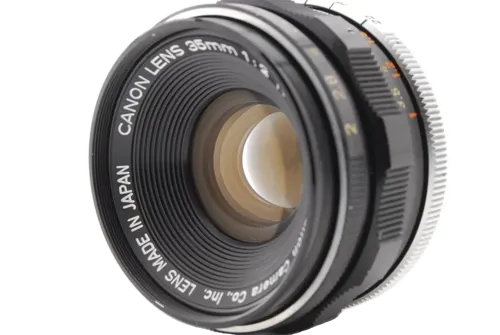
Canon records the first version at 48 by 25.5mm and 165g with a 34mm filter fitting. The Canon 35mm f/2.8 II followed in January 1957. It retained the recorded six-element, four-group count and 1m close-focus limit, but grew to 30.2mm in length, adopted a 40mm filter thread and reduced weight to 125g.
Canon's corporate history places the change from Serenar to Canon lens branding in 1953. The Type I therefore represents the earlier brand period, whereas the Type II carries the later Canon identity. A shared element count is not proof that every glass type, curvature or spacing remained unchanged, so the entry does not claim an identical optical prescription without a factory drawing.
Special Editions/Variants
No commemorative or officially named special edition of the Type I has been documented. Minor engraving, scale and coating differences may occur during production, but they require evidence before being treated as separate optical generations. The Type II is not a cosmetic subvariant within this profile because Canon marketed it as a separate version with a materially revised barrel.
Collector Notes
Identification should combine the Serenar 1:2.8 f=35mm engraving, chrome barrel, 34mm filter thread, compact 48 by 25.5mm dimensions and original coupled screw mount. A Canon-branded lens with a 40mm front fitting is the later Type II. Check that the rangefinder cam moves smoothly and agrees at infinity, middle distance and the 1m limit.
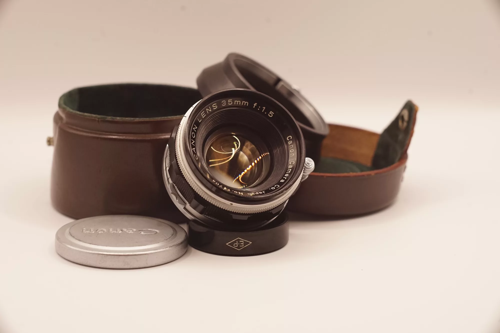
Inspect the optics for haze, fungus, separation, coating wear and signs of incorrect reassembly. The aperture should move evenly through f/22, and the focusing mount should have no damaging play. Serial numbers, included caps, auction condition and current prices describe individual copies rather than the generic model and are deliberately excluded.
Sources
Where to buy
Related lenses
Similar lenses you might be interested in
Comments