The Nippon-Kogaku W-Nikkor.C 2.8cm f/3.5 is a compact six-element 28mm LTM rangefinder lens prized by collectors for its sharpness and low distortion.
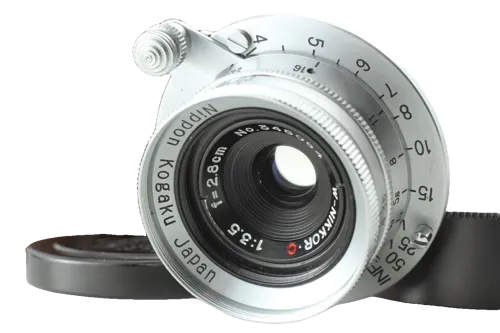
Nippon-Kogaku W-Nikkor.C 2.8cm f/3.5
LTM mount
No listings tracked for this lens right now.
The Nippon-Kogaku W-Nikkor.C 2.8cm f/3.5 is a LTM-mount lens for Leica rangefinder cameras. Leica price index →
How it compares
Measured against the 14 other 28mm LTM-mount lenses in the catalogue.
Specification
About this lens
Nippon-Kogaku W-Nikkor.C 2.8cm f/3.5
Among Nikon's early rangefinder wide-angles, the W-Nikkor.C 2.8cm f/3.5 stands out as a notably fast lens for its angle of view in an era when many 35mm-format wide-angles were limited to apertures of f/6.3 or slower [2]. It is a compact, densely built optic that derived from an aerial photography lens Nippon Kogaku had developed for military use, a design valued for low distortion and good resolution that was miniaturized into this small rangefinder lens. Sources describe a single-coated, symmetrical, non-retrofocus configuration with six elements, an Orthometar-type layout adapted to the short 28mm focal length [1].
The barrel was based closely on that of the W-Nikkor.C 3.5cm f/3.5, so the two lenses look almost identical and share their handling, to the point that they are easy to confuse. The lens is small enough to slip into a pocket yet feels heavy and solid because of its brass construction, which lends a strong perception of durability. It uses an eight-bladed straight-edged aperture that stops down to f/22 in full-stop clicks, has a focus throw of roughly 180 degrees, an infinity lock, and a minimum focusing distance near one metre; its filter thread is 34.5mm and the front accepts A36 slip-on filters or a SOOGZ adapter. The compact barrel does not block the rangefinder window, and because the lens is wide it requires an accessory viewfinder, although the Nikon SP's built-in wide finder covers the 28mm field of view.
The lens was produced in both Leica thread mount (LTM) and Nikon S bayonet form. The LTM version adapts cleanly to digital Leica M bodies and will bring up the 28mm frame lines with the correct adapter, provided it has the cutaway that clears the infinity lock; the S-mount version can interfere with the focusing cam at shorter distances, so the screw-mount example is generally preferred for use on Leica M cameras. Two main S-mount variants are documented, an early chrome barrel and a later black-barrel version, with the LTM version regarded as the scarcer of the family.
Optical qualities
Rendering Documentation of this lens is limited, but reviewers consistently praise its sharpness and distortion control while noting clear limits from its early single coatings. Reviewers describe a sharp, contrasty image with a natural rendering of in-focus subjects, an effect sometimes called a vintage look, set against weak flare resistance.
Sharpness The lens is reported to be sharp wide open at the centre, with the centre changing little on stopping down; corners improve by f/5.6 and the lens reaches its best edge-to-edge performance around f/8, where sharpness across the frame is considered a particular strength.
Distortion and vignetting Distortion control is regarded as excellent, with lines staying largely straight even near the frame edges, an unusual trait for a wide-angle of its age. Vignetting, by contrast, is pronounced wide open and does not fully clear even when stopped down.
Flare resistance Flare and ghosting are described as the lens's chief weakness; despite the red "C" coating designation in its name, the coatings are basic by modern standards and can produce ghosts and colored artifacts when shooting toward the sun.
Aberrations Chromatic aberration is generally hard to detect, while a small amount of spherical aberration is visible in some images and is considered mild overall.
History
Development and Launch The optical design traces back to an aerial photography lens Nippon Kogaku built for the Imperial Japanese military, prized for its low distortion and resolution, which was scaled down for 35mm rangefinder use. On release it was considered the fastest lens of its class, a meaningful advance when comparable wide-angle lenses were much slower. Published sources commonly cite a 1952 debut for the original lens; dates given for the various mount versions vary between references.
Production Evolution The lens appeared in Nikon S bayonet and Leica thread mount forms. Two principal S-mount variants are recorded, an earlier chrome-barrel example and a later black-barrel version, while the LTM example is the less common of the group.
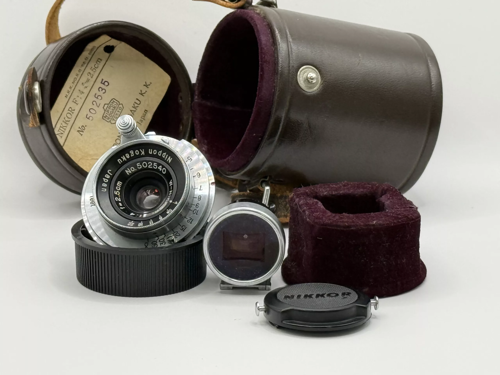
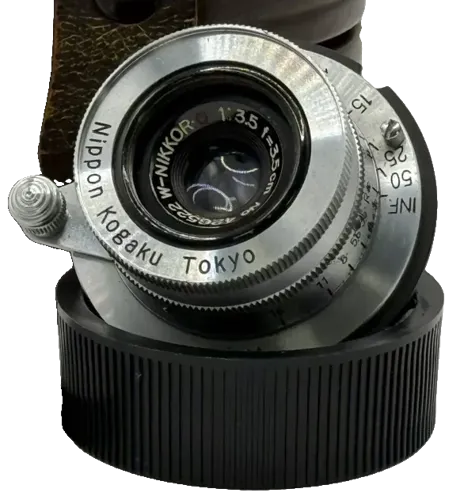
Collector Notes Because the barrel was shared with the W-Nikkor.C 3.5cm f/3.5, the two are easy to mistake for one another, so buyers should confirm the focal-length engraving. For use on Leica M, the LTM version is preferable, since the S-mount lens can foul the rangefinder cam at close distances, and adapting to digital M for 28mm frame lines requires the version with the infinity-lock cutaway. Given the early coatings, haze and the lens's inherent flare tendency are worth checking, and a daylight filter can help with veiling in bright scenes. Original hoods are scarce and command high prices, and the 34.5mm filter thread and A36 accessories can be difficult to source, so it is worth confirming which accessories accompany a lens before purchase.
Sources
Where to buy
Related lenses
Similar lenses you might be interested in
Comments