The Funky Lens List: 10 Weird and Wonderful Lenses You Can Put on a Leica
Discover 10 weird and wonderful Leica lenses, from body-cap oddities and organ transplants to Cold War glass and a 740g f/1 monster.
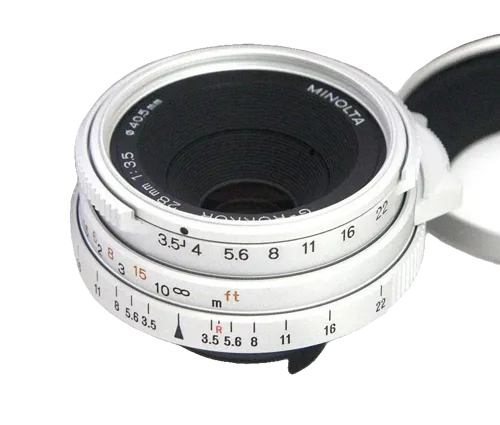
The Minolta G-Rokkor 28mm f/3.5 is a limited-run LTM rangefinder lens derived from the Minolta TC-1 compact, prized by collectors for its build and rendering.
LTM mount
No listings tracked for this lens right now.
The Minolta G-Rokkor 28mm f/3.5 is a LTM-mount lens for Leica rangefinder cameras. Leica price index →
Measured against the 14 other 28mm LTM-mount lenses in the catalogue.
The G-Rokkor 28mm f/3.5 belongs to a small group of late-1990s lenses that took the celebrated optics of high-end Japanese compact cameras and rehoused them for the Leica thread mount. Its optical formula comes directly from the Minolta TC-1, a premium 35mm compact whose fixed 28mm lens earned a strong reputation, and that pedigree is the main reason the lens is sought out today [1]. It was produced in a limited run, reported at around 2,000 units, and is often described in connection with a Minolta anniversary, which has reinforced its status as a collector item rather than a mass-market optic.
The lens uses a compact five-element, five-group design and is a genuinely small piece of glass, set into a silver barrel that carries a focus tab and a separate aperture ring. Despite the modest dimensions, reviewers note that the housing is large enough to make the controls easy to operate with the camera at the eye, and the focusing and aperture action are frequently singled out as exceptionally smooth and precise, a quality attributed to the freedom a limited edition allows in manufacturing. It is a rangefinder-coupled lens in Leica thread mount with a 40 mm filter thread, and it focuses to 0.8 m. One recurring practical observation is that the barrel sits slightly large on thread-mount Leica bodies, and several users feel the lens was designed with M-mount adaptation in mind.
A notable difference from the donor camera lies in the diaphragm. The TC-1 uses a circular aperture that produces rounded out-of-focus highlights, whereas the rehoused G-Rokkor employs a conventional iris with nine blades, so its behavior at the aperture edges differs even though the optical cells are the same. The lens has also been the subject of aftermarket conversions, with some examples of the TC-1 optics rehoused into L39 mounts by independent specialists, a point worth bearing in mind when assessing originality.
Rendering The G-Rokkor inherits the rendering character of the TC-1 lens, which combines high resolution with strong contrast and a pronounced corner falloff. One detailed user account praises it for black-and-white work in particular, describing a balance of resolution, contrast and vignetting that suits the medium well.
Distortion and vignetting A relatively strong vignette is a defining trait of the design and is reported to draw the eye toward the center of the frame.
Digital use On digital rangefinder bodies the lens shows clear limitations. A user reports a marked color shift toward the edges that camera profiles struggled to correct, and softening of the corners, including on a monochrome sensor where color shift is not a factor. This behavior is typical of a symmetrical wide-angle designed for film, and means the lens is generally happier on film than on digital sensors.
Development and Launch The G-Rokkor 28mm f/3.5 emerged during a period when manufacturers reissued the optics of their flagship compact cameras as Leica-mount special editions. The TC-1, Konica Hexar and Ricoh GR compacts were all admired for their lenses, and the 28mm f/3.5 optic of the TC-1 became the basis of this thread-mount lens, released as a limited edition reported at roughly 2,000 units.
Special editions The lens is itself effectively a special, limited production rather than a regular catalogue item, and no widely documented factory sub-variants exist beyond the standard silver LTM version. Separately, independent technicians have converted TC-1 lenses into L39 mounts, which are distinct from the factory G-Rokkor.
Collector Notes Because the factory lens was made in small numbers, condition and originality matter. Buyers should distinguish the genuine factory G-Rokkor from aftermarket conversions of the TC-1 lens. As with many older compact-derived optics, checking for haze in the cells is worthwhile before purchase; in at least one documented case a feared haze problem turned out to be minor on inspection by a repairer. The slightly oversized barrel relative to the standard LTM mount is a normal characteristic rather than a fault.
Similar lenses you might be interested in
Comments