The Ricoh GR 28mm f/2.8 is a rare LTM rangefinder lens drawn from the GR1 compact, prized by collectors of Leica screw-mount glass.
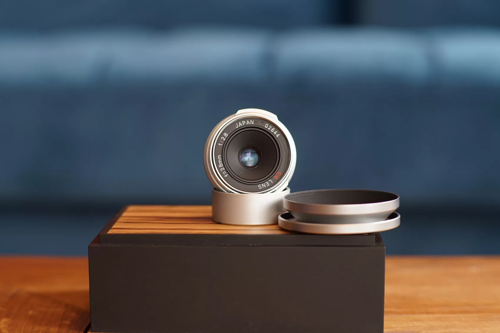
Ricoh GR 28mm f/2.8
LTM mount
No listings tracked for this lens right now.
The Ricoh GR 28mm f/2.8 is a LTM-mount lens for Leica rangefinder cameras. Leica price index →
How it compares
Measured against the 14 other 28mm LTM-mount lenses in the catalogue.
Specification
About this lens
Ricoh GR 28mm f/2.8
This lens exists because of a compact camera. Ricoh's GR1 point-and-shoot, with its fixed 28mm optic, built a strong reputation among professionals and enthusiasts through the mid-1990s, helped along by its association with photographer Daido Moriyama [1][3]. In 1997 Ricoh decided to take that lens design and offer it in a Leica screw mount, producing a standalone rangefinder lens in a class otherwise dominated by Leica, Cosina, Konica and Minolta. It was a single, short-lived project, with reportedly around 3,000 units made, split between roughly 2,000 in silver and 1,000 in black, and Ricoh did not return to rangefinder lens production afterward[2].
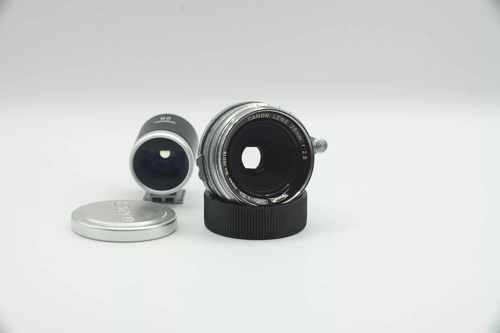
Optically the lens uses seven elements in four groups, with aspherical and multi-coated glass, and it focuses to 0.7 m. It is rangefinder coupled in Leica thread mount and can be used on Leica M bodies with an L39-to-M adapter, where a 28mm adapter is needed to bring up the correct frame lines. Reviewers consistently praise the build, describing an all-metal barrel, a well-damped focusing tab, and a precise, clicking aperture ring that many feel rivals Leica's own 28mm Elmarit despite the lens weighing only 180 g. The kit was notably complete, supplied with a dedicated 28mm optical viewfinder, a screw-in metal hood, and metal front and rear caps; the viewfinder was exclusive to the lens and not sold separately.
Because production was limited and brief, version differences are minimal; the lens is most often distinguished simply by finish, silver or black, rather than by optical or mechanical revisions. The minimum aperture is f/16, one stop short of the f/22 offered by the comparable Leica Elmarit, a point reviewers note when comparing the two.
Optical qualities
Rendering The GR 28mm is described as having a distinctive character rather than clinical precision. It can be sharp without being especially contrasty, producing a look that several reviewers call dreamy yet sharp enough, particularly when shooting toward light. Drawn from a lens designed for a small full-frame compact, it shows pronounced vignetting on a full-frame rangefinder, most visibly at infinity, and overall softness at distance even stopped down to around f/5.6. It also flares readily into bright light, which users treat as part of its character and which can be reduced with the supplied hood.
Distortion and vignetting Heavy vignetting at infinity is the most frequently cited optical trait, noticeable enough that some users consider it limiting for landscape work; one reviewer notes this falloff is not characteristic of images from the GR1 camera itself, raising questions about how directly the camera optic was adapted to the rangefinder mount.
Digital use On a full-frame digital M body the lens retains its softer, lower-contrast signature and its vignetting, giving a rendering some photographers associate with the look of the original GR1 film camera.
History
Development and Launch The lens was introduced in 1997 as an offshoot of the Ricoh GR1 compact camera, whose 28mm optic had become well regarded. Rather than design a new lens, Ricoh adapted the existing GR formula to Leica thread mount to test how it would perform on a rangefinder; the choice of LTM rather than M mount has never been clearly explained.
Production Evolution Production was a one-time run with no documented optical or coating revisions. Output was limited to roughly 3,000 units, offered in silver and black finishes, after which Ricoh ended the project and did not pursue further interchangeable rangefinder lenses.
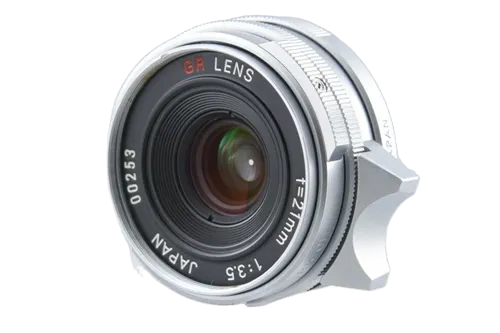
Special editions No major factory special editions are widely documented; the principal variation is finish, silver or black. A companion 21mm GR lens in LTM was also produced and is sometimes mentioned alongside it by owners.
Collector Notes Complete kits including the exclusive 28mm optical viewfinder, the metal screw-in hood, and the presentation box command particular interest, since the viewfinder was never sold separately. Buyers using the lens on a Leica M should confirm they have a 28mm L39-to-M adapter so the correct frame lines appear. Published figures for length, diameter and filter size vary slightly between sources, so dimensions are best confirmed against the specific copy.
Sources
Where to buy
Related lenses
Similar lenses you might be interested in
Comments