Best price Good
Ricoh GR Lens 21mm f/3.5 Silver L39 LTM Leica Thread Mount
Sold by Five Star Camera
€1,140 ≈ $1,231
The Ricoh GR Lens 21mm f/3.5 is a limited-production LTM ultra-wide with nine elements, ten blades and rangefinder coupling to 0.7m.
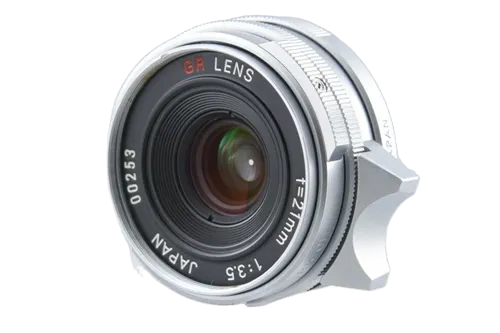
LTM mount
The Ricoh GR Lens 21mm f/3.5 L39 is a LTM-mount lens for Leica rangefinder cameras. As of September 2026, it sells from €1,140 used across 1 listing, with a 30-day median of €1,140. Leica price index →
The Ricoh GR Lens 21mm f/3.5 L39 is a limited-production ultra-wide-angle lens made for Leica screw mount cameras. It followed Ricoh’s earlier GR Lens 28mm f/2.8 L-mount project and was developed before the release of the Ricoh GR21 compact film camera. Ricoh’s own archive states that the 21mm f/3.5 L-mount interchangeable lens was released in 1999 in a limited run of 1,700 units and that its strong reception led toward the later GR21 camera .
The lens uses a 9 element, 6 group optical formula, a 10-blade diaphragm, a 40.5mm filter thread, and a compact barrel measuring 25.5mm in length and 49.5mm in maximum diameter. It weighs about 200g and focuses to 0.5m, with rangefinder coupling from infinity to 0.7m. It was supplied as a Leica L39 / LTM / M39 screw-mount lens and normally used with an external 21mm finder .
The GR Lens 21mm f/3.5 should not be merged with the lens built into the Ricoh GR21 compact camera, even though the two are historically related. The L39 version has a manual focusing mount, aperture ring, rangefinder coupling and separate lens barrel. It should also be kept separate from the Ricoh GR Lens 28mm f/2.8 L39, which has a different focal length, optical formula and production history.
Rendering
The GR Lens 21mm f/3.5 is documented as a compact, high-quality ultra-wide lens with a near-symmetrical design approach. Ricoh states that the 21mm design was arranged close to symmetrical form to minimize distortion, with separated front convex groups and individual adjustment of front and rear group barrels for best performance.
Sharpness
Modern user reports generally describe strong central resolution, with weaker edges or corners depending on camera, aperture and sensor type. Shige’s review notes a high level of center resolution on film, while also discussing digital differences between film, APS-H, APS-C and smaller sensors.
Contrast and color
The lens can give high contrast scenes a pronounced light-and-dark character. Shige’s review notes that exposure must be handled carefully in high contrast scenes to avoid black crush or blown highlights. This should be treated as practical shooting observation rather than laboratory testing.
Distortion and vignetting
Low distortion is one of the better documented traits of the design. Ricoh specifically describes the 21mm construction as minimizing image distortion, and Shige’s review also notes minimal distortion in film use. Vignetting and edge color behavior can vary by camera, especially on digital bodies.
Digital use
The lens can be used on Leica M bodies with an L39-to-M adapter and on mirrorless cameras with suitable adapters. Shige’s review notes that some cameras may show edge color cast and that aging problems such as haze or balsam separation can affect individual copies. Ricoh’s GXR compatibility list also lists the GR21 21mm f/3.5 Leica L lens as usable with the GXR mount unit when used through an adapter .
Development and Launch
Ricoh’s GR Lens 28mm f/2.8 L-mount lens was released in 1997 as a limited production lens after the success of the GR1 compact camera. After that project sold out, Ricoh developed the 21mm f/3.5 L-mount interchangeable lens as a step toward a future 21mm GR camera. Ricoh states that the 21mm f/3.5 lens was released in 1999 in a limited run of 1,700 units and was highly regarded, leading toward the GR21 compact camera.
Production Evolution
The main documented production distinction is finish. Shige’s review records approximately 1,000 silver-barrel examples and 700 black-barrel examples, for a total of about 1,700 units. The lens was supplied with accessories including a rectangular hood, external 21mm finder and focusing lever, although the focusing lever is often missing from used examples.
Special Editions/Variants
No separate commemorative factory special edition is widely documented. The collector-relevant variants are the silver finish and black finish production versions. The black version is generally considered rarer because fewer were produced. Used listings and collector reports sometimes describe numbered black examples, but numbering should be verified from the specific lens and box before being used as a database-level variant .
Collector Notes
Collectors should verify the finish, serial number, original 21mm finder, rectangular hood, focusing lever, front and rear caps, box and documentation. The focusing lever is often missing, while complete sets are more desirable. Optical checks are important because some examples may show haze, balsam separation or other age-related defects. Rangefinder coupling should also be tested, especially between infinity and 0.7m, and the close-focus 0.5m setting should be understood as outside normal rangefinder coupling.
About the usual price. The lowest listing is around the 30-day average.
Over the last 5 weeks the median price for the Ricoh GR Lens 21mm f/3.5 L39 has risen, ranging from €871 to €1,140 (now €1,140).
Weekly price (EUR). Median (Good or better) and lowest (Good or better) across 5 weeks. The full figures follow in the table below.
| Week | Median | Lowest |
|---|---|---|
| Jun 15, 2026 | €871 | Unknown |
| Aug 24, 2026 | €1,140 | €1,140 |
| Aug 31, 2026 | €1,140 | €1,140 |
| Sep 7, 2026 | €1,140 | €1,140 |
| Sep 14, 2026 | €1,140 | €1,140 |
Every shop grades differently. Leica Classic uses letters, Ffordes uses E++ and E+, German dealers write "Zustand B", Japanese dealers write A−. We map all of them onto the one ladder below. Where a shop states its own grade, we print it under ours.
As of September 2026, the Ricoh GR Lens 21mm f/3.5 L39 sells from €1,140 used, with a 30-day median of €1,140, across 1 active listing.
As of September 2026, the Ricoh GR Lens 21mm f/3.5 L39 is sold by 1 source (1 listing), from €1,140 used: all compared cheapest-first on this page.
Similar lenses you might be interested in
Comments