The Leica Super-Angulon 21mm f/4 LTM 11002 is a compact Schneider-made screw-mount ultra-wide lens produced from 1958 to 1963 for Leica rangefinders.
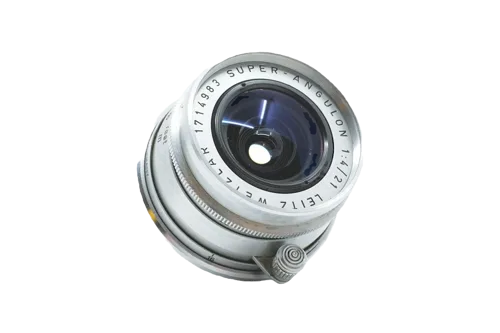
Leica Super-Angulon 21mm f/4
LTM / M39 mount
No listings tracked for this lens right now.
The Leica Super-Angulon 21mm f/4 is a LTM / M39-mount lens for Leica rangefinder cameras. Leica price index →
Specification
About this lens
Leica Super-Angulon 21mm f/4 LTM
The Leica Super-Angulon 21mm f/4 LTM, product code 11002, is an early ultra-wide Leica screw-mount lens made for rangefinder cameras. It was manufactured for Leica by Schneider-Kreuznach and introduced at Photokina 1958 under the Leitz code SUOON. Summichronica identifies the 2.1cm f/4 Super-Angulon as code SUOON, catalogue number 11002K, introduced at Photokina 1958 .
The lens is a compact 21mm f/4 ultra-wide with a deeply recessed rear optical group and a near-symmetrical wide-angle design. Ken Rockwell describes the 21mm f/4 Super-Angulon as Leica’s smallest and lightest 21mm lens, while also noting its solid brass construction, 251g weight and standard 39mm filter compatibility . Kamerastore lists the 11002 / SUOON version as a manual-focus super-wide-angle lens for Leica Thread Mount, manufactured by Schneider-Kreuznach for Leica .
This entry covers the Leica L39 / LTM / M39 screw-mount version. It should be kept separate from the M-bayonet version of the same 21mm f/4 lens, the later Super-Angulon 21mm f/3.4, and the Super-Angulon-R 21mm f/4 for Leica R. The LTM 11002 version is especially important because it is one of the earliest Leica-compatible 21mm screw-mount lenses.
Optical qualities
Rendering
The Super-Angulon 21mm f/4 is a classic symmetrical ultra-wide-angle lens with very low distortion and strong depth of field. Ken Rockwell describes it as a tiny high-performance 21mm lens with unusually good handling for filters because it accepts standard 39mm filters. Its rendering is best understood as a film-era wide-angle look with strong geometric correction and compact rangefinder handling.
Sharpness
The lens has a strong reputation for sharpness and low distortion when used within its intended film rangefinder context. Modern digital use is more complicated because the rear element sits very close to the film or sensor plane. Edge and corner performance on digital sensors may therefore differ from film use, especially on bodies without suitable sensor correction.
Contrast and color
Contrast depends strongly on condition. Clean examples can produce good contrast for a late-1950s ultra-wide lens, but haze, coating marks and internal reflections can reduce performance. Because this lens often has a protruding rear group and exposed glass surfaces, optical condition should be checked carefully.
Distortion and vignetting
Low distortion is one of the design’s key strengths. Symmetrical Super-Angulon-type lenses are valued for architecture and interiors because straight lines remain well controlled. Vignetting is part of the classic 21mm f/4 look and should be expected, especially wide open.
Handling
The lens is normally used with an external 21mm finder because Leica screw-mount and early Leica M cameras do not have 21mm framelines. Its deep depth of field also makes scale and zone focusing practical. Rangefinder-coupling behavior should be verified on the exact LTM example rather than inferred from an M-mount version.
Digital use
Digital compatibility should be treated carefully. The lens’s rear optical group sits close to the film plane, which can cause edge color shift, vignetting or smearing on some digital sensors. It should also be checked physically before mounting on digital M bodies because early Super-Angulon designs can have compatibility limitations.
History
Development and Launch
The Super-Angulon 21mm f/4 was introduced in 1958 as Leica’s first 21mm ultra-wide lens family. Summichronica states that the 2.1cm f/4 Super-Angulon, code SUOON and catalogue number 11002K, was introduced at Photokina 1958 and was based on Schneider’s Super-Angulon wide-angle design. It gave Leica users a much wider field of view than the 28mm and 35mm lenses commonly used on rangefinder cameras of the period.
Production Evolution
The 21mm f/4 Super-Angulon was produced until 1963, when it was replaced by the faster 21mm f/3.4 Super-Angulon. Ken Rockwell gives the production period as 1958 to 1963. Public references separate the LTM / screw-mount 11002 version from M-mount versions and later 21mm f/3.4 versions, so mount and product code should be recorded carefully.
Special Editions/Variants
No commemorative factory special edition is documented. Collector-relevant versions include the LTM screw-mount version, the M-mount version, complete sets with the original 21mm finder, caps and case, and rare prototype or experimental M39 examples. Leitz Auction documents an unusual 1971 M39 prototype sample made in an experimental batch of only three lenses, but that should be treated as a separate prototype note rather than a normal production variant .
Collector Notes
Collectors should verify the 11002 or 11002K product reference, SUOON code, L39 / M39 screw mount, chrome finish, Schneider-made Super-Angulon engraving, original 21mm finder, caps, case and optical condition. Important condition checks include haze, cleaning marks, coating wear, aperture operation, smooth focusing and rear-element damage. Seller titles may mix LTM, M and R versions, so the physical mount must be checked before matching.
Sources
- Summichronica. *21mm screw mount lenses*summichronica.com →
- Ken Rockwell. *LEICA 21mm f/4 SUPER-ANGULON, 1958-1963*kenrockwell.com →
- Kamerastore. *Leica 21mm f4 Super-Angulon, SUOON / 11002*kamerastore.com →
- Leitz Auction. *Super-Angulon 4/21mm prototype sample*leitz-auction.com →
- Leica Classic. *Leica Super Angulon-M 21mm F/4 Silver 11002*classic.leica-camera.com →
- Leicasisyphus. *Leica 21mm Super Angulon 1:4 LTM, 1958-1963*leicasisyphus.com →
Where to buy
Related lenses
Similar lenses you might be interested in
Comments