Best price Used
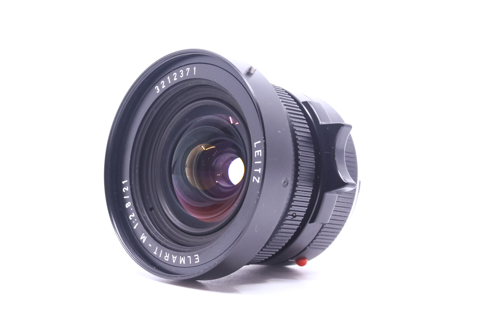
Leica Leitz Super-Angulon 21mm F/4 M-mount
Sold by Fotohandel Delfshaven
€987 ≈ $1,066
The Leica Super-Angulon-M 21mm f/4, a Schneider-derived ultra-wide M-mount rangefinder lens from 1958, prized by collectors for its symmetrical optical design.
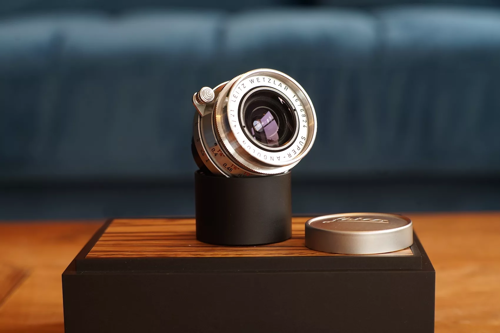
M mount
The Leica Super-Angulon-M 21mm f/4 is a M-mount lens for Leica rangefinder cameras. As of October 2026, it sells from €987 used across 3 listings, with a 30-day median of €1,510. Leica price index →
Measured against the 17 other 21mm M-mount lenses in the catalogue.
The Super-Angulon-M 21mm f/4 was the product of a collaboration between Leica and the German optical maker Schneider-Kreuznach, who supplied the symmetrical wide-angle design that gave the lens its name. Introduced in 1958, it gave Leica M rangefinder users one of the first truly ultra-wide options in the system and remains a sought-after item among collectors of early M-mount glass [1]. The optical layout uses nine elements in four groups arranged in a near-symmetrical configuration, a classic large-aperture wide-angle approach rather than a retrofocus design.
That symmetrical layout is the defining trait of the lens and the source of both its strengths and its limitations. Because there was no need to clear a reflex mirror, much of the optics could be set close to the film plane, and the rear of the lens sits deeply recessed behind the bayonet, which keeps the barrel compact at roughly 47 mm long and 250 g [2]. The lens is rangefinder coupled, focuses down to 0.4 m, and takes 39 mm filters, with a nine-blade aperture diaphragm. Its 21mm angle of view exceeds the built-in framelines of most M bodies, so the lens is normally paired with an accessory 21mm optical finder mounted in the accessory shoe. On film bodies the deeply recessed rear group is unproblematic, but on digital M cameras it causes well-documented issues, as discussed below.
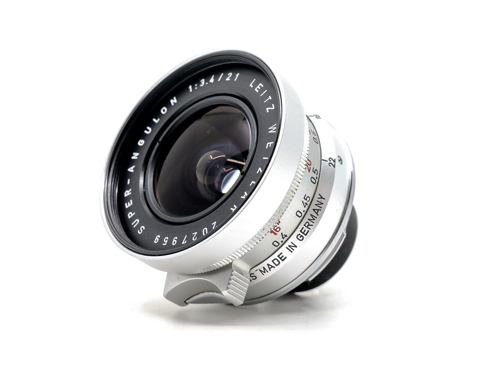
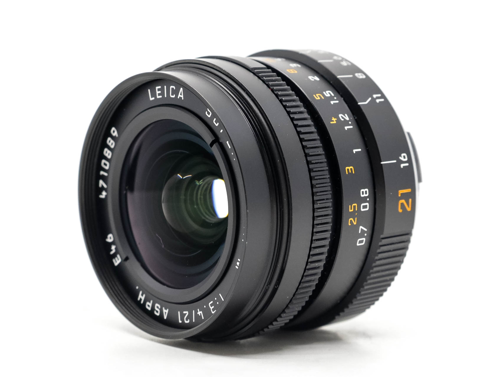
The lens carries Leica order number 11002 and was offered in black and silver finishes. The design is closely related to the later 21mm f/3.4 Super-Angulon, which used a comparable symmetrical Schneider-derived formula and shares the recessed-element handling characteristics on digital bodies [3]. There is little widely documented evidence of major factory special variants of the f/4 version beyond the standard production lens.
Rendering Reviewers describe the Super-Angulon-M 21mm f/4 as a capable performer for its era, with a slightly softer, more organic look than modern aspherical ultra-wides.
Sharpness Users report that the lens resolves detail well overall and holds up under magnification, though its corners are noticeably softer than a modern 21mm Super-Elmar-M, especially at wider apertures, with corner performance improving as the lens is stopped down.
Distortion Distortion is reported to be low for a lens of this width, with straight lines rendered close to true; one comparison found only a small, arguably negligible increase relative to the modern 21mm Super-Elmar-M.
Digital use The recessed rear element makes the lens difficult on digital M bodies. The barrel can extend past the camera's internal light meter cell, obstructing accurate through-the-lens metering and making an external meter or the Sunny 16 method advisable, and the short distance from the rear element to the sensor produces a pronounced magenta color shift toward one side of the frame on cameras such as the M10. This color cast can be partly mitigated in post-processing, but it is the main reason the lens is less popular for digital capture.
Development and Launch The lens emerged from a 1958 partnership in which Schneider-Kreuznach contributed the Super-Angulon wide-angle design and Leica produced it in M bayonet mount. It gave the M system an ultra-wide focal length at a time when few such options existed for 35mm rangefinders, and its symmetrical nine-element formula reflected the wide-angle design conventions of the period before retrofocus layouts became standard.
Production Evolution The Super-Angulon-M 21mm f/4 was later joined and effectively succeeded in the lineup by the 21mm f/3.4 Super-Angulon, which carried forward the symmetrical Schneider-derived approach with a slightly faster maximum aperture.
Collector Notes Because the lens predates digital M cameras, buyers using it on a digital body should expect metering interference and a magenta edge color shift caused by the deeply recessed rear element. The 21mm angle of view is wider than the framelines of most M bodies, so an accessory 21mm viewfinder is part of normal use and worth confirming as a matching accessory. As with any lens of this age, prospective buyers should check the optics for haze, separation, and cleaning marks, and verify smooth focus and aperture operation. One review notes a typical weight near 260 g for the lens; LeicaLensList records 250 g as the confirmed figure.
Good time to buy. The lowest listing is 35% below the 30-day average.
Lowest price Click a mark to open that listing · arrow keys to step, Enter to open
Price against condition for 3 listings of Leica Super-Angulon-M 21mm f/4, €987 to €1,663, median €1,510. Excellent: 1 at €1,510. Used: 2 at €987, €1,663. The full table follows.
| Condition | Lowest | Median |
|---|---|---|
| Excellent | €1,510 | €1,510 |
| Other | €987 | €1,325 |
Over the last 18 weeks the median price for the Leica Super-Angulon-M 21mm f/4 has risen, ranging from €1,059 to €1,588 (now €1,510).
Weekly price (EUR). Median (Good or better) and lowest (Good or better) across 18 weeks. The full figures follow in the table below.
| Week | Median | Lowest |
|---|---|---|
| Jun 1, 2026 | €1,701 | €1,327 |
| Jun 8, 2026 | €1,701 | €1,327 |
| Jun 15, 2026 | €1,701 | €1,327 |
| Jun 22, 2026 | €1,701 | €1,327 |
| Jun 29, 2026 | €1,701 | €1,327 |
| Jul 6, 2026 | €1,644 | €1,327 |
| Jul 13, 2026 | €1,644 | €1,327 |
| Jul 20, 2026 | €1,644 | €1,327 |
| Jul 27, 2026 | €1,588 | €1,327 |
| Aug 3, 2026 | €1,607 | €1,511 |
| Aug 10, 2026 | €1,609 | €1,510 |
| Aug 17, 2026 | €1,293 | €1,039 |
| Aug 24, 2026 | €1,290 | €1,069 |
| Aug 31, 2026 | €1,288 | €1,065 |
| Sep 7, 2026 | €1,511 | €1,511 |
| Sep 14, 2026 | €1,511 | €1,511 |
| Sep 21, 2026 | €1,511 | €1,511 |
| Sep 28, 2026 | €1,510 | €1,510 |
Every shop grades differently. Leica Classic uses letters, Ffordes uses E++ and E+, German dealers write "Zustand B", Japanese dealers write A−. We map all of them onto the one ladder below. Where a shop states its own grade, we print it under ours.
As of October 2026, the Leica Super-Angulon-M 21mm f/4 sells from €987 used, with a 30-day median of €1,510, across 3 active listings.
As of October 2026, the Leica Super-Angulon-M 21mm f/4 is sold by 2 sources (3 listings), from €987 used: all compared cheapest-first on this page.
Similar lenses you might be interested in
Comments