Best price Excellent
Nippon Kogaku Japan W-Nikkor 2.5cm f4 with viewfinder, pouch and M adapter
Sold by Camera Obscura Elburg
€1,871 ≈ $2,021
The Nippon-Kogaku W-Nikkor.C 2.5cm f/4 is a tiny Topogon-type 25mm wide-angle in Leica screw mount, a rare and prized rangefinder collector lens.
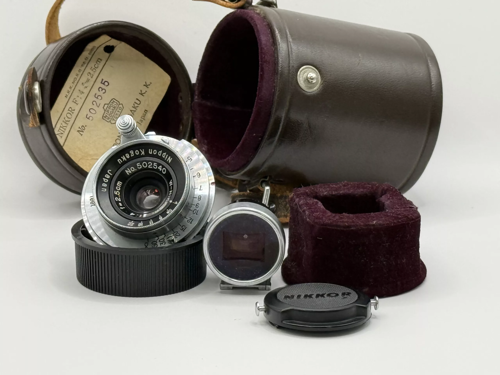
LTM mount
The Nippon-Kogaku W-Nikkor.C 2.5cm f/4 is a LTM-mount lens for Leica rangefinder cameras. As of October 2026, it sells from €1,871 used across 2 listings, with a 30-day median of €2,324. Leica price index →
Among Nikon's rangefinder wide-angles, the W-Nikkor.C 2.5cm f/4 stands out as the smallest and most unusual, a pancake-thin 25mm built around a symmetrical Topogon-type optical layout of four elements in four groups [1][2]. The Topogon design, devised in the mid-1930s, was the widest practical lens type of its era and saw heavy use in aerial photography and mapping because of its very low distortion, qualities Nikon carried over into this compact rangefinder lens. Sold both in Leica screw mount (LTM/M39) and in Nikon's own S bayonet, the screw-mount version is the one most collectors pursue today because it is considerably scarcer than the S-mount lens and can be used on a wider range of bodies.
The lens is built from brass and feels dense for its size, with a finish typical of early 1950s Japanese optics. The eight-bladed iris stops down to f/22 in one-stop clicks, and the blades have an unusual shape that runs straight before curving, a compromise needed to close the aperture down within such a tiny barrel. A defining quirk of the LTM version is that the aperture is set by rotating the front of the lens, with the value read off the face around the recessed front element rather than from a conventional ring. The screw-mount lens focuses to about 0.9 to 1 m, has a focus throw of roughly 180 degrees, and includes an infinity lock; the rear element protrudes a few millimetres into the body behind the mount. Crucially, the LTM version couples to the camera's rangefinder, whereas the S-mount lens has no focusing ring of its own and is driven entirely by the camera's focusing wheel, which makes the screw-mount lens far more adaptable to other systems. Reviewers note the manufacture of the lens was a feat in itself, since two near-hemispherical elements had to be ground extremely thin, complicating both original assembly and later servicing.
For the S-mount, two finishes are documented: earlier examples in bright chrome and later ones painted black, while the screw-mount lenses were produced alongside them. Production is generally placed from 1953 to 1954 onward and is thought to have continued, in small numbers, into the later days of the Nikon rangefinder era; the exact end date and total output are not reliably recorded. The native filter and accessory fittings are small and uncommon, and the original lens hood, a bayonet type on the S-mount lens, is exceptionally rare.
Rendering First-hand reviews describe the lens as soft wide open at f/4 and noticeably sharper when stopped down, with usable results around f/5.6 to f/8, though still trailing Nikon's contemporaneous 2.8cm and 3.5cm wides in outright sharpness. As expected of a symmetrical Topogon, distortion is corrected very well, which suits architecture and other subjects with straight lines. Vignetting is visible and falls off gradually toward the corners, an effect some users find pleasing rather than objectionable. The lens is coated and its deeply recessed front element acts as a built-in shade, which should aid flare control, although detailed contre-jour testing is limited. Bokeh is not a strength, but it is rarely a concern at this focal length.
Development and Launch The W-Nikkor.C 2.5cm f/4 was introduced in the early to mid-1950s as the widest lens in Nikon's rangefinder line, filling a super-wide slot at a time when 35mm was already considered a wide lens and 28mm marked the entry to the genuinely wide category. Nikon adapted the established Topogon formula, prized for low distortion, into an unusually small rangefinder lens, offering it for both the Nikon S system and the Leica thread mount.
Production Evolution For the Nikon S-mount, documented variation is limited to finish: earlier chrome examples and later black-painted ones. The Leica screw-mount lens was produced in smaller numbers, and because records of its run are incomplete, neither a firm end date nor a production total is established.
Collector Notes The screw-mount version is the rarer and more expensive of the two and is widely regarded as a desirable collector's piece, though reviewers stress it remains a capable picture-taking lens rather than a shelf ornament. Buyers should be aware that the near-hemispherical elements are extremely thin and delicate, which makes cleaning and servicing risky and means haze or damage should be inspected carefully before purchase. The native small-diameter filters and the original hood are hard to find, so kits that include genuine accessories carry a premium. Note that some published figures for the front fitting differ from one another; intending buyers should verify the actual thread on a given example before sourcing filters.
Good time to buy. The lowest listing is 20% below the 30-day average.
Lowest price Click a mark to open that listing · arrow keys to step, Enter to open
Price against condition for 2 listings of Nippon-Kogaku W-Nikkor.C 2.5cm f/4, €1,871 to €2,778, median €2,324. Mint: 1 at €2,778. Excellent: 1 at €1,871. The full table follows.
| Condition | Lowest | Median |
|---|---|---|
| Mint | €2,778 | €2,778 |
| Excellent | €1,871 | €1,871 |
Over the last 2 weeks the median price for the Nippon-Kogaku W-Nikkor.C 2.5cm f/4 has fallen, ranging from €2,324 to €2,340 (now €2,324).
Weekly price (EUR). Median (Good or better) and lowest (Good or better) across 2 weeks. The full figures follow in the table below.
| Week | Median | Lowest |
|---|---|---|
| Jul 6, 2026 | €2,340 | €1,902 |
| Sep 28, 2026 | €2,324 | €1,871 |
Every shop grades differently. Leica Classic uses letters, Ffordes uses E++ and E+, German dealers write "Zustand B", Japanese dealers write A−. We map all of them onto the one ladder below. Where a shop states its own grade, we print it under ours.
As of October 2026, the Nippon-Kogaku W-Nikkor.C 2.5cm f/4 sells from €1,871 used, with a 30-day median of €2,324, across 2 active listings.
As of October 2026, the Nippon-Kogaku W-Nikkor.C 2.5cm f/4 is sold by 2 sources (2 listings), from €1,871 used: all compared cheapest-first on this page.
Similar lenses you might be interested in
Comments