The Voigtländer Ultron 28mm f/1.9 is a fast LTM wide-angle from Cosina, long the quickest 28mm screw-mount lens and a budget alternative to Leica wides.
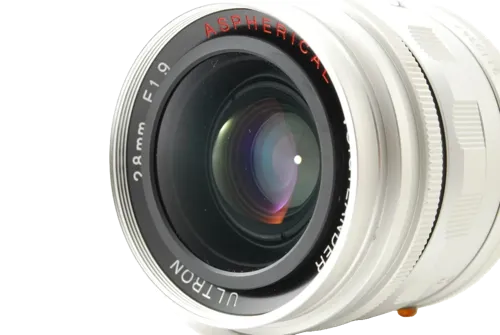
Voigtländer Ultron 28mm f/1.9
LTM mount
No listings tracked for this lens right now.
The Voigtländer Ultron 28mm f/1.9 is a LTM-mount lens for Leica rangefinder cameras. Leica price index →
How it compares
Measured against the 14 other 28mm LTM-mount lenses in the catalogue.
Specification
About this lens
Voigtländer Ultron 28mm f/1.9
When Cosina launched this lens under the revived Voigtländer name, it was the fastest production 28mm lens made for any rangefinder mount, a distinction it held until Leica introduced the 28mm f/1.4 Summilux in 2014 [1]. The odd f/1.9 maximum aperture is the giveaway of that ambition: the practical difference from f/2 is negligible, and the figure reads more like a marketing claim to secure the speed record than a meaningful optical gain [2]. For Leica thread mount users it remains the fastest 28mm available in that mount, which is the main reason collectors and film photographers still seek it out.
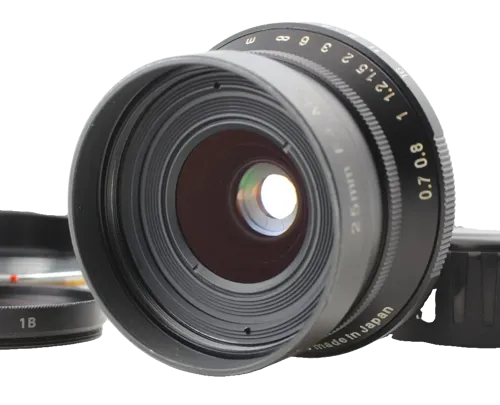
Optically the Ultron uses 9 elements in 7 groups, including an aspherical element, with a 10-bladed diaphragm that produces clean sunstars and well-rounded out-of-focus highlights. It focuses to 0.7 m, which was the long-standing norm for M-mount glass before live-view cameras encouraged closer designs. The lens is all-metal and well assembled, with a knurled aperture ring carrying half-stop clicks and a smooth, well-damped focus ring of roughly 90 degrees of travel. Being an LTM (M39) lens, it couples to the rangefinder and can be used on screw-mount bodies directly or on M-mount and mirrorless cameras through an adapter, though an adapter adds a variable that can affect centering and rangefinder accuracy. The lens is physically large for the wide focal length, so it intrudes into the viewfinder of M bodies with or without its hood, and on cameras without 28mm frame lines an external finder is needed. Cosina, which acquired rights to the Voigtländer name in 1999, is one of the few Japanese makers with its own glassworks, and this was among its earlier rangefinder lenses.
The Ultron 28mm f/1.9 was produced in both black and silver finishes. Although the black version resembles Leica black-paint lenses and shows similar brass-coloured wear with use, the barrel is too light to be brass and is most likely anodized aluminium. This early version uses a screw-in focus lever and a petal-shaped hood retained by a small side screw, details that distinguish it from the later M-mount Ultron 28mm f/2, which adopted a different 10-elements-in-8-groups design, a focus tab, and a circular hood while being slightly smaller and lighter. Original accessories included a felt-lined friction-fit cap and the small screw-in focus lever, both of which are often missing from used examples.
Optical qualities
Rendering The Ultron is sharp in the center across its range but shows a soft, glowing spherical-aberration look wide open, clearing up noticeably by f/2.8. Reviewers describe its overall character as slightly "vintage" compared with Cosina's later 28mm lenses, with lower contrast wide open and out-of-focus areas that can become more structured toward the corners.
Sharpness Center sharpness is good from maximum aperture, but corner performance lags and best across-frame results come from stopping well down; one widely cited assessment found the lens optimal around f/4 and a little soft wide open, especially at the edges. On digital bodies the corners are weaker than on film, and the thinner sensor stack of a Leica M body gives better edges than a thick-stack mirrorless sensor.
Bokeh and transitions At a 28mm focal length subject isolation is limited, but close and wide open the lens can produce pleasant background blur, helped by the rounded openings of its 10-bladed diaphragm. Field curvature is visible, so out-of-focus rendering can be uneven across the frame.
Flare resistance Flare control is a weak point. Unlike Cosina's later coatings, this earlier lens is prone to flare and contrast loss against strong light, and it can throw colored ghosts even with the hood fitted.
Distortion and vignetting Distortion is low but non-linear, and a lens-profile correction handles it well. Vignetting is heavy wide open, measured at around 3.4 EV in the corners, and remains noticeable until the lens is stopped down.
Aberrations Lateral chromatic aberration is minimal, as expected from a design predating the digital era, but longitudinal color is present, with magenta and green fringing on out-of-focus edges and purple fringing that only fully clears around f/5.6. Coma is fairly strong at f/1.9 and mostly gone by f/2.8.
History
Development and Launch The lens was part of Cosina's revival of the Voigtländer brand, whose rights it acquired in 1999, and which began producing M39 rangefinder lenses shortly after. It was shown at Photokina 2000 and entered the lineup as the speed leader among 28mm rangefinder lenses. LeicaLensList records the production start as 2001; some sources cite a Photokina 2000 debut, a minor discrepancy in dating rather than in the lens itself.
Production Evolution The f/1.9 LTM version was eventually replaced by an M-mount Ultron 28mm f/2 that used a new optical formula of 10 elements in 8 groups and was slightly smaller and lighter, with revised handling features. Cosina later continued the Ultron 28mm line with further M-mount redesigns that focus closer and use a smaller filter thread, with each generation reported to improve contrast, resolution and flare resistance while reducing size and weight.
Collector Notes Verify that an example still has its original screw-in focus lever and friction-fit cap, as both are frequently lost; the empty lever screw-hole is a common sight on used copies. The petal hood mounts with a side screw and must be oriented correctly to avoid obstructing the frame, and it has to be removed to change filters. Black examples often show brassing from wear, which some buyers value and others do not; this is cosmetic and does not indicate a brass barrel. Buyers adapting the lens to digital M or mirrorless bodies should account for the adapter's effect on centering and rangefinder coupling, and should expect significant viewfinder blockage on M cameras.
Sources
Where to buy
Related lenses
Similar lenses you might be interested in
Comments