The Voigtländer Color-Skopar 35mm f/2.5 P I is a tiny LTM screw-mount pancake lens prized by Bessa and Leica rangefinder users for its size and value.
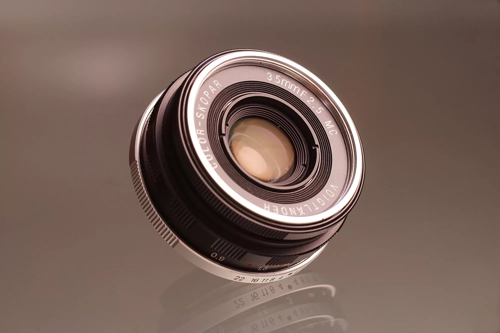
Voigtländer Color-Skopar 35mm f/2.5 P I
LTM mount
No listings tracked for this lens right now.
The Voigtländer Color-Skopar 35mm f/2.5 P I is a LTM-mount lens for Leica rangefinder cameras. Leica price index →
How it compares
Measured against the 45 other 35mm LTM-mount lenses in the catalogue.
Specification
About this lens
Voigtländer Color-Skopar 35mm f/2.5 P I
Among the smallest 35mm rangefinder lenses ever put into series production, the Color-Skopar 35mm f/2.5 P I is the original screw-mount "Pancake" version of an optic that Cosina Voigtländer sold in several different bodies. The same seven-element formula appeared in the M-mount Color-Skopar 35mm f/2.5 P II, the screw-mount Color-Skopar 35mm f/2.5 C with a focusing lever, and a 35mm f/2.5 SC for Nikon rangefinder mount, so a buyer chose largely on the basis of mount and handling rather than image quality [2][3]. The P I is the Leica thread-mount (M39) variant with a conventional focusing ring and aperture ring, which gives it a particularly flat, unobtrusive profile on a Bessa or screw-mount Leica body.
Optically the lens uses seven elements in five groups with a ten-blade diaphragm, a combination Voigtländer associated with a smooth out-of-focus rendering [1]. Build is all metal, as expected of a rangefinder lens of this class, and the front accepts inexpensive 39mm filters. At roughly 25mm long, 55mm in diameter and about 134g it is genuinely pocketable, and it remains rangefinder-coupled despite its slim barrel. With a thread mount it can be fitted to M cameras through a standard screw-to-bayonet adapter. Maximum aperture of f/2.5 keeps the lens compact at the cost of low-light speed, and the close-focus limit is modest, which suits a focal length more often used for general and street work than for close-ups.
Care is needed not to confuse the several members of this family. CameraQuest notes that the C, P I, P II and Nikon-mount SC all share the same optics, while differing in mount, focusing control and closest focusing distance. The later P II, introduced at the PMA show in Las Vegas in February 2004, adopts an M bayonet, a focusing tab and aperture handles styled after the pre-aspherical 35mm Summicron, whereas the screw-mount C is built on the 25mm f/4 barrel and carries a quick focusing lever. The P I sits between them as the plain-barrel thread-mount pancake. A vented metal lens hood was offered separately rather than supplied with the lens.
Optical qualities
Rendering Reviewers describe the lens as a neutral, dependable performer that gives a clean, modern look rather than a strongly characterful one. As a relatively slow wide-angle it is easy to correct, and it shows stable results without prominent flaws, the main limitation being that even resolution across the frame arrives only on stopping down.
Sharpness The centre is already crisp at f/2.5, but detail falls off toward the edges, with the deep corners weak wide open; most of the frame is very good by f/5.6 and good edge-to-edge evenness needs around f/8. A second reviewer likewise found it impressively sharp in the centre wide open, improving as it is stopped down.
Contrast and color Colour is strong and well separated, with a saturated, contemporary palette; micro and mid-level contrast are good rather than exceptional, leaving overall clarity slightly subdued on axis.
Bokeh and transitions The ten-blade diaphragm keeps blur discs round and reasonably even, and the out-of-focus rendering is decent for the class, with moderate outlining that persists somewhat on stopping down. On a digital body wide open, out-of-focus highlights can show hard edges and a faintly nervous quality in the corners with busy backgrounds.
Flare resistance Flare is well controlled even shooting toward the sun, with only minimal, easily avoided ghosting.
Distortion and vignetting Only slight barrel distortion is present and hard to see in practice, while corner shading is noticeable wide open, roughly halved by f/4 and effectively gone by f/5.6. One reviewer testing the lens on a mirrorless body found vignetting heavier wide open and recommended stopping down for landscapes.
Digital use Adapted to a full-frame mirrorless sensor the lens can show smeared, darkened corners between about f/2.5 and f/4, a common trait of short rangefinder lenses caused by the steep light angle onto the sensor stack.
History
Development and Launch The Color-Skopar 35mm f/2.5 was part of the Cosina Voigtländer Bessa system that revived the Voigtländer name for new screw-mount and bayonet rangefinder gear from around the turn of the millennium. The screw-mount Pancake and Compact versions preceded the M-mount edition, which Cosina Voigtländer introduced at PMA in February 2004.
Production Evolution Across the line the optical formula was held constant at seven elements in five groups with ten aperture blades, so changes between versions were mechanical rather than optical: mount type, focusing ring versus lever versus tab, aperture ring versus handles, and slightly different close-focus limits. The optics remain in production in Japan under later catalogue versions.
Special editions No major factory special editions of the screw-mount Pancake are widely documented; the notable variations are the parallel mount and ergonomic versions, namely the screw-mount C with a focusing lever, the M-mount P II, and the Nikon S-mount SC.
Collector Notes Because the C, P I, P II and SC look similar and share glass, identify a lens by its mount and controls: the P I is thread mount with a focusing ring and aperture ring, the C is thread mount with a focusing lever, and the P II is an M bayonet with a focusing tab and aperture handles. The supplied snap-on plastic cap is flimsy and easily lost, so a filter or hood is a sensible substitute, and the dedicated vented hood is usually sold separately and worth seeking out. On the M-mount sibling some users report a loose aperture ring; checking aperture and focus action is advisable on any used copy. Published sources sometimes quote a 0.7m close-focus figure for the M-mount version, so confirm the focusing range on the specific screw-mount example in hand.
Sources
Where to buy
Related lenses
Similar lenses you might be interested in
Comments