The Konica UC-Hexanon 35mm f/2 is a rare LTM rangefinder lens of modified Xenotar design, prized by collectors for its multi-coating and Summicron-like build.
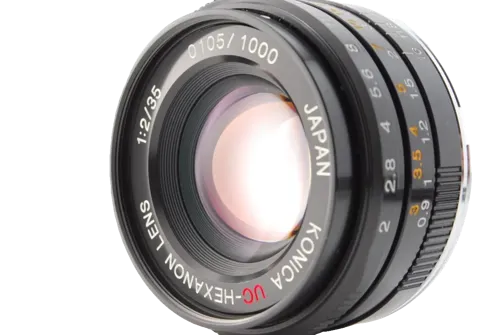
Konica UC-Hexanon 35mm f/2
LTM mount
No listings tracked for this lens right now.
The Konica UC-Hexanon 35mm f/2 is a LTM-mount lens for Leica rangefinder cameras. Leica price index →
How it compares
Measured against the 45 other 35mm LTM-mount lenses in the catalogue.
Specification
About this lens
LONG DESCRIPTION:
Konica UC-Hexanon 35mm f/2
Few modern screw-mount lenses carry as unusual a pedigree as the Konica UC-Hexanon 35mm f/2, a limited-run optic whose design lineage reaches back to the Schneider Xenotar and the Zeiss Biometar of the mid-century. The W-Nikkor 35mm f/1.8 of 1956 and the Konica UC-Hexanon 35mm f/2 of 2001 are considered unique in rangefinder lens history because of their use of a modified Xenotar design, and it is widely considered, though not officially documented by either company, that Konica based the lens of its 1993 Hexar AF, and later the UC-Hexanon, on Nikon's design. The "UC" prefix is not decorative: the optical design remained the same as the Hexanon L 35mm F2 released in April 1996, but the lens barrel was made more compact and multi-coating was applied on all air-to-glass surfaces, with "UC" standing for Ultra Coating.
The seven-element, six-group optical layout descends from a point-and-shoot lens rather than from a purpose-built interchangeable optic, and that origin shows in its handling and its quirks. In 1996, at the request of a large camera store in Japan, Konica replicated the 35mm f/2 lens from its Hexar AF in Leica screw mount thread (M39). In 2001, Konica made another run of these lenses with a painted brass barrel body, a focusing tab, a click aperture ring in half stops, and multi-coated glass surfaces, superficially resembling Leica's version IV 35/2 Summicron. The lens couples to the rangefinder and, with an LTM-to-M adapter, mounts readily on M bodies. In size the lens is almost exactly the same as the 35/2 Summicron, down to the dimensions of the Leica-style focus tab, though the overall barrel diameter is smaller; the only mechanical difference is that the Konica stops at 0.9m rather than 0.7m, and the aperture control takes more effort to turn but has half-stops.
This is a deliberately small production. The Konica UC-Hexanon 35mm f2 was released in September 2001 to only 1000 pieces, in a project commissioned by Fujisawa Shokai, a large Tokyo camera retailer. Build and finish set it apart from the contemporary M-Hexanons: the UC is lacquered brass rather than enameled alloy, with aperture numbers that show signs of having been stamped from a malleable metal, a feet scale filled in yellow-orange like Leica, and an oval aperture control like Leica rather than the round ones used on M-Hexanons. The full set comprised the lens, a vented hood coded FL-8, a Hexanon front cap, a rear cap, and Konica pouches for the lens and hood.
Optical qualities
Rendering Reviewers describe a lens that punches well above its modest origins, with strong central performance, modern coatings that suppress flare, and a known focus-shift trait inherited from its undercorrected spherical aberration. For an afterthought lens based on an optic from a point-and-shoot camera, the UC Hexanon is surprisingly good; while its distortion is noticeable, its minimum focusing distance is not class competitive, and it has a focus shift issue, it is an incredibly sharp lens in the center while retaining very competitive corner performance.
Sharpness The Konica UC-Hexanon 35mm f2 is an incredibly sharp lens in the center while retaining very competitive corner performance.
Flare resistance The multi-coating is a defining advantage of the UC version. In side-by-side testing against the W-Nikkor, the reviewer found that the Konica's modern multicoatings let it show very little flaring at any aperture, whereas the older Nikkor flared at every aperture.
Distortion and vignetting Distortion is the lens's clearest weakness, and it improves only slightly as the lens is stopped down. On vignetting, both the UC-Hexanon and the W-Nikkor show noticeable light fall-off at f/2 that essentially disappears by f/2.8.
Bokeh and transitions The 10 blade aperture offers a pleasing bokeh, on par with its German rivals. Dante Stella likewise singles out the lens's out-of-focus rendering as a striking trait.
Aberrations The design carries a documented focus-shift characteristic. In the Hexar AF, the camera's autofocus computer compensated for this shift, but on a manually focused rangefinder lens no such automatic correction is possible.
History
Development and Launch The lens belongs to a wider revival of premium compact-camera optics in the 1990s. When Konica introduced its M-Hexanon 35mm f/2 for its Hexar RF series in the early 2000s, it was of a completely different and more conventional design. The UC-Hexanon, by contrast, preserved the Xenotar-derived formula of the Hexar AF in interchangeable form, making it a direct optical descendant of that camera rather than a member of the later M-Hexanon family.
Production Evolution The screw-mount Hexanon 35mm f/2 evolved across two runs: the 1996 Hexanon L with a knurled focusing ring, and the 2001 UC version with a focusing tab, more compact barrel, and full multi-coating. The first-version 35/2L Hexanon used a knurled focusing ring instead of a tab, and the LTM family also included a 50/2.4L collapsible Hexanon and a 60/1.2L Hexanon.
Collector Notes Identification is helped by the lens's deliberate Leica resemblance and by a few distinguishing details. Coatings look identical to a Summicron except that the front element reflects green in the manner of Nikon Integrated Coatings, and the rear element is significantly flatter so that no shroud is needed to protect it. One practical point for buyers: there is no red dot, which makes mounting the lens interesting. Because the body is lacquered brass rather than enameled alloy, finish wear and brassing should be expected on used examples, and the original vented FL-8 hood, Hexanon-marked cap, and leather case are worth verifying given the lens's limited production. LeicaLensList records production as beginning in 2001; some sources describe a small one-time run of about 1,000 units rather than ongoing production.
Sources
- Japan Camera Hunter. Camera Geekery: Konica UC-Hexanon 35mm f2japancamerahunter.com →
- davidde.com. The Two Xenotars: The W-Nikkor 35mm f/1.8 & the Konica UC-Hexanon 35mm f/2davidde.com →
- davidde.com. The Two Xenotars: The W-Nikkor 35mm f/1.8 & the Konica UC-Hexanon 35mm f/2davidde.com →
- Dante Stella. Konica 35mm f/2 UC-Hexanon for Leicadantestella.com →
- davidde.com. The Two Xenotars: The W-Nikkor 35mm f/1.8 & the Konica UC-Hexanon 35mm f/2davidde.com →
Where to buy
Related lenses
Similar lenses you might be interested in
Comments