A scarce LTM rangefinder-coupled collaboration, the Lomography x Zenit Mercury 35mm f/2 is a Soviet-flavored standard wide that close-focuses to 0.45m.</parameter> <parameter name="long_description">## Lomography x Zenit Mercury 35mm f/2 Few modern rangefinder lenses are as poorly documented as the Lomography x Zenit Mercury 35mm f/2, a product of the partnership between Lomography and the Russian optics maker Zenit (KMZ). Collectors who have handled it report finding it through eBay rather than mainstream retail, with little published technical information and no widely circulated optical diagram, which has given it a reputation as an obscure, mysterious Russian lens [1]. The name ring is engraved "Mercury2," and at least one reviewer has linked the name to the Soviet-era Mercury half-frame cameras, speculating that the lens nods to that earlier line rather than copying its optics directly. Mechanically it is a compact LTM (M39 / Leica thread mount) lens with rangefinder coupling, so it can be used on Leica screw-mount bodies and, via an adapter, on M-mount cameras. The optical formula uses seven elements in four groups with a nine-blade aperture, and it focuses unusually close for a coupled rangefinder optic, down to 0.45m, which is well beyond the typical 0.7m to 1m minimum of vintage 35mm rangefinder lenses. The user who reviewed it noted achieving roughly 0.4m focus after servicing and described a close-focusing rangefinder lens of this type as remarkable, since coupled rangefinder optics that focus that near are uncommon. Reliable production details are limited. The lens is part of the broader run of Lomography x Zenit collaborations that also includes the New Petzval and the Lomogon, but the Mercury 35mm f/2 received far less promotion than those products. No factory variants, finish options, or special editions are widely documented; collectors should treat finish and engraving details as unverified until checked against the individual example in hand. --- ## Optical qualities **Rendering** Documentation is thin and rests largely on a single hands-on user account, so the following should be read as collector impression rather than tested performance. That reviewer described overall imaging as slightly low in contrast, comparing the look to the Jupiter 3+, with a saturated, distinctly Soviet color character on film. The center was reported as very sharp, even reaching strong edge-to-edge sharpness when stopped down to about f/5.6, while the extreme corners showed weak rendering with a hazy, soft quality and pronounced coma wide open. The same account found close-up performance notably better than distant subjects and suggested the high central resolution against degraded corners helps isolate a subject. The lens was also judged to weaken in high-contrast lighting. These are the observations of one user and have not been corroborated by formal testing. --- ## History **Development and Launch** The lens emerged from Lomography's collaborations with Zenit (Krasnogorski Zavod, KMZ), the Russian manufacturer behind the firms' jointly produced art lenses. It appears to date from around 2016 and was sold with minimal marketing, which is why so little reference material exists for it compared with the better-known New Petzval and Lomogon lenses. **Special editions** No major factory special variants, regional names, or alternative finishes are widely documented for this lens. **Collector Notes** Buyers should be cautious about mechanical condition. The one detailed account of the lens reports that the example arrived unable to reach infinity focus and required adjustment by a specialist repairer before it was usable, after which it focused down to roughly 0.4m. Given the scarcity of the lens and its limited paper trail, confirming infinity focus, rangefinder coupling accuracy, and the absence of internal haze is advisable before purchase. The "Mercury2" engraving on the name ring is a useful identification point. --- ## Sources * [1] Chan'Blog (chan.nds.hk). *Lomography Zenit 35mm f2 神秘俄鏡*. https://chan.nds.hk/blog/?p=9915
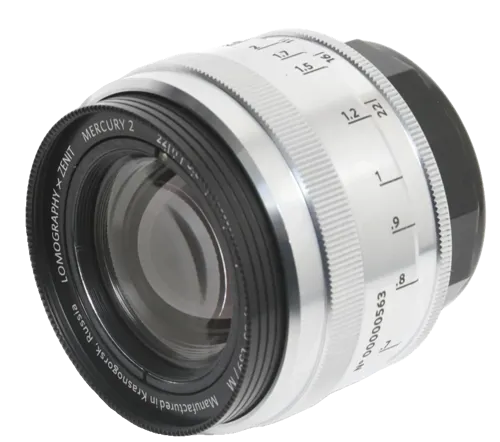
Lomography x Zenit Mercury 35mm f/2
LTM mount
No listings tracked for this lens right now.
The Lomography x Zenit Mercury 35mm f/2 is a LTM-mount lens for Leica rangefinder cameras. Leica price index →
How it compares
Measured against the 45 other 35mm LTM-mount lenses in the catalogue.
Specification
About this lens
Lomography x Zenit Mercury 35mm f/2
The Lomography x Zenit Mercury 35mm f/2 is a moderately wide rangefinder lens produced in the Leica thread mount (LTM, also called M39). It pairs a fast f/2 maximum aperture with a compact body that measures about 35 mm long and 56 mm in diameter and weighs roughly 202 g, making it a small and easily pocketable optic for screw-mount and adapted camera bodies.
Optically the lens uses a seven-element design arranged in four groups. The aperture is formed by nine blades, a count associated with a rounded iris opening across the stop range. The lens is rangefinder coupled, so it can be focused through the coupled rangefinder of a compatible LTM or, with a thread-to-bayonet adapter, an M-mount camera. The minimum focus distance is 0.45 m, and the front accepts 46 mm filters. The lens is not six-bit coded, so it will not transmit lens identification automatically to coded Leica M bodies. The finish is described as nickel.
The Mercury has been in production from 2016 onward, with no confirmed end date recorded. Because it is a recent screw-mount design rather than a vintage classic, documented factory variants and detailed production history are limited, and well-supported reference material on version differences is sparse.
Optical qualities
Rendering Detailed, independently verified information on this lens's rendering character is limited. Based on its specifications, the seven-element, four-group formula with a fast f/2 aperture and a nine-blade iris is consistent with a small wide-normal lens intended for general use on rangefinder and adapted mirrorless cameras. Specific, reliably documented claims about its sharpness, contrast, bokeh, flare behavior, distortion, or vignetting are not established here, so they are not asserted.
Collector Notes
When evaluating a Mercury 35mm f/2, confirm the LTM (M39) thread is clean and that the rangefinder coupling cam moves smoothly, since this determines accurate focus on coupled bodies. Verify the 46 mm filter thread is undamaged, check the nine-blade aperture for oil, and confirm the front and rear elements are free of haze or fungus. For use on Leica M cameras, remember that the lens is not six-bit coded and will require a thread-to-bayonet adapter.
Where to buy
Related lenses
Similar lenses you might be interested in
Comments