A 1957 Japanese 100mm f/2 rangefinder-coupled Leica M39 telephoto by Kowa, with six elements in three groups, 1.5m focusing and E55 filters.
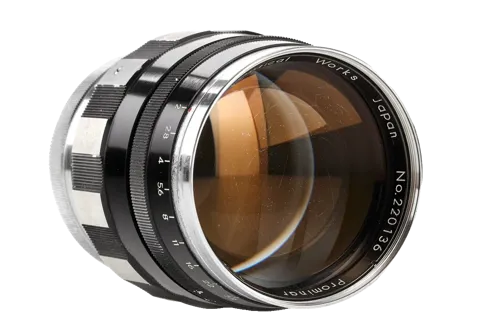
Kowa Prominar 100mm f/2
LTM mount
No listings tracked for this lens right now.
The Kowa Prominar 100mm f/2 is a LTM-mount lens for Leica rangefinder cameras. Leica price index →
How it compares
Measured against the 8 other 100mm LTM-mount lenses in the catalogue.
Specification
About this lens
Kowa Prominar 100mm f/2
The Kowa Optical Works Prominar 100mm f/2 is a Japanese high-speed short telephoto announced in 1957 for Leica-thread rangefinder cameras. Lens DB records six elements in three groups, a 1.5-metre minimum focusing distance, and an E55 filter thread. Leitz Auction documents an original Leica M39 example with mechanical rangefinder coupling. The lens is rigid, manually focused, and intended to cover the full 24 by 36mm still frame.
An f/2 maximum aperture supports lower-light use and shallow depth of field, but also places greater demands on cam accuracy and optical alignment. The 100mm field is narrower than that of a 90mm lens and may require an appropriate external finder.
The six-element, three-group specification is model-specific and should not be replaced by data for Kowa's projection, cine, fixed-camera, or later SLR lenses. Reliable documentation used here does not establish the aperture-blade count, dimensions, weight, coating name, or a detailed factory production sequence for this Leica-thread version. Those fields should remain unknown unless period literature or measurements of verified examples become available.
Optical qualities
Rendering
The six-element, three-group construction is not assigned to a named formula in the cited sources. It should not be called a Sonnar copy solely from the group count. No factory MTF chart or controlled multi-sample comparison has been found, so numerical performance claims are not supported.
At full aperture, the narrow depth of field makes focus placement critical. Residual spherical and chromatic aberrations may be more apparent than after stopping down, while closing the diaphragm generally improves field evenness. The actual result depends on element centring, cam calibration, optical condition, and whether the mount has been modified. A strong portrait effect from one example is not evidence that all copies render identically.
Contrast and flare
The available model sources do not name a coating system. Surviving lenses may show coated surfaces, but appearance alone does not establish an identical specification across production. A deep hood can reduce oblique light. Haze, separation, and internal reflections should be ruled out before flare is attributed to the design.
Out-of-focus rendering
At 100mm and f/2, the lens can create substantial background blur at portrait distances. No dependable blade count or controlled highlight study has been located. Defocus shape changes with aperture and subject distance, so terms such as smooth, swirled, or painterly should be tied to documented photographs rather than used as universal model characteristics.
Rangefinder use
Lens DB gives a 1.5-metre close-focus limit. At that distance and f/2, even a small rangefinder or cam error can move the focus plane noticeably. Accurate use on film requires a calibrated body, while digital live view can separate optical performance from mechanical coupling. An L39-to-M adapter provides mounting on Leica M bodies but must select suitable finder frames or be paired with an external finder.
History
Development and Launch
Kowa's optical operation grew from the company's postwar diversification. Its official history records the Kalloflex I in 1954 as the first Kowa Koki camera and the creation of Kowa Optical Corporation in New York in 1955. The Prominar name became associated with Kowa photographic and observation optics. The 100mm f/2 appeared in 1957, during the firm's early expansion into internationally compatible camera equipment.
Using Leica M39 gave the lens access to Leica bodies and the many Japanese screw-mount rangefinders already in circulation. Mechanical coupling made it an integrated system lens rather than a simple scale-focus telephoto. It joined the 35mm f/2.8 Prominar in demonstrating Kowa's participation in the third-party Leica-thread market before the company concentrated on proprietary camera systems.
Production Evolution
The sources agree on the 1957 period, coupled M39 mount, and high-speed 100mm specification. They do not provide a confirmed start-and-end production range, optical revision, or factory total. Auction catalogues show that genuine screw-mount examples survive, but an auction's date estimate and photographed condition cannot substitute for a production ledger.
Kowa later used the Prominar name for many unrelated lenses, including fixed-camera, SLR, medium-format, cine, projection, and modern optics. Shared branding does not prove shared optical design. The Leica-thread 100mm f/2 must be identified by its complete specification and mount rather than by the Prominar name alone.
Special Editions/Variants
No formally named editions or verified optical generations have been established for the LTM lens. Finish and engraving differences may exist, but they need corroborating factory literature before they are treated as separate versions. A converted cine lens or custom-mounted Kowa optic is not equivalent to the original rangefinder-coupled M39 model.
Collector Notes
Identification should include Kowa Optical Works attribution, Prominar 100mm f/2 engraving, rigid barrel, E55 front thread, Leica screw mount, and rangefinder cam. Check infinity registration, cam agreement at closer distances, aperture operation, and the condition of cemented groups. The faster aperture makes accurate mechanical alignment especially important.
Claims of rarity or a specific production quantity remain unsupported by the sources used here. Sale prices, caps, and optical condition belong to individual listings. Collectors should also avoid transferring the four-element construction reported for some large-format Kowa telephotos to this documented six-element, three-group rangefinder lens.
Sources
Where to buy
Related lenses
Similar lenses you might be interested in
Comments