The Funky Lens List: 10 Weird and Wonderful Lenses You Can Put on a Leica
Discover 10 weird and wonderful Leica lenses, from body-cap oddities and organ transplants to Cold War glass and a 740g f/1 monster.
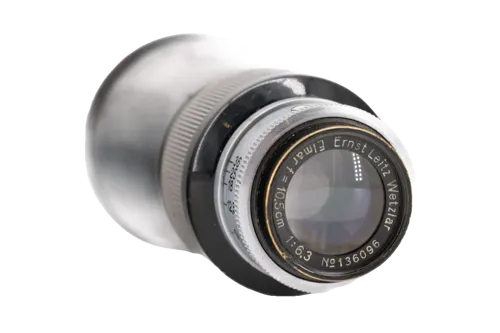
The Leica Elmar 105mm f/6.3 is a slim 1930s "Mountain Elmar" telephoto in LTM screw mount, prized by collectors for its rarity and lightweight design.
LTM mount
The Leica Elmar 105mm f/6.3 is a LTM-mount lens for Leica rangefinder cameras. As of October 2026, it sells from €550 used across 10 listings, with a 30-day median of €744. Leica price index →
Measured against the 9 other 105mm LTM-mount lenses in the catalogue.
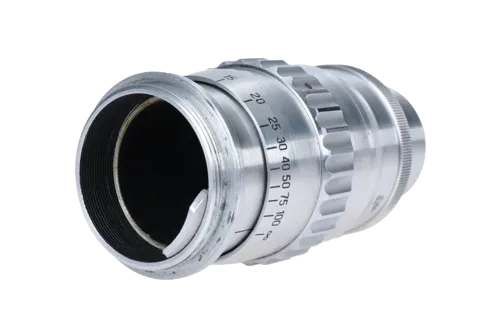
Often called the "Mountain Elmar" or "Berg Elmar," the Leica Elmar 105mm f/6.3 is the longest and slowest of the early screw-mount Elmars, built around a slender cone-shaped barrel rather than the usual cylindrical form [1][2]. A 1933 Leitz brochure described it as a small, light distance lens favoured by mountaineers, arguing that its modest aperture was sufficient because distant views generally had to be stopped down to f/6.3 anyway to cut through atmospheric haze. Some accounts connect its development to Oskar Barnack himself, who is said to have wanted something lightweight and long to carry on outings, though whether it was truly designed for mountaineering or simply acquired the nickname later is not settled. It was the only 105mm lens Leitz made for the screw-mount system, and despite its reputation it was never a strong seller[3].
The lens uses a four-element design and a 36mm filter thread reached through its dedicated push-on hood, since the front opening itself is unusually narrow. It is rangefinder coupled, and collectors have long discussed whether an uncoupled production version exists; the earliest recorded units are coupled, a museum prototype differs from production lenses, and no confirmed uncoupled example has been documented. In use on screw-mount Leicas, or on M-series bodies through an adapter, the slim barrel keeps the lens largely clear of the 90mm finder framelines, and its performance is optimised toward infinity, which fits its intended role as a distance lens. The minimum focusing distance is longer than most contemporaries; the scale stops short, though the lens focuses somewhat closer than the marked figure.
Early examples are finished in black and nickel, with production shifting to black and chrome after about 1933. Lenses scaled in feet are typically engraved "Germany" for export, while those scaled in meters are not. Other identification details recorded by collectors include a change in the lens cap from full internal velvet lining to a lining only on the inner rim around serial 162,xxx, and the appearance of an infrared focusing mark on later units. A small number of 105 Elmars carry an "a" after the serial number, reported as factory duplications of numbers also used on other lenses.
Rendering Contemporary use of the lens reports surprisingly strong results for its age, with one reviewer noting fine detail rendered both near infinity and at close range, and pleasant color rendering on a modern digital body despite the lens being designed for black-and-white work. Because the design favours distant subjects, it performs at its best around its infinity setting. Reviewer experience also suggests a focus-shift quirk when using deep red filters, where images can come out soft unless focus is placed slightly forward of the subject. As surviving samples vary widely in condition, individual rendering depends heavily on the state of the glass.
Development and Launch By most accounts the lens reached the market in early 1932, appearing as a coupled lens in a March 1932 dealer bulletin, around the same period as the Leica Model D, while many Model C cameras lacking rangefinder coupling were still in circulation. It carried the Leitz code word ELZEN.
Production Evolution Production ran from 1932 to 1937, and total output was low, with collector records citing roughly 3,975 units. The most visible production change is the move from the early black-and-nickel finish to black-and-chrome after about 1933, alongside the smaller running changes to caps, engravings, and the addition of an infrared index on later lenses.
Collector Notes The Mountain Elmar is a sought-after item among Leitz collectors, and its rarity and distinctive cone shape make originality the key concern. Repainted and refinished examples exist; an all-chrome cone, for instance, is generally regarded as a later modification rather than a factory finish. The dedicated hood and matching A36 cap are difficult to find separately, and because A36 filters mount over the front of the hood, a missing hood effectively prevents using filters. Internal haze is commonly noted on surviving lenses, so glass condition is worth checking before purchase. Buyers may also wish to verify serial-number engravings against the early batches and watch for the unusual "a" suffix on some units.
Good time to buy. The lowest listing is 26% below the 30-day average.
Lowest price Click a mark to open that listing · arrow keys to step, Enter to open
Price against condition for 10 listings of Leica Elmar 105mm f/6.3, €550 to €1,559, median €732. Excellent: 3 at €572, €732, €1,003. Good: 4 at €599, €676, €732, €1,559. Fair: 1 at €926. Unknown: 2 at €550, €942. The full table follows.
| Condition | Lowest | Median |
|---|---|---|
| Excellent | €572 | €732 |
| Good | €599 | €704 |
| Fair | €926 | €926 |
| Other | €550 | €746 |
Over the last 18 weeks the median price for the Leica Elmar 105mm f/6.3 has fallen, ranging from €744 to €1,041 (now €744).
Weekly price (EUR). Median (Good or better) and lowest (Good or better) across 18 weeks. The full figures follow in the table below.
| Week | Median | Lowest |
|---|---|---|
| Jun 1, 2026 | €967 | €950 |
| Jun 8, 2026 | €950 | €650 |
| Jun 15, 2026 | €840 | €650 |
| Jun 22, 2026 | €842 | €650 |
| Jun 29, 2026 | €846 | €650 |
| Jul 6, 2026 | €717 | €582 |
| Jul 13, 2026 | €715 | €581 |
| Jul 20, 2026 | €740 | €579 |
| Jul 27, 2026 | €836 | €585 |
| Aug 3, 2026 | €837 | €587 |
| Aug 10, 2026 | €839 | €589 |
| Aug 17, 2026 | €757 | €596 |
| Aug 24, 2026 | €753 | €593 |
| Aug 31, 2026 | €750 | €592 |
| Sep 7, 2026 | €749 | €590 |
| Sep 14, 2026 | €740 | €584 |
| Sep 21, 2026 | €735 | €581 |
| Sep 28, 2026 | €732 | €572 |
Every shop grades differently. Leica Classic uses letters, Ffordes uses E++ and E+, German dealers write "Zustand B", Japanese dealers write A−. We map all of them onto the one ladder below. Where a shop states its own grade, we print it under ours.
As of October 2026, the Leica Elmar 105mm f/6.3 sells from €550 used, with a 30-day median of €744, across 10 active listings.
As of October 2026, the Leica Elmar 105mm f/6.3 is sold by 5 sources (10 listings), from €550 used: all compared cheapest-first on this page.
Similar lenses you might be interested in
Comments