A circa-1930 Dallmeyer 4-inch f/5.6 telephoto in original uncoupled Leica M39 mount, an early scale-focus design equal to approximately 101.6mm.
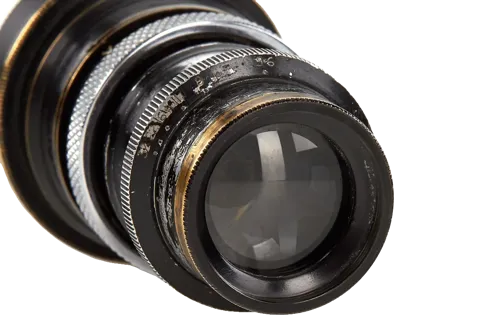
Dallmeyer Dallon 4-inch 101.6mm f/5.6
LTM mount
No listings tracked for this lens right now.
The Dallmeyer Dallon 4-inch 101.6mm f/5.6 is a LTM-mount lens for Leica rangefinder cameras. Leica price index →
Specification
About this lens
Dallmeyer Dallon 4-inch 101.6mm f/5.6
The Dallmeyer Dallon 4-inch 101.6mm f/5.6 is an early British telephoto lens documented in an original, uncoupled Leica M39 mount around 1930 and 1931. One surviving example is described for a non-standardized Leica I, while another is associated with the interchangeable-lens Leica I Model C. Both records identify an uncoupled focusing barrel, so distance is set by scale rather than through the camera's rangefinder.
Four inches converts to 101.6mm, which places the lens in the short-telephoto range on 35mm film. The wider Dallon Tele-Anastigmat family was designed by L. B. Booth and introduced by Dallmeyer in 1920. It used telephoto construction to obtain a long effective focal length with less camera extension than a simple long-focus lens. The exact element and group count of this 4-inch Leica version is not published by the sources reviewed here, and specifications from much longer Dallons made for large-format or military work should not be transferred to it.
The lens is fully manual. Aperture and focus are set on the barrel, and an approximately 100mm or adjustable external finder is required for accurate composition. An external rangefinder or measured-distance method assists focus on film bodies. A suitable M39-to-M adapter permits mounting on many Leica M cameras, but does not add coupling; live view is preferable on compatible digital bodies. Minimum focusing distance, diaphragm-blade count, filter fitting, weight and coating status remain undocumented for the exact 4-inch M39 version.
Optical qualities
Rendering
There is insufficient controlled evidence to assign a specific rendering signature to the original 4-inch uncoupled Leica lens. Reviews of longer Dallons concern different formats, focal lengths and barrels, so they cannot establish identical contrast, blur or coverage. The narrow angle of view and longer working distance are this Leica version's clearest practical characteristics.
Sharpness and focus
At 101.6mm, focusing error is easier to see than with a standard lens, even though f/5.6 provides more depth of field than a fast portrait lens. The uncoupled scale must be checked against actual focus, especially on an early Leica body whose mount may predate full standardization. Stopping down increases depth of field, but an exact aperture-by-aperture result is not documented. Lens condition and flange placement can dominate observed sharpness.
Bokeh and compression
The focal length provides stronger perspective compression and potentially greater subject separation than a 50mm lens when framing is comparable. Background blur depends on focus distance, subject spacing and diaphragm geometry. Since the blade count and exact formula are not confirmed, this profile does not promise a specific highlight shape or degree of smoothness.
Contrast, flare and color
The documented Leica examples date from the beginning of the 1930s. Coating status is not stated, so no universal claim should be made. A long hood is sensible, particularly if internal blackening has faded or the glass has cleaning marks. Haze, separation or element displacement can lower contrast.
History
Development and Launch
The Science Museum Group records that the Dallon Tele-Anastigmat was invented by L. B. Booth and introduced by J. H. Dallmeyer in 1920. Its museum object is a much longer 20-inch military lens, so that record establishes the family's designer and launch rather than the specification of the 4-inch Leica model. Dallmeyer later adapted the Dallon idea to several focal lengths and camera applications.
Direct documentation places original 4-inch M39 lenses at approximately 1930 and 1931. The earlier record describes an uncoupled lens probably intended for a non-standardized Leica I, while the 1931 record describes an uncoupled black-and-chrome 10cm lens for the Leica I Model C, with a metre scale and period accessories. Together they establish early Leica use without proving that every surviving barrel has identical dimensions or calibration.
Production Evolution
For Leica use, the transition from early non-standardized bodies to the standardized Model C system is particularly relevant. A lens matched to one early camera may not focus correctly on another merely because the thread engages. The 1931 Model C record proves a standardized-era version existed, but the particular lens still requires checking. The records use 4-inch and 10cm language for approximately the same focal length; this profile preserves the imperial identity and supplies its metric conversion.
Special Editions/Variants
The principal variants are mount, focal length and barrel versions rather than commemorative editions. The original uncoupled 4-inch Leica lens is distinct from Dallons in Exakta, large-format, military or later adapted mounts. Metric and imperial engraving, black or black-and-chrome finish, distance units and included accessories can help document an example but should not be generalized beyond the supporting record.
Collector Notes
An early M39 thread deserves careful verification. Check whether the lens was made for a standardized Leica register, body-matched to a non-standardized camera or converted later. Infinity focus should be tested on the intended body, and the engraved scale should be compared with measured or live-view focus at several distances. Because the lens is uncoupled, a mechanically perfect rangefinder in the camera does not correct a scale or register error in the lens.
Sources
- Leitz Auction: Dallmeyer Dallon 4-inch M39, circa 1930leitz-auction.com →
- Leitz Auction: Dallmeyer Dallon 4-inch M39 for Leica I Model Cleitz-auction.com →
- Science Museum Group: Dallon Tele-Anastigmat family historycollection.sciencemuseumgroup.org.uk →
- Dallmeyer lens catalogue transcription: Dallon fixed-separation telephoto familyscribd.com →
Where to buy
Related lenses
Similar lenses you might be interested in
Comments