A 1949 Japanese 50mm f/1.5 Sonnar-type lens with seven elements, coupled LTM focusing, 40.5mm filters and an uncoupled 0.46m near range.

Nippon-Kogaku Nikkor-S.C 50mm f/1.5
LTM mount
No listings tracked for this lens right now.
The Nippon-Kogaku Nikkor-S.C 50mm f/1.5 is a LTM-mount lens for Leica rangefinder cameras. Leica price index →
How it compares
Measured against the 108 other 50mm LTM-mount lenses in the catalogue.
Specification
About this lens
Nippon-Kogaku Nikkor-S.C 50mm f/1.5
The Nippon-Kogaku Nikkor-S.C 50mm f/1.5 is an early postwar Japanese high-speed standard lens in factory Leica screw mount. The recorded optical system has seven elements and follows the compact Sonnar tradition. Its LTM focusing barrel is rangefinder coupled through the normal distance range, then continues into an uncoupled close sector reaching approximately 1.5 feet or 0.46 metres. The front accepts 40.5mm filters.
This profile covers the original 5cm f/1.5 Leica-thread lens introduced in 1949. It is separate from the later Nikkor-S.C 50mm f/1.4 and from Nikon rangefinder-mount versions, even though these lenses share aspects of their design lineage and external presentation.
Optical qualities
Rendering
The f/1.5 design belongs to Nippon Kogaku's early programme of fast rangefinder optics. Collector and technical references identify it as a seven-element Sonnar-type system, using cemented groups to combine high speed with relatively few air-to-glass surfaces. Nikon's own history confirms that the optical work was completed before the war and later revived for civilian production.
At maximum aperture, residual spherical aberration, field curvature and focus shift can affect the apparent plane of best detail. Central subjects can be separated strongly from the background, while contrast and edge definition depend on both the optical design and the condition of the early coating. A hazy or incorrectly spaced example can appear much softer than a clean, correctly assembled lens.
At f/1.5
The 50mm focal length gives a conventional field of view, while f/1.5 provides significantly less depth of field than the slower standard lenses sold in the same period. Precise rangefinder calibration is therefore important. Background rendering depends on focus distance, highlight placement and the outer field, so it should not be reduced to one universal description.
The close extension is particularly useful but must be understood correctly. Once the lens enters its nearest sector, the camera's rangefinder no longer supplies valid focus information. Distance measurement, scale focusing or live view on an adapted digital body is required near the 0.46m limit.
Stopped down
Closing the aperture increases depth of field and ordinarily improves contrast and consistency away from the centre. Early examples documented by Leitz Auction can lack click stops and may stop down only to f/11. That configuration should not be assigned automatically to every later barrel without checking the actual aperture scale and mechanism.
Handling and compatibility
The native LTM mount should focus to infinity and agree with a calibrated rangefinder through its coupled travel. On a Leica M body, an M39-to-M adapter supplies the bayonet interface but cannot correct a misadjusted cam. Mirrorless bodies allow direct sensor focus through the entire range. The 40.5mm front thread should be inspected for dents before attaching a filter.
History
Development and Launch
Nikon's published history attributes the early 5cm lenses to Saburo Murakami. It states that the optical design of the 5cm f/1.5 was completed around 1942, after prewar research on photographic lenses. Civilian production was delayed by wartime conditions and by the availability of suitable optical glass.
Nikon dates the postwar 5cm f/1.5 to 1949. Leitz Auction likewise documents a Leica M39 example made that year. The lens formed part of the first group of Nippon Kogaku interchangeable lenses offered for Leica-thread cameras before Nikon's own rangefinder system reached full production.
Production Evolution
Leitz Auction describes an early 1949 example with large engraving, a clickless aperture and an f/11 minimum setting. Those details establish one early configuration, not a universal specification for every surviving lens. Engraving, coating and small barrel details may vary within the model.
The 50mm f/1.4 followed in 1950 and became the better-known fast Nikkor standard lens. It is a successor rather than another name for the f/1.5. Production totals repeated in market descriptions are omitted because a complete factory ledger has not been verified.
Special Editions/Variants
Factory Leica-thread and Nikon rangefinder-mount versions exist. This entry is limited to the LTM product with its own coupling barrel and close extension. Occupation-period export markings can provide historical context but do not define a special edition. A lens head installed in a later mount should be catalogued as a conversion.
Collector Notes
Identification should combine the Nikkor-S.C 1:1.5 f=5cm engraving, original LTM thread, coupled cam, close-focus extension and 40.5mm front. Check whether the aperture is clickless, its smallest marked value and whether the coupling disengages where expected. Rangefinder agreement should be tested at several distances.
Inspect for haze, separation, fungus, coating wear and evidence of disassembly. Fast Sonnar-type lenses are sensitive to element spacing and calibration. Auction prices, condition grades, accessories and individual serial numbers should not be treated as generic model data.
Sources
Where to buy
Related lenses
Similar lenses you might be interested in
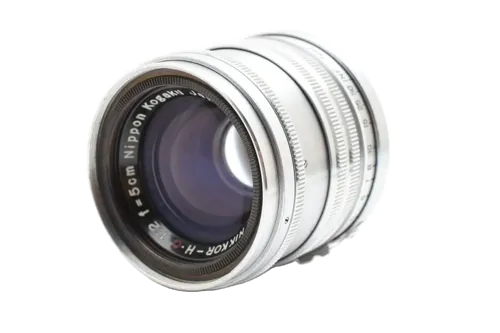
Nikkor-H.C 5cm f/2
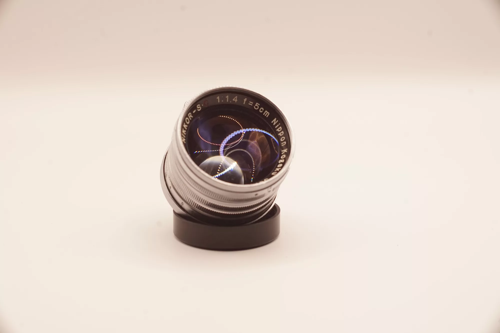
Nikkor-SC 50mm f1/1.4
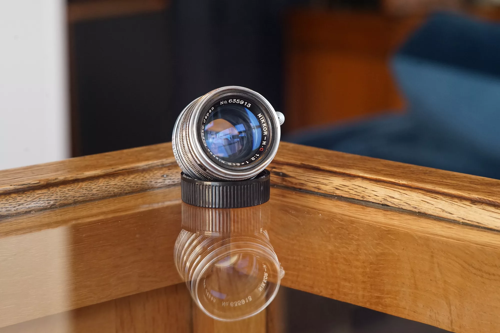
Nikkor-HC 5cm f/2 Rigid
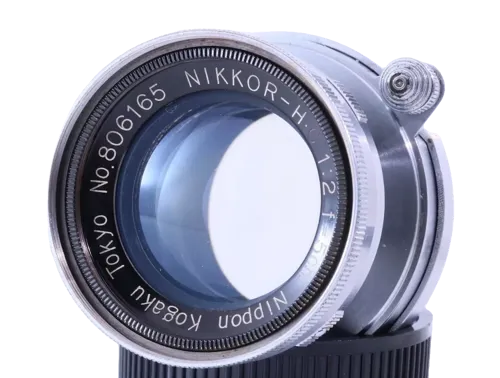
Nikkor-HC 5cm f/2 Collapsible

Nikkor-Q.C 50mm f/3.5 (Collapsible)

Comments