An early postwar Japanese collapsible 50mm f/3.5 lens with four elements in three groups, coupled LTM focusing and a 0.91m near limit.

Nippon-Kogaku Nikkor-Q.C 50mm f/3.5 (Collapsible)
LTM mount
No listings tracked for this lens right now.
The Nippon-Kogaku Nikkor-Q.C 50mm f/3.5 (Collapsible) is a LTM-mount lens for Leica rangefinder cameras. Leica price index →
How it compares
Measured against the 108 other 50mm LTM-mount lenses in the catalogue.
Specification
About this lens
Nippon-Kogaku Nikkor-Q.C 50mm f/3.5 (Collapsible)
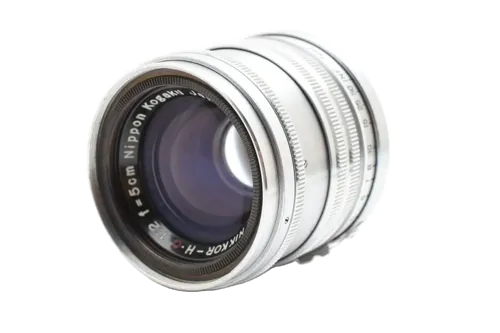
The Nippon-Kogaku Nikkor-Q.C 50mm f/3.5 (Collapsible) is an early postwar Japanese standard lens in factory Leica screw mount. Its optical construction uses four elements in three groups, and the retractable barrel keeps the lens compact for transport. The focusing mount is rangefinder coupled and reaches approximately 3 feet or 0.91 metres. The recorded front filter thread is 34.5mm.
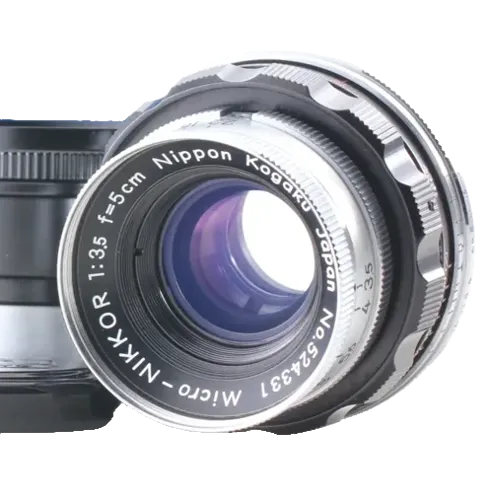
This entry is limited to the collapsible LTM version. The later rigid Nikkor-Q.C 50mm f/3.5 has a fixed barrel and an additional uncoupled close-focus sector, while the Micro-Nikkor 50mm f/3.5 uses a different five-element optical system. Their shared focal length and aperture do not make them one commercial product.
Optical qualities
Rendering
The four-element, three-group specification provides a compact standard-lens layout suited to the limited diameter of a collapsible barrel. Technical secondary sources describe a diaphragm position associated with the early retractable construction and distinguish it from the later rigid version. In the absence of a Nikon factory section drawing for this exact lens, broader formula labels should remain secondary to the confirmed element and group count.
At 50mm, the field of view is conventional for 35mm photography. The f/3.5 maximum aperture provides moderate depth of field and keeps the optical unit small. A clean, correctly assembled example can deliver useful central detail, while edge contrast and flare are more sensitive to early coating condition than they are in a modern multi-coated lens.
At f/3.5
Full aperture is practical for general daylight photography and for subjects that do not require even focus across the entire frame. The lens is not designed for strong shallow-focus effects, although background separation remains possible at its 0.91m near limit. Focus accuracy and subject distance influence the result more than a generic claim of vintage softness.
Nikon's rangefinder history records the introduction and later improvement of optical coatings during this period. Individual lenses may therefore differ in coating appearance and preservation. Haze, fungus and cleaning wear can reduce contrast independently of the original design.
Stopped down
Closing the aperture increases depth of field and usually improves consistency away from the centre. The middle apertures are appropriate for street scenes, architecture and landscapes where detail extends across the frame. At the smallest available setting, diffraction eventually limits fine resolution. The diaphragm blade count is not confirmed in the database, so no fixed highlight shape is claimed.
Handling and compatibility
The optical tube must be pulled forward and locked before an exposure. If it remains collapsed, the optics sit at the wrong extension. On digital cameras, rear clearance must be checked before retracting the lens because internal structures vary by body and adapter. The original LTM cam should be tested for agreement from infinity to the 0.91m limit.
The 34.5mm thread requires a matching filter, while compatible clamp-on accessories may fit the outer rim. A fitting should never be forced onto the fine thread.
History
Development and Launch
Nikon's Camera Chronicle states that production of a 50mm f/3.5 standard lens for Leica screw mount was recommended in December 1945. The product name was NIKKOR-Q.C 5cm f/3.5. This decision preceded the launch of Nikon's own rangefinder camera and places the LTM lens at the beginning of Nippon Kogaku's postwar 35mm programme.
The chronology describes early coating work in April 1946, followed by changes in coating material in 1948 and a harder coating from 1950. It also documents an advertisement for M39 Nikkor lenses in July 1947. These records establish the lens family firmly in the immediate postwar period, although a precise retail day for the first collapsible version is not stated.
Production Evolution
The collapsible lens passed through several exterior and engraving changes. Leitz Auction describes a late sixth version in coupled M39 mount, but the cited lot does not establish every boundary in the full sequence. Minor engraving differences remain within this profile when the retractable factory LTM construction is confirmed.
The later rigid lens introduced a fixed barrel, a separate uncoupled near sector and other mechanical changes. It is maintained as its own profile. The Micro-Nikkor likewise remains separate because it was developed for high-resolution reproduction and uses five elements in four groups.
Special Editions/Variants
Native Leica-thread collapsible examples are the subject of this entry. Related Nikkor-Q.C standard lenses may appear in other rangefinder mounts or barrels, but mount and focusing construction must be recorded accurately. No commemorative special edition is documented in the consulted sources.
Collector Notes
Check the Nikkor-Q.C 5cm f/3.5 engraving, original LTM thread, coupled cam and retractable tube. The barrel should extend smoothly and lock positively. Confirm infinity focus and rangefinder agreement, then test the 0.91m near limit. A lens head transferred into another mount should be described as a conversion.
Inspect for haze, fungus, coating wear, scratches and separation. Mechanical checks should include the locking mechanism, helicoid, aperture and fine filter thread. Auction prices, condition grades and serial numbers belong to individual examples and are excluded from the general description.
Sources
Where to buy
Related lenses
Similar lenses you might be interested in


Comments