An early-1950s Japanese rigid 50mm f/3.5 lens with four elements in three groups, coupled LTM focus, 12 blades and a 0.46m near range.

Nippon-Kogaku Nikkor-Q.C 50mm f/3.5 (Rigid)
LTM mount
No listings tracked for this lens right now.
The Nippon-Kogaku Nikkor-Q.C 50mm f/3.5 (Rigid) is a LTM-mount lens for Leica rangefinder cameras. Leica price index →
How it compares
Measured against the 108 other 50mm LTM-mount lenses in the catalogue.
Specification
About this lens
Nippon-Kogaku Nikkor-Q.C 50mm f/3.5 (Rigid)
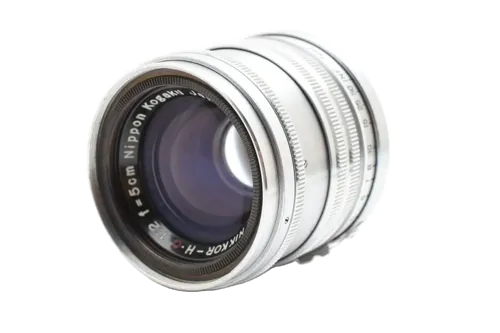
The Nippon-Kogaku Nikkor-Q.C 50mm f/3.5 (Rigid) is a mechanically distinct Leica screw-mount standard lens from the early 1950s. Its optical system uses four elements in three groups, while the fixed chrome barrel incorporates a twelve-blade diaphragm and a 34.5mm filter thread. Focusing is rangefinder coupled through the normal distance range, then continues into an uncoupled close sector that reaches approximately 1.5 feet or 0.46 metres.
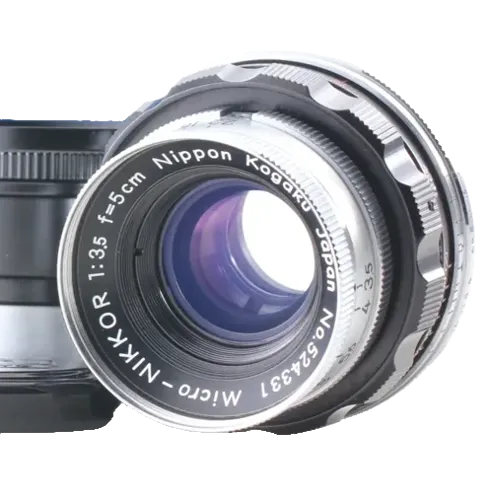
This rigid version has its own LeicaLensList profile because its fixed barrel, extended near range and aperture mechanism differ from the earlier collapsible Nikkor-Q.C 50mm f/3.5. It must also be kept separate from the five-element Micro-Nikkor 50mm f/3.5, despite their shared focal length and maximum aperture.
Optical qualities
Rendering
The four-element, three-group formula belongs to the compact standard-lens tradition. Secondary technical examinations report that the rigid and collapsible Nikkor-Q.C versions share closely related optics but position the diaphragm differently. Without a factory section drawing for this exact barrel, the reliable database specification remains the element and group count rather than a stronger claim of complete optical identity.
At f/3.5, the lens provides a normal field of view with moderate depth of field. Central detail and contrast depend heavily on coating and internal condition. Early optical surfaces affected by haze, fungus or cleaning wear can give a softer, lower-contrast result that should not be described as an intentional signature.
Close-range performance
The rangefinder-coupled travel ends near 3.5 feet. A tactile transition leads into a red or otherwise differentiated near sector extending to about 1.5 feet. In that sector, the lens moves closer but the camera rangefinder no longer supplies correct focus information. Measurement, scale focus or live view is required.
The close range is useful for details, but it does not transform the lens into the specialised Micro-Nikkor. The ordinary four-element formula, simpler focusing concept and different development purpose remain important distinctions. Depth of field at 0.46m is limited even at f/3.5, so precise image-plane focus is essential.
Stopped down
Closing the aperture normally improves field consistency and increases depth of field. The rigid version extends to f/22, while the twelve curved blades keep the opening comparatively rounded through much of the range. At the smallest settings, diffraction reduces fine detail. The optimum aperture depends on whether the priority is central definition, even coverage or close-range depth.
Handling and compatibility
The fixed barrel needs no extension before use and is mechanically simpler to deploy than a collapsible lens. Its long focusing rotation accommodates the extra near sector. On an LTM rangefinder, the user must recognise where coupling ends. On a mirrorless body, direct sensor focus covers the entire travel. The 34.5mm thread is uncommon, although suitable A36 clamp-on accessories are also reported for this barrel.
History
Development and Launch
Nippon Kogaku's original 5cm f/3.5 LTM standard lens was recommended for production in December 1945 and became part of the company's first postwar rangefinder programme. The rigid barrel appeared later. Leitz Auction dates a documented rigid example to about 1953 and confirms both the Leica screw mount and the 1.5-foot close-focus limit.
The exact catalogue introduction date for the rigid version has not been confirmed in Nikon's published chronology. It is therefore described as an early-1950s development rather than assigned an unsupported single launch year.
Production Evolution
The rigid construction replaced the retractable tube with a fixed barrel, extended the minimum aperture to f/22 and added the dedicated uncoupled close-focus sector. Secondary technical sources also note a changed diaphragm position. These are substantive mechanical differences and justify a separate profile even where the core optical specification remains four elements in three groups.
Engraving and minor finish details may differ between examples. No complete factory sequence or verified production total has been located, so cosmetic differences should be recorded without inventing formal generations.
Special Editions/Variants
The relevant counterpart is the collapsible Nikkor-Q.C 5cm f/3.5. That lens has its own profile. The Micro-Nikkor is a separate five-element high-resolution design. No commemorative edition of the rigid standard lens is documented. A lens in a later custom mount should be identified as an adaptation rather than a native variant.
Collector Notes
Verify the fixed barrel, Nikkor-Q.C 5cm f/3.5 engraving, twelve-blade iris, 34.5mm front and original coupled LTM cam. Check the tactile transition into the close sector and confirm that the normal range agrees with a calibrated rangefinder. The red near scale should be tested at the image plane.
Inspect the fine filter thread, helicoid, aperture and glass for damage or previous repair. Auction rarity language, serial numbers and accessories describe individual lots and should not be incorporated into the generic record.
Sources
Where to buy
Related lenses
Similar lenses you might be interested in


Comments