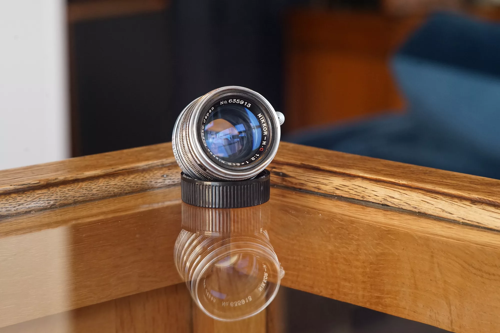
Nippon-Kogaku's 50mm f/1.1 Nikkor for the S-mount and L39 rangefinders, a fast 1950s ultra-speed lens prized by Leica and Nikon collectors.
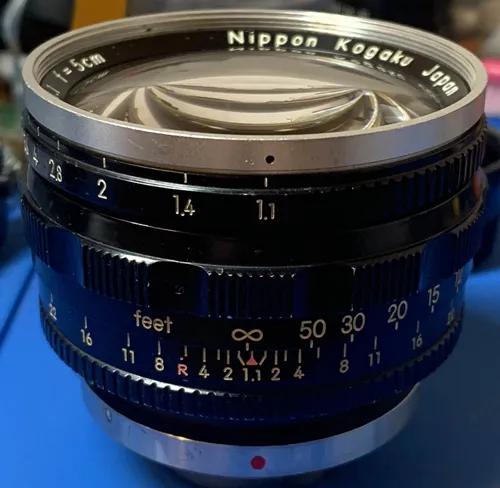
Nippon-Kogaku Nikkor-H (C) 5cm f/1.1
No listings tracked for this lens right now.
The Nippon-Kogaku Nikkor-H (C) 5cm f/1.1 is a Leica-mount lens for Leica rangefinder cameras. Leica price index →
How it compares
Measured against the 205 other 50mm lenses in the catalogue.
Specification
About this lens
Nippon-Kogaku Nikkor-H (C) 5cm f/1.1
When it appeared in 1956, this 50mm f/1.1 was the fastest lens Nippon-Kogaku had ever produced, and it would hold that distinction within the company's catalogue for more than half a century [1]. It was conceived as a direct answer to the Zunow 5cm f/1.1, the lens that had startled the Japanese optical industry as one of the world's first ultra-speed designs, and Nikon's engineers worked to match it[2]. The optical layout uses nine elements arranged in six groups, a Gauss-derived formula that incorporates rare-earth lanthanum glass to help control the aberrations that plague very fast apertures. The result became one of the signature fast normals of the 1950s rangefinder era, frequently set against the Leica Noctilux and the Canon 50mm f/0.95 in collector discussion[3].
The barrel is large and heavy, with a bulbous front element that sits close behind the 62mm filter ring, and period Nikon filters are recommended because other rings can foul the glass. The twelve-bladed iris is unusually delicate: the elements are packed so tightly that the blades had to be made very thin, leaving them prone to bending or warping if the aperture ring is forced, so a smooth-operating example is an important sign of health. Focusing reaches to one metre. The lens couples to the Nikon S-mount rangefinder bodies such as the SP and S2, and on those cameras the fast aperture pairs with the bright life-size finder that the SP introduced [4].
The lens is documented in three principal forms. The internal-mount version attaches like a conventional S-mount Nikkor but is heavy enough to stress a body's bayonet; the external-mount version adds its own focusing unit and is generally considered the most practical and most sought after; and a rare Leica screw-mount (L39) version was also made and commands the highest prices of the three. The optical design is the same across all three to the extent it has been documented. The verified records for this entry list the lens as a Nikkor-H (C); collectors and most published references instead label the 5cm f/1.1 as a Nikkor-N(·C), the N reflecting the nine-element count under Nikon's lettering system, so the designation is worth confirming against the barrel engraving on any given example.
Optical qualities
Rendering Reviewers consistently describe a fast lens that is unusually capable wide open while retaining a distinct vintage signature. Used at f/1.1 it is reported as surprisingly sharp at the point of focus, with focus described as easier to nail than on some rivals, and sharpness that improves on stopping down. The out-of-focus rendering is the lens's calling card: a swirly, oval bokeh likened to an olive or rugby-ball shape, a soft glow in the highlights, and transitions described as very natural, although the swirl can become busy against repetitive background texture. Colour is rich and contrast adequate from wide open, which users contrast favourably with the lower-contrast, paler look of the Canon 50mm f/0.95.
Aberrations As with most ultra-speed lenses of the period, coma is visible at night when shooting wide open, though it is reported as better controlled than on the Zunow 5cm f/1.1.
History
Development and Launch The 5cm f/1.1 was produced from 1956 to around 1959 and represented a breakthrough for Nippon-Kogaku in both optical and mechanical engineering. The optics are credited to Saburo Murakami and rely on lanthanum rare-earth glass to make the very large aperture usable. The lens arrived during the intense rivalry that followed Leica's M3 of 1954, as Nippon-Kogaku worked to position its S-series rangefinders, culminating in the SP of 1957, against the German benchmark.
Production Evolution The most significant production change was mechanical rather than optical. The early internal-mount design coupled directly through the body's helicoid like other S-mount Nikkors, but its weight made it awkward and a risk to the mount, so an external-mount version was introduced with a self-contained focusing unit; on this version the front barrel does not rotate while focusing. A Leica screw-mount edition was also produced.
Special editions Beyond the three documented mount variants (internal, external, and Leica L39 screw mount), no widely reported factory special finishes or commemorative versions are associated with this lens.
Collector Notes The external-mount version is generally the most desirable and the easiest to adapt, including to Leica bodies, although getting the rangefinder to agree with the lens on an adapter is a precise task best left to a technician; the Leica-mount version is rarer and dearer, and the internal-mount version is the least favoured because of the strain its weight places on a body. Prices for all three rose sharply in the years before 2024. Two practical checks dominate buying advice: the fragile thin iris blades, which warp or cave if the aperture is operated roughly and should never be forced if resistance or oil is felt, and the original hood, which is enormous and now scarce and expensive, with reproduction hoods made through the Nikon Historical Society as one alternative. Because the verified name on file (Nikkor-H (C)) differs from the Nikkor-N(·C) designation used by most references for this nine-element lens, the engraving on the barrel is worth verifying when identifying an example.
Sources
- Richard Haw's Classic Nikon Repair and Review. Repair: Nikkor-N 5cm f/1.1 (External-Mount)richardhaw.com →
- Japan Camera Hunter. Camera Geekery: Nikon SP + Nikkor 5cm F/1.1japancamerahunter.com →
- Tahusa. Nikkor-N 50mm f1.1 S Mount Nippon Kogaku Japan - Love at First Sighttahusa.co →
- Japan Camera Hunter. Camera Geekery: Nikon SP + Nikkor 5cm F/1.1japancamerahunter.com →
Where to buy
Related lenses
Similar lenses you might be interested in


Comments