Best price Good
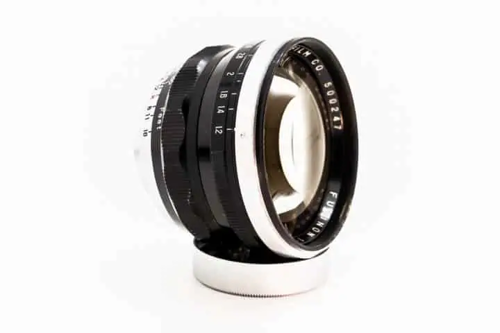
Zunow 5cm f1.1 version 2 LTM
Sold by Camera Obscura Elburg
€5,358 ≈ $5,787
The Zunow 5cm f/1.1 in LTM is a rare 1953 Japanese Sonnar-type optic, the first ultrafast rangefinder lens and a prized collector piece.
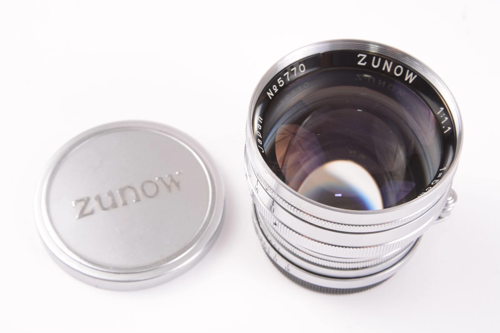
LTM mount
The Zunow 5cm f/1.1 is a LTM-mount lens for Leica rangefinder cameras. As of August 2026, it sells from €5,358 used across 1 listing, with a 30-day median of €5,358. Leica price index →
Measured against the 72 other 50mm LTM-mount lenses in the catalogue.
When this lens reached the market in 1953, it became the fastest normal lens available for a 35mm camera, briefly putting a small Japanese maker ahead of the larger optical firms in the postwar speed race [1][2]. Its roots run deeper than its release date suggests: development of an f/1.1 normal lens began in 1943 at Teikoku Optical to meet a wartime requirement from the Japanese Navy for a fast objective usable in low light, such as dawn and dusk aerial reconnaissance. Three prototypes were built, but the factory was destroyed in a wartime air raid, and the project took roughly a decade to complete, with finished prototypes appearing around 1950 before the production lens arrived in 1953. Zunow's name is generally linked to the Japanese word for "brain," and the lens is closely associated with the Teikoku Optical lineage.
Optically the lens uses a 9-element, 5-group Sonnar-type layout, likely derived from the 50mm f/1.5 Sonnar, and it was notable for reaching f/1.1 without resorting to rare-earth glasses. It was offered in Contax and Nikon rangefinder fittings as well as Leica screw mount, the configuration recorded here. The earliest version, the form that matches the 9-element design, earned the nickname "Ping-Pong ball" because its rounded front cell protruded noticeably. Despite the extreme aperture the barrel is fairly compact for an f/1.1 optic, with a reviewer comparing its overall size to a modern MS-Optical 50mm f/1.1 Sonnetar [3]. One practical quirk noted in period testing is that the lens mount can intrude into the corner of some rangefinder viewfinder windows, which led testers to suggest an accessory finder.
Zunow revised the design after the original launch. To address flare and wide-open performance issues, the company introduced a Type 2 in 1955 that replaced the protruding front with a flat-rear arrangement reported as 8 elements in 5 groups, with hard coatings on the air-to-glass surfaces to reduce internal reflections. Because the verified configuration here is 9 elements in 5 groups, this entry corresponds to the original 1953 type rather than the later revision. Production was small, and survivors are split across the Contax, Nikon, and Leica thread mounts, so mount type is an important identification point for collectors.
Rendering Contemporary and modern accounts agree that the lens is at its most characterful, and least corrected, wide open. Period testing found vignetting at f/1.1 that clears by about f/2.8, acceptable central sharpness, and softening toward the edges and corners, with the sharpest results between roughly f/5.6 and f/11. A modern user shooting it on film and on a digital Leica described a soft, glowing look at f/1.1, with f/2.8 emerging as a sweet spot where sharpness builds and the subject separates well; the same user noted field curvature that keeps the corners from crisping up even stopped down.
Bokeh and transitions The Sonnar-type design produces a busy, radial out-of-focus rendering that one reviewer likened to fireworks and compared to the modern Zeiss Sonnar 50mm f/1.5 ZM, noting it can compete with the subject unless the background is kept clean.
Flare resistance The original protruding-front version was reported to suffer from flare wide open, which was among the reasons Zunow reworked the optics and added coatings for the later type.
Digital use The lens has been used on a modern Leica M digital body, where its soft, glowing wide-open signature and Sonnar-style background rendering remain evident.
Development and Launch The f/1.1 project originated in 1943 at Teikoku Optical under a Japanese Navy requirement for a high-speed lens for low-light and reconnaissance use. Design work is associated with Sakuo Suzuki and Michisaburo Hamano, the latter described as having moved from Nippon Kogaku toward the Teikoku Optical effort. After wartime destruction of the factory and a long rebuild, prototypes were finished around 1950 and the production 5cm f/1.1 was released in 1953, making it the first ultrafast lens for rangefinder cameras. It held the speed lead until Nippon Kogaku matched it with the Nikkor 5cm f/1.1 in early 1956; Canon later went faster with the 50mm f/0.95 in 1961, and Leitz reached f/1.0 only with the Noctilux in 1976.
Production Evolution The original 1953 lens, with its rounded protruding front element, was followed in 1955 by a redesigned Type 2 that adopted a flat-rear layout and added hard coatings to improve flare control and wide-open brightness. The two versions differ in element count and front-cell shape, which is the clearest way to tell them apart.
Special editions No major factory special editions are widely documented for this lens. The principal variations of interest are the rangefinder mount fittings, with Contax, Nikon, and Leica thread-mount examples recorded.
Collector Notes The Zunow 5cm f/1.1 is rare and sought after, with reported sales commonly in the multi-thousand-dollar range and higher for clean or desirable mounts; for reference, its 1956 price was roughly US$450. Mount type, version (protruding-front original versus flat-rear Type 2), and coating condition are worth verifying before purchase, and buyers should remember that the lens mount may interfere with some camera viewfinder windows. Because so few were made, provenance and originality matter, and confirming the LTM fitting against the camera is advisable.
About the usual price. The lowest listing is around the 30-day average.
Over the last 12 weeks the median price for the Zunow 5cm f/1.1 has risen, ranging from €5,266 to €5,358 (now €5,358).
Weekly price (EUR). Median (Good or better) and lowest (Good or better) across 12 weeks. The full figures follow in the table below.
| Week | Median | Lowest |
|---|---|---|
| Jun 1, 2026 | €5,279 | €5,279 |
| Jun 8, 2026 | €5,279 | €5,279 |
| Jun 15, 2026 | €5,279 | €5,279 |
| Jun 22, 2026 | €5,279 | €5,279 |
| Jun 29, 2026 | €5,279 | €5,279 |
| Jul 6, 2026 | €5,279 | €5,279 |
| Jul 13, 2026 | €5,279 | €5,279 |
| Jul 20, 2026 | €5,266 | €5,266 |
| Jul 27, 2026 | €5,316 | €5,316 |
| Aug 3, 2026 | €5,339 | €5,339 |
| Aug 10, 2026 | €5,354 | €5,354 |
| Aug 17, 2026 | €5,358 | €5,358 |
Every shop grades differently. Leica Classic uses letters, Ffordes uses E++ and E+, German dealers write "Zustand B", Japanese dealers write A−. We map all of them onto the one ladder below. Where a shop states its own grade, we print it under ours.
As of August 2026, the Zunow 5cm f/1.1 sells from €5,358 used, with a 30-day median of €5,358, across 1 active listing.
As of August 2026, the Zunow 5cm f/1.1 is sold by 1 source (1 listing), from €5,358 used: all compared cheapest-first on this page.
Similar lenses you might be interested in
Comments