The Fujinon 50mm f/1.2 is a rare 1954 Sonnar-derived ultra-fast LTM rangefinder lens, one of Japan's "Big Four" speed lenses and a prized collector piece.
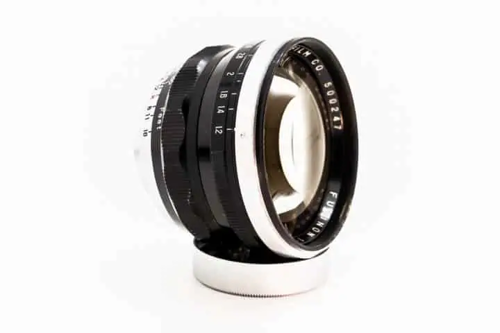
Fujifilm Fujinon 5cm f/1.2
LTM mount
No listings tracked for this lens right now.
The Fujifilm Fujinon 5cm f/1.2 is a LTM-mount lens for Leica rangefinder cameras. Leica price index →
How it compares
Measured against the 108 other 50mm LTM-mount lenses in the catalogue.
Specification
About this lens
Fujifilm Fujinon 50mm f/1.2
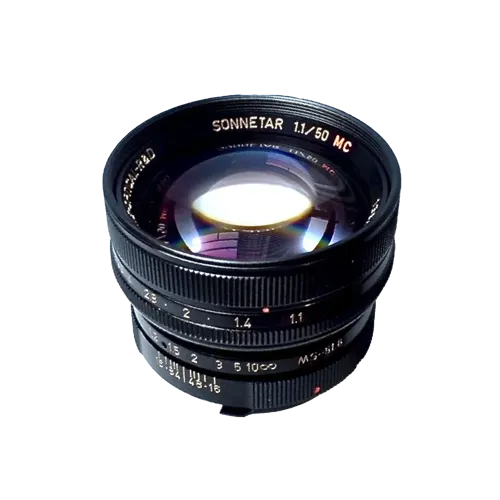
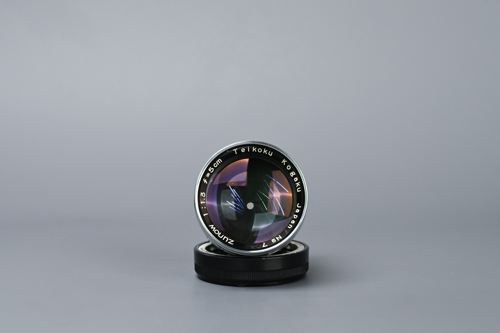
Fuji Photo Film's entry into the postwar Japanese "speed race" produced one of the rarest ultra-fast rangefinder lenses of its era. Released in 1954, the Fujinon 50mm f/1.2 is usually grouped with three other landmark designs as the "Big Four" of Japanese fast normal lenses: the Zunow 50mm f/1.1, Nippon Kogaku's Nikkor 50mm f/1.1, and the Konishiroku Hexanon 60mm f/1.2 [2]. The Zunow 50mm f/1.1 of 1953 had briefly held the title of the fastest Leica-mount lens, and the Fujinon and Hexanon answered it the following year. Production was very limited, with collector accounts citing roughly 800 examples made in Leica screw mount and only about 50 in the Nikon S rangefinder mount, which is the main reason surviving examples now trade at exceptionally high prices [1].
The optical design is credited to Fuji's Ryoichi Doi and traces back to his earlier Solinon 5cm f/1.5, a Sonnar-type formula patented in 1948. Doi reportedly pushed the Sonnar layout toward higher speed, passing through a nine-element prototype before settling on the eight-element production design, which uses new low-refractive-index, high-dispersion glass intended to suppress flare and hold contrast wide open. The lens is built in Leica screw mount (LTM/M39) and is not rangefinder coupled in the M-mount sense recorded by LeicaLensList, so close-distance accuracy depends on the host body's coupling. Reviewers describe a relatively compact barrel for such a fast aperture, solid metal construction, crisp aperture detents, and smooth focusing; the click-stopped aperture ring carries an f/1.6 marking rather than the more usual f/1.8, and the spacing of the stops recalls older cine lenses. On a modern body, a loaded Leica with the lens mounted weighs close to one kilogram, and the unit is slightly front heavy.
Documented variants are defined mainly by mount: the common LTM version and the much scarcer Nikon S rangefinder version, with the design also associated with Contax-type rangefinder fittings of the period. Published descriptions of the construction are not fully consistent: at least one collector source lists a twelve-bladed diaphragm and a four-group layout, which differs from the values recorded by LeicaLensList; the verified specifications (ten blades, six groups, eight elements) should be treated as authoritative.
Optical qualities
Rendering First-hand reports of this lens are scarce because so few exist, so any rendering summary should be read as limited. The eight-element Sonnar-derived design with selected low-dispersion glass was engineered to keep flare down and contrast up at full aperture. In practical use on both film and a high-resolution digital body, one reviewer described the results as sharp yet soft-edged and "painterly," with thin, crisp lines, comparing the character to 1960s Zeiss Planars rather than to a clinical modern lens. These are individual impressions rather than measured data, and behavior at the extreme corners, flare resistance against modern light sources, and sample-to-sample variation are not well documented.
History
Development and Launch The lens was a product of the speed competition that drove several Japanese optical makers in the early 1950s, with the German optical industry as the implicit benchmark. Fuji's design grew out of Doi's Sonnar-type work of the late 1940s and reached the market in 1954, alongside the Konishiroku Hexanon 60mm f/1.2 and shortly after the Zunow 50mm f/1.1. Contemporary accounts suggest the Fujinon's "new generation glass" and more practical handling were viewed as advantages over the awkwardly shaped Zunow.
Special editions No widely documented factory special editions are recorded beyond the differing rangefinder mounts; the principal distinction collectors track is between the LTM version and the far rarer Nikon S version.
Collector Notes This is a low-production, high-value lens, and a late-1950s price list shows it then selling for about US$299.50, with present-day asking prices reported well into five figures because so few were made. Given that scarcity, buyers should verify mount type, optical condition, and originality carefully, and be aware that published specifications for blade count and group arrangement vary between sources.
Sources
Where to buy
Related lenses
Similar lenses you might be interested in

Comments