The Zunow 50mm f/1.3 is a rare Sonnar-derived LTM rangefinder lens from Japan's Teikoku Kogaku, a sought-after companion to the famous Zunow 5cm f/1.1.</parameter> <parameter name="long_description">## Zunow 50mm f1.3 Among the small family of fast standard lenses built by Japan's Zunow operation, the 50mm f/1.3 is the lesser known sibling of the celebrated 5cm f/1.1, the lens that in 1953 was the fastest available for any 35mm camera [1]. The f/1.3 belonged to the same ambitious push toward high-speed optics: a 1957 catalogue listing places it alongside the firm's other rangefinder offerings, a 35mm f/1.7, the 50mm f/1.1, a 50mm f/1.9, and a 100mm f/2, all offered in mounts for Leica, Contax, Canon and Nikon bodies. Surviving examples are scarce and trade for high sums, which keeps the f/1.3 firmly in collector territory rather than everyday use [2]. The lens uses a Sonnar-type optical layout and was produced in Leica screw mount. In LeicaLensList's records it is a seven-element design in five groups, with an eight-blade diaphragm and a minimum focusing distance of one metre, and it is not rangefinder coupled, so distance must be set by scale or estimation rather than via the camera's coupled rangefinder. As an LTM (M39) lens it can be adapted to later M-mount bodies and to mirrorless cameras with a screw-mount adapter, though the absence of rangefinder coupling means focusing on a film rangefinder body is approximate. Documented version detail for this particular lens is thin, reflecting how few were made and how rarely they surface. It is marked under the Zunow name, the brand used by Teikoku Kogaku and later Zunow Optical, and is sometimes catalogued as "Zunow Teikoku Kogaku" by dealers. Because the f/1.1 dominates almost all discussion of the marque, buyers should not assume that notes written about the f/1.1 apply to the f/1.3. --- ## Optical qualities **Rendering** Reliable, detailed rendering reports for the 50mm f/1.3 specifically are limited, in keeping with its rarity, so firm performance claims cannot be made with confidence. What is established is the design pedigree: a Sonnar-type formula and a fast f/1.3 maximum aperture from the era of Zunow's high-speed standard lenses. As with other fast Sonnar-derived lenses of the 1950s, the wide-open character would be expected to favour an older drawing style over modern clinical correction, but this should be treated as design context rather than a tested result. --- ## History **Development and Launch** The lens traces to Teikoku Kogaku, founded around 1930 by Suzuki Sakuta as the Imperial Optical Research Institute, a firm that initially ground lenses for other companies. It was renamed Teikoku Kogaku Kogyo in 1954 and became Zunow Optical Industry in 1956. Zunow's reputation rests on its high-speed standard lenses: the 5cm f/1.1 of 1953 was unmatched for speed until Nippon Kogaku's Nikkor 50mm f/1.1 of 1956. The 50mm f/1.3 appears among the company's rangefinder lenses in a 1957 listing, offered for Leica, Contax, Canon and Nikon cameras. **Production Evolution** The company's lenses were generally well regarded, and after the early ultrafast designs Zunow also supplied optics to other camera makers. Zunow's fortunes declined after the failure of its SLR in 1959 and the collapse of customers Arco and Neoca around 1960; rather than be absorbed by another firm, the company closed in 1961, with its work continuing in a new venture, Ace Optical, founded the same year in partnership with Elmo. Detailed production-change records specific to the 50mm f/1.3, such as coating or barrel revisions, are not well documented in available sources. **Collector Notes** This is a rare lens that surfaces mainly on the Japanese market, and asking prices for surviving examples are very high. One dealer listing describes it as a Sonnar-type design and dates the firm's underlying high-speed lens work to wartime aviation optics, but the same listing quotes a nine-element, five-group construction, which conflicts with the seven-element, five-group figure recorded by LeicaLensList; the verified specification should be treated as authoritative. Because the Zunow name is overwhelmingly associated with the f/1.1, verify that any lens offered as an f/1.3 is correctly identified by its engraved maximum aperture, and confirm mount, glass condition and originality given the scarcity and value involved. --- ## Sources * [1] Crafting Pixels. *Vintage lens makers – Zunow (Japan)*. https://pixelcraft.photo.blog/2025/03/06/vintage-lens-makers-zunow-japan/ * [2] LSKamera. *Zunow Teikoku Kogaku 50mm f/1.3 LTM*. https://lskamera.com/zunow-teikoku-kogaku-50mm-f13-ltm
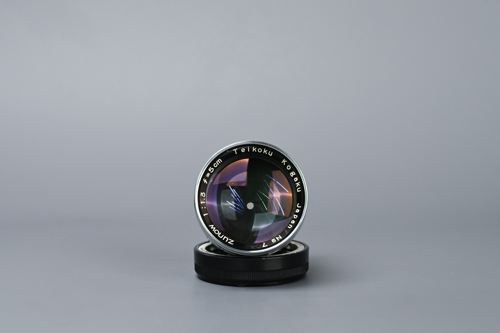
Zunow 50mm f1.3
LTM mount
No listings tracked for this lens right now.
The Zunow 50mm f1.3 is a LTM-mount lens for Leica rangefinder cameras. Leica price index →
How it compares
Measured against the 74 other 50mm LTM-mount lenses in the catalogue.
Specification
About this lens
Zunow 50mm f1.3
The Zunow 50mm f/1.3 is one of the lesser known fast standard lenses from Zunow, a small Japanese maker remembered chiefly for the ultrafast 5cm f/1.1 of 1953, which at its introduction was the fastest lens available for any 35mm camera [1]. The f/1.3 sat just below that headline lens in the catalogue, offering a still very fast aperture in a more conventional package. Period documentation lists it among the rangefinder lenses Zunow offered for Leica thread, Contax, Canon and Nikon mounts alongside the 35mm f/1.7, 50mm f/1.1, 50mm f/1.9 and 100mm f/2. It is far rarer than the f/1.1 and appears infrequently, mostly on the Japanese market and through specialist dealers.
The lens uses a seven element, five group optical layout and a Leica screw mount, and like Zunow's other fast standards of the period it follows the Sonnar lineage that defined the company's design approach [2]. Aperture is set with eight blades, and focusing runs to a minimum distance of one metre, which was typical of fast rangefinder fifties of the era. The barrel is finished in chrome in the screw mount form sold by dealers. As with many independent LTM lenses, buyers should confirm rangefinder behaviour on a given body, since coupling accuracy across different camera makers cannot be assumed for every example.
Zunow itself evolved through several names. The firm traces to Teikoku Kogaku Kenkyujo, founded around 1930, which became Teikoku Kogaku Kogyo in 1954 and then Zunow Kogaku Kogyo, or Zunow Optical Industry, in 1956. Because of this, surviving lenses and dealer listings sometimes carry the Teikoku Kogaku name alongside Zunow, which is a point of identification rather than a sign of a different lens. The company's fortunes declined at the end of the decade, and after the failure of its SLR and the loss of key customers it closed in 1961.
Optical qualities
Rendering
Detailed, independent testing of the 50mm f/1.3 specifically is scarce, so firm performance claims are limited. As a fast Sonnar-derived design of the 1950s, it can be expected to share the general traits of its family, namely a soft, glowing wide open look that gains definition on stopping down. Given the limited published evidence for this particular lens, more precise statements about its sharpness, bokeh or flare control are not well supported and are best verified against a specific sample.
History
Development and Launch
Zunow's reputation rested on speed. The 5cm f/1.1 of 1953 was the first ultrafast 50mm for rangefinder cameras and was not matched until Nippon Kogaku released the Nikkor 50mm f/1.1 in 1956. After establishing that lead, Zunow broadened its range with good quality but less extreme lenses, and the 50mm f/1.3 belongs to this group of fast but more practical standards. A list of Zunow lenses from 1957 records the 50mm f/1.3 among the rangefinder offerings for Leica, Contax, Canon and Nikon cameras, placing its availability in the second half of the decade.
Collector Notes
The f/1.3 is uncommon and is encountered far less often than the f/1.1, with most examples surfacing in Japan or through dealers who specialise in vintage Japanese glass. Listings may show the lens under the Zunow or Teikoku Kogaku name, reflecting the company's name changes during the 1950s, so both labels can be correct. As with other fast Japanese rangefinder lenses of this age, prospective buyers should check the optics carefully for haze, separation and cleaning marks, and confirm focusing and mount fit on their intended camera before purchase. Published figures for early Zunow lenses occasionally vary between sources, so individual specimens are worth verifying directly.
Sources
Where to buy
Related lenses
Similar lenses you might be interested in
Comments