A 1956 Japanese collapsible 50mm f/3.5 macro lens with five elements in four groups, Xenotar-type optics and dual-range LTM focus to 0.46m.
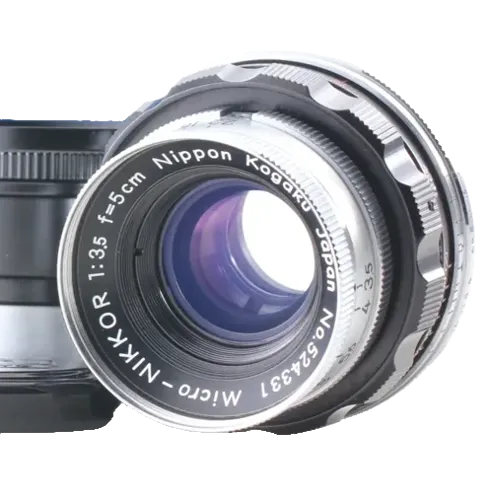
Nippon-Kogaku Micro-Nikkor 50mm f/3.5
LTM mount
No listings tracked for this lens right now.
The Nippon-Kogaku Micro-Nikkor 50mm f/3.5 is a LTM-mount lens for Leica rangefinder cameras. Leica price index →
How it compares
Measured against the 108 other 50mm LTM-mount lenses in the catalogue.
Specification
About this lens
Nippon-Kogaku Micro-Nikkor 50mm f/3.5
The Nippon-Kogaku Micro-Nikkor 50mm f/3.5 is the original Micro-Nikkor for Nikon rangefinder and Leica screw-mount cameras, introduced in 1956. The LTM version combines a five-element, four-group Xenotar-type optical system with a two-part focusing scale. The white range from infinity to about 3.5 feet is rangefinder coupled, while the red close range continues without coupling to approximately 1.5 feet or 0.46 metres. The recorded filter thread is 34.5mm.
This is a purpose-designed high-resolution Micro lens, not the four-element Nikkor-Q.C 50mm f/3.5 standard lens. It is also separate from the later 55mm f/3.5 Micro-Nikkors for Nikon F cameras, which use a longer focal length and different mechanical construction.
Optical qualities
Rendering
Nikon describes a typical Xenotar arrangement. In front of the diaphragm are a positive element and a cemented positive-negative pair; behind it are separate negative and positive elements. The glass choices correct chromatic and spherical aberration as well as coma, while Nikon notes that field-curvature correction is a more difficult part of this design family.
The lens was developed for high-resolution reproduction at reduction ratios rather than optimized only for infinity. Nikon's modern evaluation nevertheless finds useful performance from distant subjects through close-up work. At f/3.5, resolution is described as consistent across the frame with a small degree of residual blur and moderate contrast. Condition remains critical because haze or disturbed element spacing can erase the advantage of a specialised formula.
Close-range performance
Nikon traces the design standard to reproduction work and discusses performance across magnifications extending well beyond ordinary rangefinder distances. The coupled white scale supports normal photography down to roughly 1.07m. Beyond that point, the red scale is not communicated to the camera's rangefinder, so focus must be established by measurement, ground-glass methods or live view on an adapted digital body.
At close range, depth of field becomes very small and effective exposure changes with extension. A stable support and careful focus are often more consequential than using the smallest aperture. The lens's mechanical transition between ranges should be understood before close-up work begins.
Stopped down
Nikon reports a clear increase in contrast at f/5.6, with particularly strong overall quality around f/5.6 to f/8. At f/11 diffraction begins to reduce sharpness, becoming more visible at f/16 and f/22. Smaller apertures may still be necessary for close-up depth of field, but they involve a resolution trade-off.
Handling and compatibility
The original LTM mount is coupled only over the white distance range. A user should not assume that the camera rangefinder remains valid after entering the red sector. On mirrorless cameras, direct sensor focusing makes the entire travel usable, provided the adapter gives correct register. The compact 34.5mm thread requires correctly sized filters and must not be forced by a near-fitting accessory.
History
Development and Launch
Nikon links the lens to ultra-high-resolution microcard research conducted by Professor Zyun Koana with Nippon Kogaku designers Hideo Azuma and Zenji Wakimoto. Prototype drawings were issued in April 1952, and the R Nikkor prototypes were probably completed by 1954. The production name became Micro-Nikkor rather than R Nikkor.
Mass production began on 4 May 1956. Nikon identifies it as the first Micro lens for Nikon S and L-mount cameras. The project was associated with Koana's miniature reproduction of the novella Takekurabe and with public demonstrations of high-resolution microcard work.
Production Evolution
The lens was produced in Nikon rangefinder and Leica-thread barrels. Front-ring engraving may include the C suffix, and exterior details can vary. Those markings do not justify splitting otherwise matching 5cm f/3.5 LTM examples into separate optical profiles.
The later 55mm f/3.5 Micro-Nikkor for the Nikon F was derived from the concept but changed focal length and glass choices to accommodate the SLR register. It is a successor, not the same lens in a different mount.
Special Editions/Variants
Native Nikon S and LTM versions are the principal documented variants. Leitz Auction records a black-and-chrome, collapsible M39 example with the coupled white scale and uncoupled red scale. Its stated production quantity is an auction-house claim rather than a complete factory ledger, so no lifetime total is asserted here.
Collector Notes
Confirm the Micro-Nikkor name, 5cm f/3.5 specification, five-element identity and original LTM focusing assembly. Both distance scales and their transition should operate correctly. Check rangefinder agreement in the white sector, then verify the red sector by direct image-plane focus.
The complex focusing mechanism should move smoothly without play. Inspect the cemented group for separation and all surfaces for haze, fungus, coating wear or cleaning damage. Original accessories can add context, but auction prices, condition grades and individual serial numbers do not belong in the generic model profile.
Sources
Where to buy
Related lenses
Similar lenses you might be interested in



Comments