A circa-1935 Meyer 40mm f/4.5 wide-angle in original uncoupled Leica M39 mount, built around a four-element symmetrical design later named Helioplan.
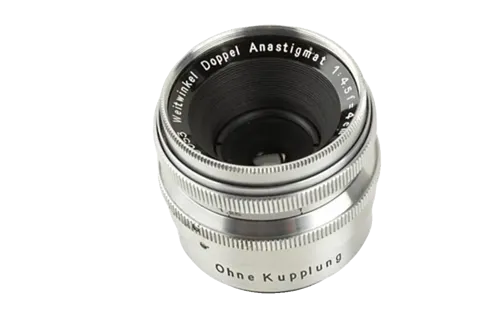
Meyer-Optik Gorlitz Weitwinkel Doppel Anastigmat 40mm f/4.5
LTM mount
No listings tracked for this lens right now.
The Meyer-Optik Gorlitz Weitwinkel Doppel Anastigmat 40mm f/4.5 is a LTM-mount lens for Leica rangefinder cameras. Leica price index →
How it compares
Measured against the 4 other 40mm LTM-mount lenses in the catalogue.
Specification
About this lens
Meyer-Optik Gorlitz Weitwinkel Doppel Anastigmat 40mm f/4.5
The Meyer-Optik Gorlitz Weitwinkel Doppel Anastigmat 40mm f/4.5 is a prewar manual-focus lens documented in an original Leica M39 mount from about 1935. The surviving Leica example is explicitly engraved “Ohne Kupplung,” meaning without coupling, so it focuses by scale and does not operate the camera's rangefinder. Although 40mm is now often treated as a moderate wide or wide-normal focal length on 35mm film, it was marketed as a wide-angle option in the period.
The 40mm f/4.5 Weitwinkel Doppel Anastigmat belongs to Meyer's symmetrical four-element, four-group double-anastigmat tradition. Period and postwar documentation connects this optical type with the later Helioplan 40mm f/4.5, but that continuity does not make every Helioplan mechanical specification applicable to the prewar Leica lens. The exact minimum focusing distance, diaphragm-blade count, filter fitting, weight and coating status of the M39 version remain undocumented in the sources reviewed here.
Operation is fully manual. The photographer sets the aperture on the lens, estimates or measures subject distance, transfers that distance to the focusing scale and composes with an external finder suited to approximately 40mm. The lens can be mounted on many later Leica M bodies with an appropriate M39-to-M adapter, but it remains uncoupled. Live view or an electronic viewfinder is the most reliable focusing method on a compatible digital camera, especially at closer distances.
Optical qualities
Rendering
The symmetrical double-anastigmat layout was designed to balance several aberrations around a central stop and to provide a useful image field with modest distortion. That design history gives useful context, but it does not justify a universal claim about the look of every surviving M39 example. No controlled test of the exact uncoupled Leica version was found. Sample images from Exakta or postwar Helioplan lenses may indicate family tendencies, yet coatings, barrels and individual condition can alter contrast and flare.
Sharpness and field behavior
Contemporary technical discussion of the 40mm family describes a 56-degree field and a symmetrical construction developed before retrofocus wide-angle lenses became common. A four-element design can deliver good central detail, while the outer field may respond to stopping down. The balance of center and edges should be tested on the individual lens. At f/4.5 its distinction was compact wide-angle coverage rather than high speed.
Distortion and close-range use
Symmetry around the aperture can help suppress distortion, one reason related double-anastigmat designs were also useful for reproduction work. This does not mean that the camera lens is mathematically distortion-free at every focus distance. The practical advantage is better described as an optical layout that controls distortion without the asymmetry of a later retrofocus construction. Because the Leica version has no rangefinder coupling, accurate close-range work requires an external distance measurement or direct sensor viewing.
Contrast and flare
Eight exposed glass-air surfaces in an uncemented four-element layout make internal reflections an important consideration, particularly for a prewar lens. Postwar Helioplan production later benefited from antireflection coating, but that should not be projected backward onto the circa-1935 M39 model. A well-fitted hood and careful placement of bright light sources can materially improve usable contrast. Haze, cleaning marks and deteriorated internal blackening can have a stronger effect than the nominal formula.
History
Development and Launch
Meyer had a long history with double-anastigmat lenses before adapting the type to miniature-camera focal lengths. The 40mm f/4.5 version appears in the company's prewar range and is documented in Leica M39 form at approximately 1935. A 1939 catalogue reproduced in a historical study lists the same focal length and aperture for small-format cameras, while a separate Leitz Auction record establishes the earlier original M39 example and its uncoupled engraving.
Production Evolution
The design was offered in more than one camera mount before the Second World War. After the war, Meyer continued the closely related 40mm f/4.5 optical type under the Helioplan name. Historical catalogue analysis describes the postwar Helioplan as the successor to the Weitwinkel Doppel Anastigmat and says the optical construction remained unchanged, while the barrel and later aperture arrangements evolved. Coating was introduced into Meyer production after the war, further separating later examples from the prewar Leica lens.
Special Editions/Variants
Known forms include the uncoupled Leica M39 lens, prewar reflex-camera versions and postwar Helioplan successors. A Contax prototype is also documented, but it is a separate mount variant and does not supply mechanical specifications for the Leica lens. The words “Ohne Kupplung” are especially useful for identifying the function of the documented M39 barrel: they state directly that the lens lacks rangefinder coupling.
Collector Notes
The first check is whether the rear mount and engraving correspond to an original uncoupled M39 barrel. The lens should focus smoothly, its distance scale should agree reasonably with measured or live-view focus, and the diaphragm should move cleanly. Because the camera rangefinder is not connected, calibration of the engraved scale matters directly in use. A 40mm or adjustable finder provides more accurate framing than a standard 50mm finder.
Sources
- Leitz Auction: Hugo Meyer Weitwinkel Doppel Anastigmat 4.5/4cmleitz-auction.com →
- Zeiss Ikon VEB history: Meyer Helioplan and its double-anastigmat backgroundzeissikonveb.de →
- Photobutmore: Meyer prewar lenses and the 40mm double anastigmatphotobutmore.de →
- JAPB: Meyer lens-name and construction guidejapb.net →
Where to buy
Related lenses
Similar lenses you might be interested in
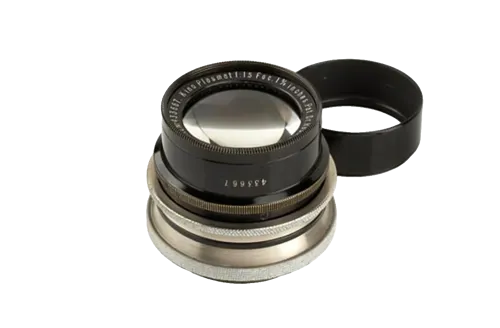
Kino-Plasmat 1 5/8-inch 41.3mm f/1.5
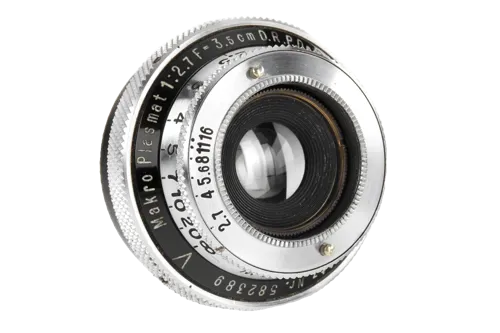
Makro-Plasmat 35mm f/2.7
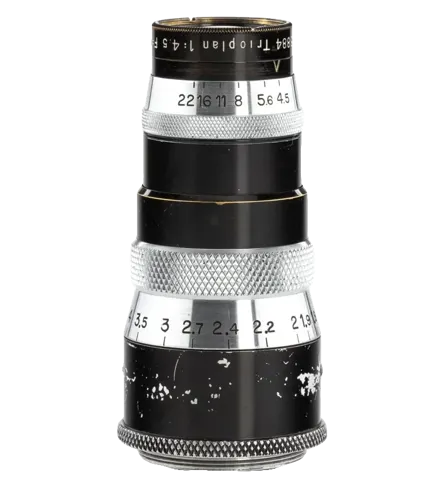
Trioplan 105mm f/4.5
Primoplan 50mm f/1.9 (Collapsible)
Makro-Plasmat 50mm f/2.7 (Collapsible)
Comments