A 1933 Makro-Plasmat 35mm f/2.7 wide-angle in original coupled Leica M39 mount, distinguished by a long focus throw and approximately 0.7m close focus.
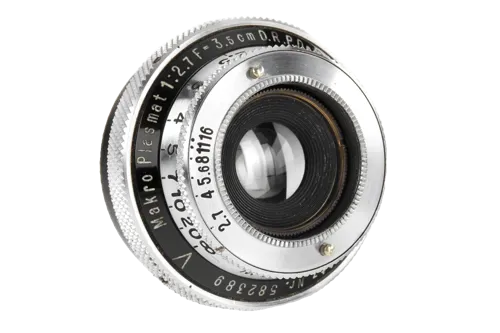
Meyer-Optik Gorlitz Makro-Plasmat 35mm f/2.7
LTM mount
No listings tracked for this lens right now.
The Meyer-Optik Gorlitz Makro-Plasmat 35mm f/2.7 is a LTM-mount lens for Leica rangefinder cameras. Leica price index →
How it compares
Measured against the 45 other 35mm LTM-mount lenses in the catalogue.
Specification
About this lens
Meyer-Optik Gorlitz Makro-Plasmat 35mm f/2.7
The Meyer-Optik Gorlitz Makro-Plasmat 35mm f/2.7 is a prewar moderate wide-angle documented in an original, rangefinder-coupled Leica M39 mount from 1933. The exact auction record describes a compact, robust barrel with a long focus throw and focusing to approximately 0.7 metres. That close-focus capability is the clearest practical distinction behind the Makro designation in this Leica version.
The Makro-Plasmat belongs to the Plasmat work associated with optical designer Paul Rudolph and Hugo Meyer. Modern references agree that it is a multi-element symmetrical or near-symmetrical design, but the exact grouping reported for the 35mm lens is inconsistent. One lens database lists six elements in five groups, while general Plasmat descriptions are often summarized as six elements in four groups. Without a primary section drawing for this exact 35mm M39 version, this profile does not fix the group count.
Focus and aperture are entirely manual. Mechanical rangefinder coupling assists normal-distance focusing, but a camera's own close-range limit may prevent coupled use throughout the lens's full 0.7m travel. A 35mm accessory finder is needed on bodies without a matching view, and live view is preferable near the minimum distance. The lens can mount on many Leica M cameras with a suitable M39-to-M adapter. Diaphragm-blade count, filter fitting, weight and dimensions remain undocumented here.
Optical qualities
Rendering
No controlled test of the exact 35mm coupled M39 version was found. Results from 50mm and 105mm Makro-Plasmats involve different focal lengths and optical spacing, so they cannot establish the 35mm lens's signature. Its documented facts support a more restrained description: it combines a relatively fast f/2.7 aperture for its period with a moderate wide-angle view and unusually close focusing for an early Leica accessory.
Sharpness and close focus
The long helicoid gives fine control over focus, especially near the minimum distance where depth of field becomes small. Rangefinder calibration, field curvature and focus shift may affect observed sharpness, but no measured aperture series is available for this exact lens. Stopping down increases depth of field and may improve edge consistency. At close range, direct sensor viewing is more reliable than assuming the camera's rangefinder remains coupled across the entire extension.
Bokeh and field behavior
At 35mm, strong background separation depends on close subject distance and sufficient spacing behind the subject. The f/2.7 aperture can make that possible, but the shape and texture of blur depend on diaphragm geometry and residual aberrations. Since the blade count and exact grouping are not securely established, claims of a fixed highlight shape or a specific “Plasmat look” would be speculative.
Contrast and flare
The lens dates from 1933, before lens coating became standard practice. One current database describes the 35mm lens as uncoated, but coating and resurfacing should still be inspected on the individual example. A hood can help control veiling light. Haze, separation, cleaning damage and displaced internal groups are especially important in a complex lens of this age and can overwhelm the intended optical character.
History
Development and Launch
Paul Rudolph joined Hugo Meyer around 1920 and contributed the Plasmat family after earlier work for Carl Zeiss. A historical account dates his Makro-Plasmat patent to 1926. The term described a branch intended for close-range correction, while Meyer also developed faster Kino-Plasmats for motion-picture work.
The exact 35mm f/2.7 Leica lens is documented in 1933, when coupled interchangeable lenses for 35mm rangefinders were still a young category. Leitz Auction confirms the original M39 mount, rangefinder coupling and approximately 0.7m focusing. That evidence is stronger than later sales descriptions and supports the lens's identity without relying on a single serial number.
Production Evolution
Makro-Plasmat lenses existed in several focal lengths and formats, including 50mm and substantially longer versions. Their shared name does not establish identical element spacing, coverage, barrel mechanics or close focus. The 35mm M39 lens therefore remains a distinct entry rather than a scaled specification copied from another Makro-Plasmat.
Special Editions/Variants
The meaningful variants are original focal lengths, mounts and focusing barrels. This profile covers the 35mm f/2.7 original coupled M39 lens only. The 50mm collapsible Leica version and the 105mm Makro-Plasmat have their own mechanical and optical records and should not be merged into it.
No commemorative edition is established. Original caps, hood, case and black-and-chrome finish can document a surviving set, but do not define a separate optical version. A later adapter or recut thread is not equivalent to factory M39 construction.
Collector Notes
Verify infinity focus, rangefinder travel and the full close-focus movement on the intended body. The long throw should remain smooth and free from binding. At distances nearer than the camera's normal coupled range, use direct viewing or a measured target rather than relying on the rangefinder patch.
Inspect every group for haze, separation, scratches and evidence of disassembly. Optical-group count should be recorded as unresolved unless a primary diagram for the exact lens is available. Production totals are not established, so originality, condition and documented provenance are more useful than unsupported rarity or value claims.
Sources
- Leitz Auction: Meyer Gorlitz Makro-Plasmat 2.7/3.5cm in coupled M39leitz-auction.com →
- Lens DB: Hugo Meyer Gorlitz Makro-Plasmat 35mm f/2.7 LSMlens-db.com →
- Meyer Optik Gorlitz: Paul Rudolph and the Plasmat familymeyer-optik-goerlitz.com →
- Jo Geier: Makro-Plasmat family and Rudolph patent historyjogeier.com →
Where to buy
Related lenses
Similar lenses you might be interested in
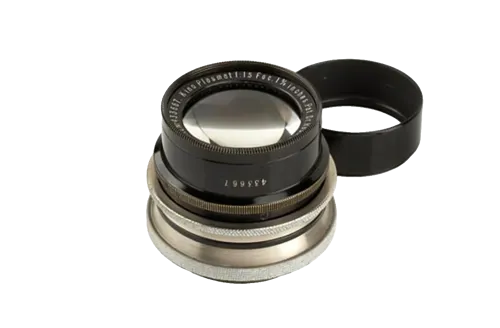
Kino-Plasmat 1 5/8-inch 41.3mm f/1.5
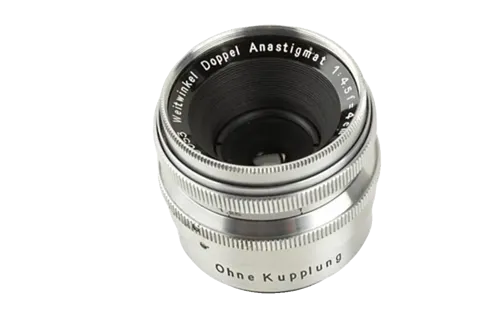
Weitwinkel Doppel Anastigmat 40mm f/4.5
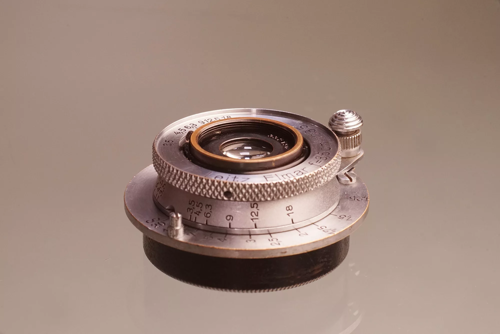
Elmar 35mm f/3.5 LTM Nickel (1930)
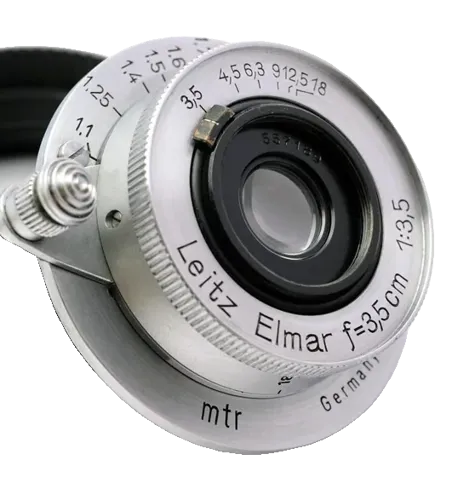
Elmar 35mm f/3.5 LTM Chrome (1933)
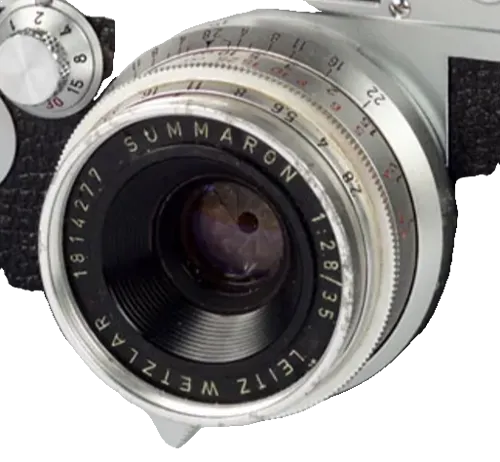
Summaron 35mm f/2.8 SIMOO
Comments