Best price Fair
Leica LTM SM 50mm 5cm f3.5 Elmar lens
Sold by Cardinal Camera Used
€231 ≈ $249
The Leica Elmar 35mm f/3.5 Chrome is a compact, rangefinder-coupled LTM wide-angle lens with four-element optics and an A36 accessory fitting.
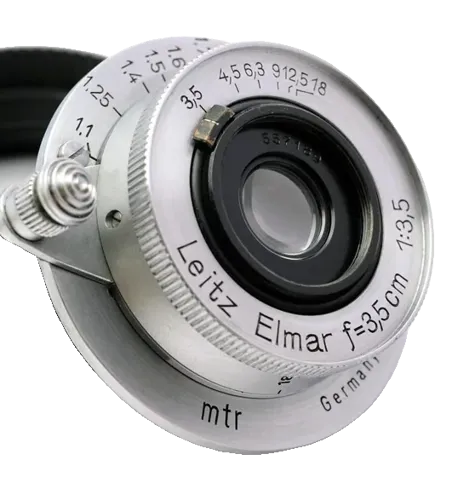
LTM / M39 mount
The Leica Elmar 35mm f/3.5 LTM Chrome (1933) is a LTM / M39-mount lens for Leica rangefinder cameras. As of October 2026, it sells from €231 used across 5 listings, with a 30-day median of €415. Leica price index →
Measured against the 46 other 35mm lenses in the catalogue.
The Leica Elmar 35mm f/3.5 Chrome is a compact wide-angle rangefinder lens manufactured by Ernst Leitz Wetzlar for Leica screw-mount cameras. Its native mount is the Leica L39, LTM or M39 screw mount, and the lens is mechanically coupled to the camera’s rangefinder. The chrome-plated brass construction distinguishes it from the earlier nickel-finished version .
The lens uses a four-element optical design arranged in three groups. It focuses to 1 metre and accepts Leica A36 clamp-on filters and compatible hoods. Period literature described the 35mm Elmar as covering approximately 65 degrees and emphasised its considerable depth of field, small physical size and suitability for rapid outdoor photography.
The chrome EKURZCHROM version appeared in 1933. Prewar examples are normally uncoated, while later production included coated optics after the Second World War. Kamerastore notes that late 1949 to 1950 examples may combine factory coating with the later continental aperture sequence.
The lens can be used on Leica M cameras with a suitable L39-to-M adapter, although the adapter does not change its native screw-mount identity. Correct adapter fit and rangefinder operation should be checked, particularly with unusual early focusing-cam variants.
For collectors, the finish, serial number, coating, aperture scale, distance scale and rangefinder-cam construction are all relevant. Rare early chrome examples with a snail-type rangefinder cam are documented, but these are mechanical production variants rather than commemorative special editions .
Rendering
Rendering varies significantly with optical condition and coating. A specialist dealer describes a prewar uncoated 1938 example as showing good central definition at full aperture with a more atmospheric transition towards the edges, but this should not be treated as a universal description of every surviving lens .
Sharpness
Contemporary Leica literature focused more on practical depth of field than on modern laboratory measurements. It recommended slightly stopping the lens down for broad zone focus and noted that its short focal length made quick, minimally focused photography practical.
Contrast and color
Prewar examples are generally uncoated, while later examples may have factory coating. Contrast and colour response therefore depend on production date, coating condition, internal haze and cleaning damage. Claims made for one example should not automatically be applied to the entire chrome production run.
Flare resistance
The chrome Elmar family includes both uncoated and coated examples. Flare resistance cannot therefore be represented by a single version-wide characteristic. An appropriate A36 hood is useful, particularly with uncoated lenses.
Handling
The lens is notably compact and projects only a short distance from the camera body. Its 1 metre minimum focusing distance, rangefinder coupling and small A36 front fitting are typical of Leica wide-angle lenses from the screw-mount period.
Digital use
The lens can be mounted on digital Leica M bodies with a suitable L39-to-M adapter. It remains a native screw-mount lens, and adapter quality, rangefinder-cam movement and infinity calibration should be checked before use.
Collector and user notes
Published specifications conflict on some mechanical details. The version-specific Kamerastore record lists ten aperture blades and a weight of 100g, while Leica Wiki lists six blades and 112g for the broader 35mm Elmar family. The database values above follow the version-specific EKURZCHROM record, but unusual or transitional examples should be checked individually.
Development and Launch
The 35mm f/3.5 Elmar was introduced around 1930 as one of the early interchangeable wide-angle lenses for the Leica system. Chrome serial-number batches are documented from 1933, following the earlier nickel-finished production.
Production Evolution
Production continued through the prewar and postwar periods. Changes included nickel and chrome finishes, different rangefinder cams, metre or feet distance scales, alternative aperture sequences and the introduction of coated optics after 1946. Late coated examples were made near the end of production around 1949 to 1950.
Special Editions/Variants
Documented variants include nickel and chrome finishes, early snail-type rangefinder cams, different infinity-lock arrangements, heavy-cam versions and later coated lenses. Leitz Photographica Auction has documented a very rare early chrome snail-cam example dating from approximately 1932, but this is an early mechanical variant rather than a commemorative special edition.
Collector Notes
Serial numbers are important for dating the lens and separating early nickel, standard chrome and postwar coated examples. Collectors should also inspect the engraving, distance unit, aperture scale, coating, focusing cam and infinity lock rather than relying only on the silver appearance.
Good time to buy. The lowest listing is 44% below the 30-day average.
Lowest price Click a mark to open that listing · arrow keys to step, Enter to open
Price against condition for 5 listings of Leica Elmar 35mm f/3.5 LTM Chrome (1933), €231 to €1,105, median €363. Good: 3 at €363, €363, €415. Fair: 1 at €231. Used: 1 at €1,105. The full table follows.
| Condition | Lowest | Median |
|---|---|---|
| Good | €363 | €363 |
| Fair | €231 | €231 |
| Other | €1,105 | €1,105 |
Over the last 21 weeks the median price for the Leica Elmar 35mm f/3.5 LTM Chrome (1933) has risen, ranging from €365 to €613 (now €415).
Weekly price (EUR). Median (Good or better) and lowest (Good or better) across 21 weeks. The full figures follow in the table below.
| Week | Median | Lowest |
|---|---|---|
| Jun 1, 2026 | €407 | €365 |
| Jun 8, 2026 | €407 | €365 |
| Jun 15, 2026 | €391 | €365 |
| Jun 22, 2026 | €417 | €365 |
| Jun 29, 2026 | €417 | €365 |
| Jul 6, 2026 | €417 | €365 |
| Jul 13, 2026 | €450 | €365 |
| Jul 20, 2026 | €367 | €260 |
| Jul 27, 2026 | €544 | €365 |
| Aug 3, 2026 | €521 | €365 |
| Aug 10, 2026 | €482 | €365 |
| Aug 17, 2026 | €489 | €365 |
| Aug 24, 2026 | €542 | €365 |
| Aug 31, 2026 | €625 | €365 |
| Sep 7, 2026 | €570 | €365 |
| Sep 14, 2026 | €417 | €365 |
| Sep 21, 2026 | €417 | €365 |
| Sep 28, 2026 | €391 | €365 |
| Oct 5, 2026 | €363 | €363 |
| Oct 12, 2026 | €365 | €365 |
| Oct 19, 2026 | €363 | €363 |
Every shop grades differently. Leica Classic uses letters, Ffordes uses E++ and E+, German dealers write "Zustand B", Japanese dealers write A−. We map all of them onto the one ladder below. Where a shop states its own grade, we print it under ours.
As of October 2026, the Leica Elmar 35mm f/3.5 LTM Chrome (1933) sells from €231 used, with a 30-day median of €415, across 5 active listings.
As of October 2026, the Leica Elmar 35mm f/3.5 LTM Chrome (1933) is sold by 2 sources (5 listings), from €231 used: all compared cheapest-first on this page.
The Leica Elmar 35mm f/3.5 LTM Chrome (1933) takes 36 mm screw-in filters (E36).
The Leica Elmar 35mm f/3.5 LTM Chrome (1933) focuses down to 1 m, and the rangefinder stays coupled over the whole range.
The Leica Elmar 35mm f/3.5 LTM Chrome (1933) weighs 100 g, lighter than 81% of the 31 other 35mm lenses in the catalogue.
The Leica Elmar 35mm f/3.5 LTM Chrome (1933) is a Leica screw-mount (M39/LTM) lens. It fits Leica M bodies with a screw-to-M adapter, which keeps rangefinder coupling, and mirrorless cameras with an M39 adapter. It carries no 6-bit code, so select the lens profile by hand on a digital M.
The Leica Elmar 35mm f/3.5 LTM Chrome (1933) was produced from 1933 to 1950.
Similar lenses you might be interested in
Comments