A 1929 uncoupled Kino-Plasmat f/1.5 in original Leica M39 mount for Leica I cameras, identified by its 1 5/8-inch engraving, equal to about 41.3mm.
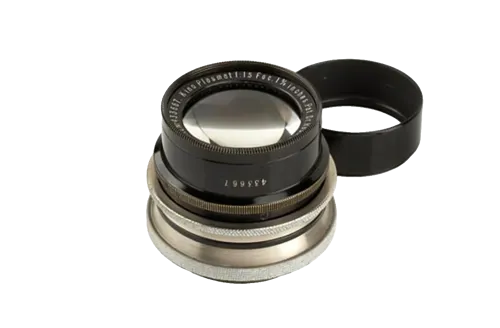
Meyer-Optik Gorlitz Kino-Plasmat 1 5/8-inch 41.3mm f/1.5
LTM mount
No listings tracked for this lens right now.
The Meyer-Optik Gorlitz Kino-Plasmat 1 5/8-inch 41.3mm f/1.5 is a LTM-mount lens for Leica rangefinder cameras. Leica price index →
Specification
About this lens
Meyer-Optik Gorlitz Kino-Plasmat 1 5/8-inch 41.3mm f/1.5
The Meyer-Optik Gorlitz Kino-Plasmat 1 5/8-inch 41.3mm f/1.5 is an early high-speed lens documented in an original Leica M39 mount from 1929. The surviving auction record describes a black-and-nickel, uncoupled lens intended for the Leica I Model C. Its engraved focal length of 1 5/8 inches converts to approximately 41.3mm. One source title also calls the lens 5cm, but that value conflicts with the inch engraving, so this profile retains the direct conversion rather than silently treating it as a 50mm lens.
Kino-Plasmat was developed within Meyer's collaboration with optical designer Paul Rudolph and originated as a fast cine-lens family. The broader f/1.5 family is associated with a sophisticated Plasmat-derived construction, but the sources reviewed here do not independently publish a section drawing or element count for this exact 1 5/8-inch M39 version. Its formula, diaphragm-blade count, minimum focusing distance, filter fitting and weight therefore remain unspecified in this profile.
The documented Leica lens has no rangefinder coupling. Focusing is by scale, with distance estimated or measured externally, and aperture control is fully manual. Its approximately 41.3mm field lies between conventional 35mm and 50mm Leica finder views, so a 40mm or adjustable accessory finder is appropriate. On a digital camera, live view provides a more dependable method for both framing and focus. An M39-to-M adapter can provide physical mounting on compatible Leica M bodies, but it cannot create coupling that the original barrel lacks.
Optical qualities
Rendering
No controlled, version-specific test of the 1 5/8-inch uncoupled Leica lens was found. The wider Kino-Plasmat family is often discussed for strong rendering effects at full aperture, but those accounts cover different focal lengths, cine formats and later adaptations. They should not be treated as proof of a particular look across the full 35mm frame. For this exact lens, the defensible statement is that f/1.5 offered unusually high speed for 1929 and gives very shallow focusing tolerance at close and medium distances.
Sharpness and field coverage
The original M39 mounting supports the lens's identity as a Leica accessory, but the available records do not provide a measured image circle, field curve or resolution chart. The inconsistency between “5cm” in an auction title and the physical 1 5/8-inch designation also makes it important not to substitute test data from a 2-inch or 50mm Kino-Plasmat. Full-aperture sharpness, corner coverage and the effect of stopping down should be evaluated on the actual lens. Center focus can be critically narrow at f/1.5, especially without a coupled rangefinder.
Bokeh and aberrations
Fast lenses from this period can show visible spherical aberration, coma and field-dependent blur at wide apertures, but the degree depends on the exact computation, focus distance and condition. Claims of swirl or a specific highlight shape drawn from 25mm, 50mm, 75mm or 90mm Kino-Plasmats are not reliable evidence for the 41.3mm Leica version. Diaphragm shape can also change as the lens is stopped down, and the blade count of this barrel has not been established.
Contrast, color and flare
The documented lens dates from the prewar era and should be approached as an early high-speed optic with many potential sources of veiling light. A hood is particularly helpful, and the auctioned example was documented with one. Coating status should be inspected rather than assumed from reflected color alone. Haze, separation and old internal blackening can reduce contrast substantially, while careful shielding from direct light may make a healthy example more usable.
History
Development and Launch
Paul Rudolph worked with Hugo Meyer from 1920 to 1942 after an earlier career at Carl Zeiss. Meyer's historical account credits that collaboration with the Plasmat lenses and describes the Kino-Plasmat as exceptionally fast for its time. Historical summaries place the first Kino-Plasmat developments in the 1920s, with f/1.5 versions following the earlier f/2 design. The exact 1 5/8-inch Leica lens documented here is dated 1929, placing it near the beginning of interchangeable-lens 35mm rangefinder photography.
Production Evolution
Kino-Plasmat lenses were produced in many focal lengths for cine, scientific and still-photographic uses. Some were supplied in original Leica screw mounts, while many lenses seen today began in cine or specialist mounts and were later converted. The existence of a factory M39 lens in one focal length does not establish that a visually similar lens in another focal length was built for the same format.
Special Editions/Variants
Variants are best separated by focal-length engraving, mount origin and coupling rather than by the shared Kino-Plasmat name. This 1 5/8-inch uncoupled M39 lens is distinct from 2-inch and 5cm versions, from longer Leica lenses, and from cine lenses later adapted to M39 or Leica M. Black-and-nickel construction and an original hood are documented for the 1929 example, but they should not be declared universal without a broader factory catalogue.
Collector Notes
Collectors should first verify the focal-length engraving. One and five eighths inches equals 41.275mm, which rounds to 41.3mm, and it should not be catalogued as 50mm merely because a secondary title says 5cm. They should then distinguish a factory Leica focusing mount from a later conversion and confirm the absence or presence of a rangefinder cam directly. A cleanly cut M39 thread by itself is not proof of original Leica manufacture.
Sources
- Leitz Auction: Hugo Meyer Kino-Plasmat 1.5, 1 5/8 inchleitz-auction.com →
- Leitz Auction: Hugo Meyer Kino-Plasmat 1.5 in original M39 mountleitz-auction.com →
- Meyer Optik Gorlitz: Company history and Paul Rudolph collaborationmeyer-optik-goerlitz.com →
- Espen Susort: History of the Kino-Plasmat familyespensusort.no →
Where to buy
Related lenses
Similar lenses you might be interested in
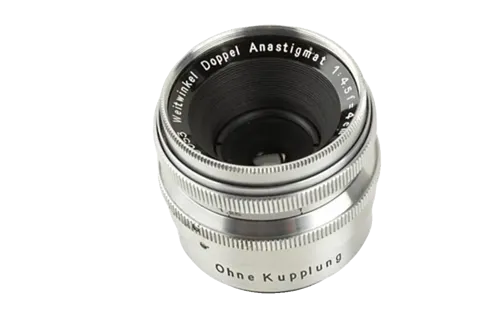
Weitwinkel Doppel Anastigmat 40mm f/4.5
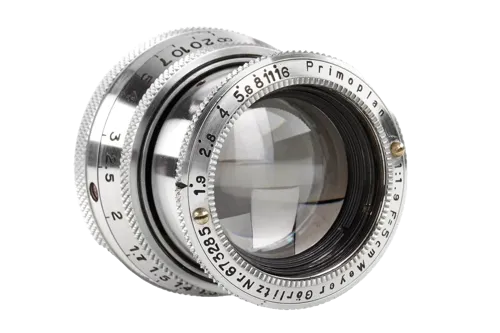
Primoplan 50mm f/1.9 (Collapsible)
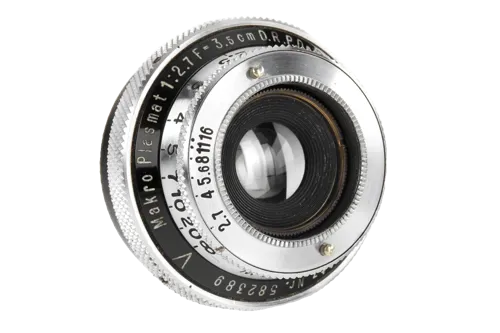
Makro-Plasmat 35mm f/2.7
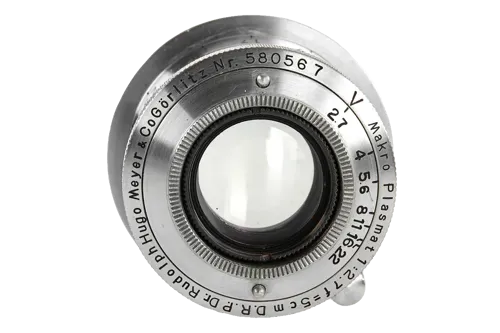
Makro-Plasmat 50mm f/2.7 (Collapsible)
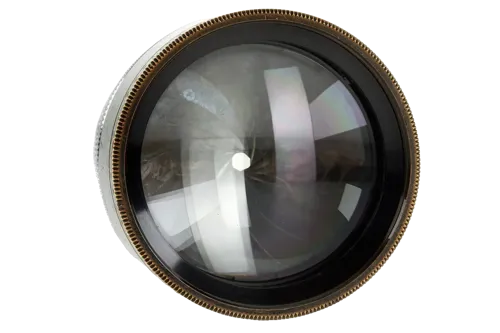
Kino-Plasmat 75mm f/1.5
Comments