A 1933 German collapsible 50mm f/2.7 lens with six elements in five groups, original rangefinder-coupled Leica M39 focusing and 1m close focus.
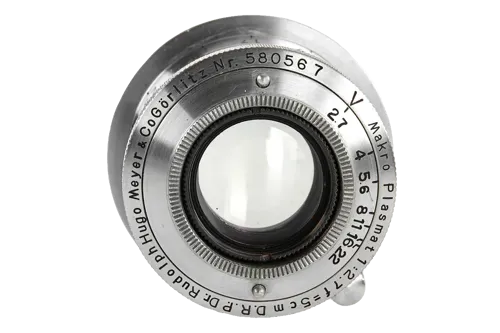
Meyer-Optik Gorlitz Makro-Plasmat 50mm f/2.7 (Collapsible)
LTM mount
No listings tracked for this lens right now.
The Meyer-Optik Gorlitz Makro-Plasmat 50mm f/2.7 (Collapsible) is a LTM-mount lens for Leica rangefinder cameras. Leica price index →
How it compares
Measured against the 108 other 50mm LTM-mount lenses in the catalogue.
Specification
About this lens
Meyer-Optik Gorlitz Makro-Plasmat 50mm f/2.7 (Collapsible)
The Meyer-Optik Gorlitz Makro-Plasmat 50mm f/2.7 is a German standard lens in an original collapsible, rangefinder-coupled Leica 39mm screw mount. Lens DB records six elements in five groups and a 1-metre minimum focusing distance. Leitz Auction documents factory M39 examples made in 1933 with both nickel and chrome exterior finishes.
The retractable barrel reduces the lens's stored length, while a dedicated focusing helicoid and cam provide coupled use on compatible Leica-thread cameras. Its f/2.7 maximum aperture offered useful speed in a compact prewar standard lens. The name Makro-Plasmat identifies the optical family, but the 1-metre minimum is not macro reproduction by modern 1:1 standards.
This profile covers the original collapsible 5cm Leica-mount product. Longer Makro-Plasmat lenses, shutter-mounted versions, later cinema adaptations, and modern APO-Makro-Plasmat revivals are separate products. Reliable sources used here do not establish a diaphragm-blade count, filter size, weight, dimensions, or a complete production total.
Optical qualities
Rendering
The six-element, five-group layout belongs to Paul Rudolph's wider Plasmat design lineage. The available model sources provide the construction count but no factory MTF chart, glass catalogue, or controlled comparison of multiple 50mm LTM examples. Claims about apochromatic correction or modern macro performance should not be transferred from later APO-Makro-Plasmat products.
At f/2.7, focus placement and optical alignment remain important, particularly in a collapsible assembly. Stopping down generally improves field evenness and contrast, but play in the tube, altered element spacing, or decentring can limit performance independently of the formula. A known example should be tested before using absolute sharpness descriptions.
Contrast and flare
The documented 1933 production date predates the postwar coating programme described in Meyer's company history. The cited auction pages do not establish an original coating specification for every example. Haze, separation, cleaning wear, reflective barrel surfaces, and weakened blackening can lower contrast. A suitable hood may reduce oblique light without changing the lens's intrinsic correction.
Out-of-focus rendering
At 50mm and f/2.7, the lens can separate a subject at its 1-metre minimum, though less strongly than a 50mm f/1.5. Diaphragm-blade count and highlight geometry are not securely documented in the sources used here. Defocus smoothness or outlining should therefore be based on photographs from a verified lens and known aperture.
Collapsible handling and digital use
The tube must be fully extended and locked before making an exposure. Check internal clearance before retracting it on any digital body or adapter, because the rear assembly can approach components not present in a period film Leica. Rangefinder use depends on correct cam registration; mirrorless live view removes the coupling requirement but still needs an accurate adapter.
History
Development and Launch
Meyer began working with former Zeiss designer Paul Rudolph during the 1920s. The firm's historical account associates that collaboration with the Plasmat lenses and the expansion of Meyer's interchangeable-lens range between 1920 and 1942. The compact 5cm Makro-Plasmat brought this design lineage to a 35mm rangefinder format.
Leitz Auction documents original coupled nickel and chrome examples from 1933. These records demonstrate that both finish presentations were factory Leica-thread products rather than recent conversions. The dedicated collapsible mount allowed Meyer to offer a compact alternative within the established M39 system.
Production Evolution
The two documented finishes show that exterior presentation varied within the 1933 model. Available sources do not establish whether nickel preceded chrome, whether both were concurrent, or whether any optical change accompanied the finish. A single serial number or auction estimate cannot establish a production sequence.
A separate auction record describes a factory sample engraved as not for sale. That object is evidence of factory evaluation or presentation activity, not a standard retail edition or a basis for a production count. Postwar Meyer coating practices and modern reproductions belong to later historical periods.
Special Editions/Variants
Nickel and chrome collapsible M39 versions are both documented and may be recorded as finish variants within this profile. A factory-sample engraving is exceptional provenance attached to one object. Other Makro-Plasmat focal lengths and modern APO versions differ in format, mount, optical execution, or production era and should remain separate.
Collector Notes
Identification should combine the Makro-Plasmat 2.7/5cm engraving, Meyer Görlitz attribution, collapsible tube, original Leica screw thread, and coupled rangefinder cam. Check that the tube locks without tilt, infinity is registered correctly, and the cam follows focus smoothly to approximately one metre.
Inspect the five-group optical assembly for haze, separation, element reversal, and cleaning damage. Finish alone cannot prove date or originality because parts may have been exchanged or refinished. Auction condition, accessories, serials, and prices apply only to the individual lot and should not be copied into the generic model description.
Sources
Where to buy
Related lenses
Similar lenses you might be interested in
Comments