A 1930s German collapsible 50mm f/1.9 standard lens with five elements in four groups, original coupled LTM focusing and a ten-blade iris.
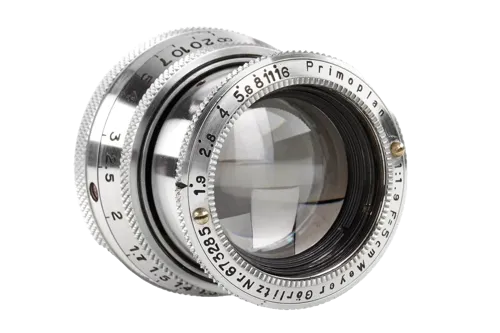
Meyer-Optik Gorlitz Primoplan 50mm f/1.9 (Collapsible)
LTM mount
No listings tracked for this lens right now.
The Meyer-Optik Gorlitz Primoplan 50mm f/1.9 (Collapsible) is a LTM-mount lens for Leica rangefinder cameras. Leica price index →
How it compares
Measured against the 108 other 50mm LTM-mount lenses in the catalogue.
Specification
About this lens
Meyer-Optik Görlitz Primoplan 50mm f/1.9 (Collapsible)
The Meyer-Optik Görlitz Primoplan 50mm f/1.9 (Collapsible) is a prewar German standard lens made in an original rangefinder-coupled Leica screw mount. The recorded optical construction uses five elements in four groups, and the diaphragm has ten blades. Its brass focusing assembly can be collapsed so that the lens projects only a short distance from a compatible camera body when stored.
This entry covers the historical 5cm collapsible LTM product documented around 1934 and 1935. It is not the better-known rigid 58mm Primoplan for single-lens reflex cameras, the 75mm portrait lens, or the modern Primoplan II. Focal length, optical specification, focusing construction and intended camera system all make those separate products.
Optical qualities
Rendering
The exact lens is recorded as a five-element, four-group design, but no verified factory optical section or period laboratory report for the collapsible Leica-thread execution has been found. Descriptions of later 58mm lenses should not be copied to this 50mm version.
At 50mm, the lens provides a conventional field of view on 35mm film. Its f/1.9 maximum aperture permits selective focus and lower-light work while remaining more compact than many later fast standard lenses. Claims about a fixed swirl, glow or painterly background are avoided because background structure, focus distance, aperture, optical condition and sensor or film all affect the result.
At f/1.9
Full aperture gives the least depth of field and makes focus accuracy particularly important. The camera's rangefinder and the lens cam should agree at several distances. A nearly ninety-year-old example with haze, scratched glass, separation or disturbed element spacing can show lower contrast and definition that should not be mistaken for the intended performance of the design.
The ten-blade diaphragm can retain a relatively rounded opening, but blade count alone does not determine bokeh. No controlled test has been located for the exact LTM version, so numerical resolution, distortion and vignetting claims are omitted. Early examples are documented with uncoated optics; coating should be checked on each lens.
Stopped down
Closing the aperture increases depth of field and usually improves contrast and consistency away from the centre. Middle settings are appropriate when more even definition is required. Aperture control details vary between the documented pre-series and regular versions, so the presence, absence and operation of adjustment pins should be checked directly.
Handling and compatibility
The native M39 thread and coupling cam identify the lens as Leica-standard LTM rather than an unrelated 39mm product. The collapsible tube must be extended and locked for photography. It should be collapsed only after confirming clearance inside the exact camera or adapter, especially on digital bodies with internal baffles or sensor assemblies.
An LTM-to-M adapter permits use on Leica M bodies, while a mirrorless adapter provides direct sensor focus. Neither validates the original cam. The filter fitting and minimum focusing distance remain unconfirmed and should not be borrowed from another Primoplan.
History
Development and Launch
The Primoplan name was used by Hugo Meyer in Görlitz for a family of fast photographic lenses. Leitz Auction dates both a regular collapsible 5cm example and an early pre-series example to about 1934. The database uses 1935 as the start of regular production, reflecting the transition from the documented experimental or pre-series form to the established product.
The Leica-thread version addressed users who wanted a fast standard lens in a compact, coupled mount. Its ability to retract reduced the space required for storage, while the integrated focusing mechanism drove the camera's rangefinder over its coupled travel.
Production Evolution
Leitz Auction records a pre-series lens marked “V1” on the underside of the mount ring. That early configuration lacks the two aperture-adjustment pins visible on the documented standard production barrel. These features identify a developmental stage, but they do not justify treating every small engraving or finish difference as a separate optical generation.
Regular collapsible examples are documented in chrome and with a metre scale. Flints Auctions independently confirms a coupled M39 version. No complete factory ledger has been located for production duration, optical revisions or quantity.
Special Editions/Variants
The documented V1 pre-series configuration is a genuine early variant within the collapsible 50mm identity. Standard production has the aperture-control pins described by Leitz Auction. Rigid 58mm and 75mm Primoplans, lenses in SLR mounts and modern revivals are related by name but are not special editions of this profile.
Collector Notes
Confirm the Primoplan 1:1.9 f=5cm engraving, original collapsible brass construction, Leica-standard M39 thread and a functional rangefinder cam. Examine the aperture ring for the production pins or documented pre-series arrangement. Foreign-market engravings can be useful context but do not create a separate model.
Check that the tube extends and locks securely, that infinity is correctly set and that the rangefinder agrees at several distances. Inspect the ten-blade iris for oil and deformation, and the optics for haze, fungus, separation and cleaning damage. Auction prices, individual serial numbers and condition reports describe single examples and are not generic specifications.
Sources
- Leitz Auction, Meyer Primoplan 1.9/5cm pre-series in Leica M39leitz-auction.com →
- Leitz Auction, Hugo Meyer Primoplan 1.9/5cm collapsible LTMleitz-auction.com →
- Flints Auctions, Meyer Görlitz Primoplan f/1.9 50mmflintsauctions.com →
- Jo Geier, Hugo Meyer Primoplan 1.9/5cm in coupled Leica M39jogeier.com →
Where to buy
Related lenses
Similar lenses you might be interested in
Comments